Bo Jackson Battle Arena: How the Game Works and Why Weapon Type Is the Whole Rarity Ladder
Seven face-down cards, one per Battle Zone. The reveal mechanic is simple. The weapon-type system underneath it is doing two jobs at once, and understanding that changes how you shop for the Mahomes Set.
Seven cards, face-down, one per Battle Zone. Neither player knows what the other is holding. That is the entire engine of Bo Jackson Battle Arena: a reveal mechanic that forces every decision you made while building your deck to either pay off or collapse in seven flips. The higher Power wins the zone; win four zones and you win the game. It is genuinely simple to learn. What is not immediately obvious is that the weapon-type system sitting underneath those Power values is doing two jobs simultaneously, and the second job is the one that matters most to collectors arriving for the Mahomes Set.
The Three Card Types and How They Fit Together
Every deck runs three card types. Heroes are the core: each one has a Name, a Power value in the upper right, and a Weapon Type in the lower right. Hot Dogs are the resource currency; each player holds exactly ten, the count is always public, and they are spent to activate Plays. Plays live in a separate 30-card Playbook, each is unique, and each carries a Hot Dog cost.
The lore is that people who ate a hot dog on the wrong night gained powers and built personas around the athletes they admired. These are the Home Team Heroes. The pug mascot is Billy, listed in the checklist as Billy The Pug. The game is published by Imagination Mining Company out of Columbia, South Carolina, with Bo Jackson as co-founder.
The Three Modes, Learned in Order
Rookie Mode is Heroes only. Shuffle, draw seven, place them face-down one per Battle Zone in any order. A randomly chosen player sets the direction battles resolve, left-to-right or right-to-left. Both players flip simultaneously in each zone; higher Power takes a Trophy. Win four Trophies, win the game. Tied Power means no Trophy awarded.
Substitution Mode adds Hot Dogs and a Bench. Draw four extra Heroes into your hidden hand. Before each reveal, starting with the player who has honors, either player may pay two Hot Dogs to swap a Bench Hero face-down into the current zone. The replaced Hero is discarded and you draw a replacement. This happens once per battle, and whoever won the last battle has honors in the next one.
Playmaker Mode is the full game. Add the Playbook: draw four Plays at the start and one more after every battle. The sequence for each zone is Substitution Phase, then Reveal, then Play Phase, then Determine Winner, then Trophy, then draw one Play. In the Play Phase the player with honors may run one or more Plays by paying Hot Dogs, or pass; then the other player gets the same opportunity. Plays resolve in the order played. If Powers are still tied after all Plays resolve, a Super Tie-Breaker kicks in.
Deck Construction: Where the Rules Get Specific
Standard format runs a 60-Hero Deck, exactly 10 Hot Dogs, and a 30-Play Playbook. Two constraints shape the Hero Deck: no more than six Heroes may share the same Power value, and you may run only one copy of each Hero variation. That second rule is the one collectors need to internalize. A Trainer format also exists at 30 Heroes, 10 Plays, and 10 Hot Dogs for quicker games.
For sanctioned Playmaker events, the Deck Balancing Score system applies. Every Play and Bonus Play carries a DBS point value, and the Playbook total must not exceed 1,000 points. Heroes and Hot Dogs carry no DBS cost. Bonus Plays sit on top of the Playbook and do not count toward the 30-card limit.
Why Weapon Type Is the Rarity Ladder
There are ten weapon types: Alt, Brawl, Cyber, Fire, Glow, Gum, Hex, Ice, Steel, and Super. Every Hero carries one, and the weapon does two jobs at once. In the game it decides which Plays can touch that Hero, and Super breaks ties. On the collecting side, the weapon IS the rarity ladder.
Brawl and Steel are the commons that build every deck. Fire and Ice are the rares, and their Inspired Ink on-card autographs are numbered to 50. Glow is ultra rare, with autos numbered to 25. Hex is the elite rung, with autos numbered to 10. Gum is the secret rare, and Super is the Superfoil one-of-one at the very top.
Battlefoils sit on top of that ladder and are colour-matched to the weapon: Red on Brawl, Silver on Steel, Blue on Ice, Orange on Fire, Green on Glow as an SSP case hit, and Pink on Hex, which is now the game's only Secret one-of-one.
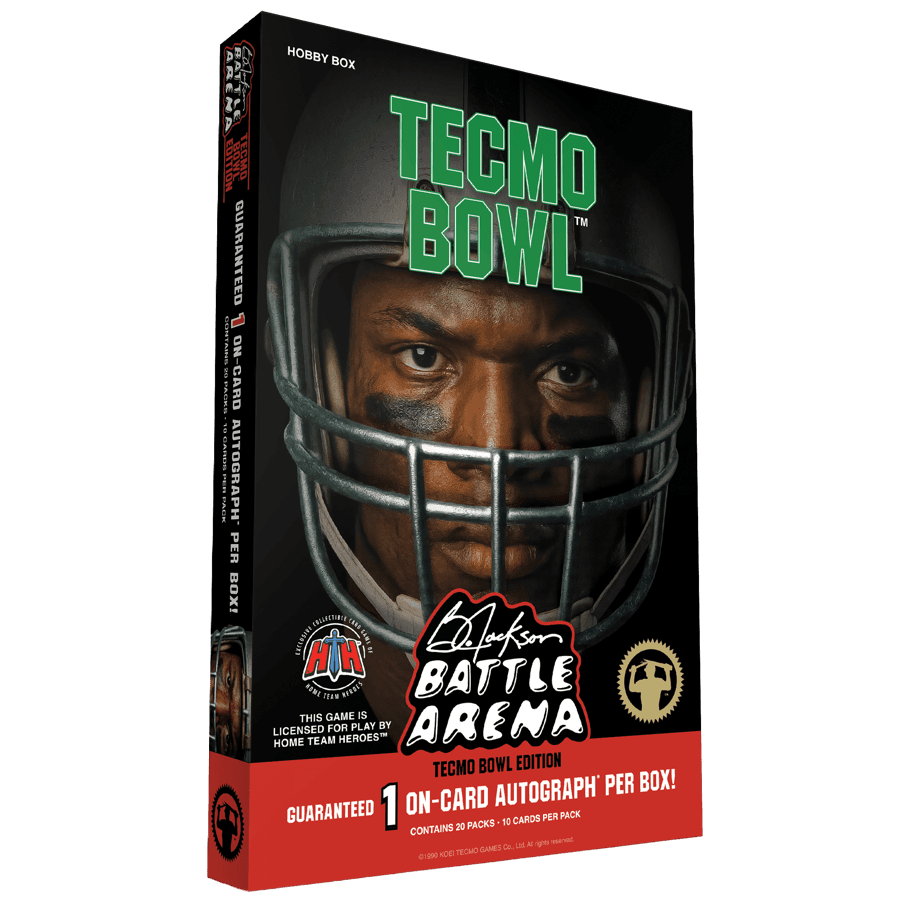
In the rules, a Hero variation is its own card when the pose name, weapon type or Power changes, so a Hero printed across several weapons gives a deckbuilder several distinct cards. The Tecmo Bowl Edition makes this concrete: the four Merlomes base cards are Fire at 135 Power, Ice at 135, Steel at 130 and Brawl at 120. Four legal cards, four different rungs of the collecting ladder.
The weapon does two jobs at once: it shapes how a Hero plays, and it is the rarity ladder collectors chase, from Brawl and Steel commons up to the Superfoil one-of-one.
The Tecmo Bowl Edition Checklist: 35 Treatments, 596 Auto Slots
The Tecmo Bowl Edition has a 240-card base set built on 178 distinct Heroes, 225 Plays, and 596 Inspired Ink autograph cards spread across 35 treatments. The treatment list covers Alpha Battlefoil, 80's 8-Bit Rad, Sore Thumb, Gold Coin Flip, Silver Coin Flip, Blow On It, Tecmo News, Scoreboard, Helmets, Helmet Icon, Big Pixel, Skyline, Endzone, Logofoil, Tecmo Bowl Logofoil, Rage Quit (45 cards), 8-Bit Alt Art (45 cards), Pixel Helmet Alt, Halftime Alts, Billy and CJ Cameo Alts, Superfoil, and Battlefoils in Pink, Green, Orange, Blue, Silver, and Red.
The Inspired Ink autograph cards sit at the top of that treatment ladder. With 596 slots across the set, the question for a collector targeting Merlomes specifically is which of those slots represent which weapon-type variant, because each auto slot is tied to a distinct Hero card. The full Tecmo Bowl Edition checklist, including every treatment and every Merlomes position, is at the Collector Nation Bo Jackson Battle Arena section.
What to Do Before the October Presale
The Mahomes Set, officially the 2026 Update Edition, carries a four-hobby-box ceiling per buyer across all presale channels. IMC has made presale codes non-transferable after codes for earlier sets were resold on the secondary market. That means access is the first constraint, not budget.
Before the presale window opens, pull up the full checklist and identify which Merlomes weapon-type variants you are actually targeting. If you are building a competitive Hero Deck, the Power values matter as much as the treatment: Fire and Ice both sit at 135, Steel at 130, Brawl at 120. If you are chasing the Inspired Ink autos, know which treatment tier you are after and how it maps to the weapon-type variant on the card. The 596 autograph cards in the Tecmo Bowl Edition give you a sense of the scale, and the Mahomes Set carries 82 signers, up from 67.
The CN Bo Jackson Battle Arena section has the complete Tecmo Bowl Edition checklist and the how-to-play breakdown. Use it before you spend.
Follow the hobby in the app
Track the products and players you collect and get told the moment anything moves.
Get the Collector Nation App