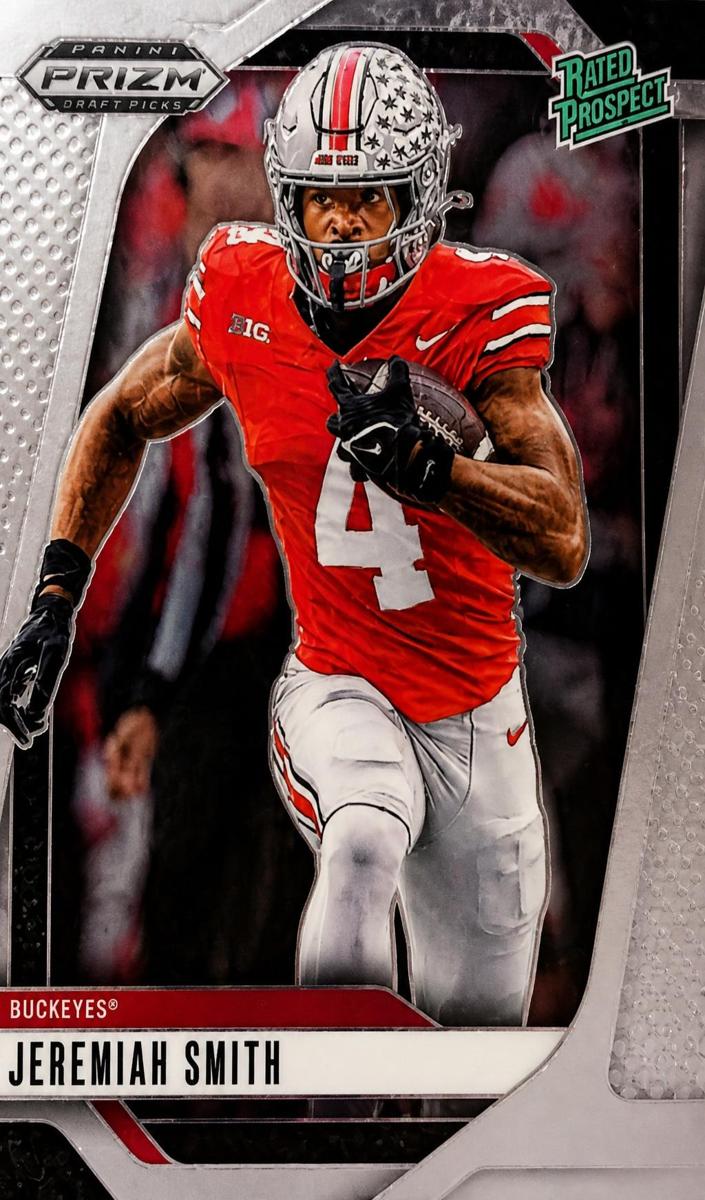
Jeremiah Smith Broke an Ohio State Record Saturday. Here Is What His Cards Did.
Smith is the only player from this slate with a liquid card market and a measurable move. Everyone else had a monster game and no card to buy. That gap is the whole position.
Kevin Jennings throws five touchdowns for 330 yards in a single half. Colton Joseph scores four times for Wisconsin. Jack Gebhardt sets a Drake school record with eight touchdowns. None of them have a card you can buy today. Jeremiah Smith breaks an Ohio State receiving record in a 59-3 demolition of Western Michigan, and he does have cards, and those cards moved. That asymmetry is the whole story from September 19.
The One Name With a Market: Jeremiah Smith
Smith's performance against Western Michigan was the kind that reprices a market within hours. He broke Ohio State's receiving record, finished with a stat line that put him back in the Heisman conversation, and did it in a game that was never close. His existing cards saw a measurable uptick in sales velocity following the game.
The window to act is the next 48 to 72 hours. Post-game spikes on college players with existing card markets tend to compress fast once casual buyers finish chasing highlights. If you are already holding Smith cards, check your current sales velocity against your cost basis and decide whether you are adding into strength or trimming into the demand. Both are valid reads; sitting without a thesis is the one that costs you.
The Cardless Slate: Jennings, Joseph, Gebhardt
Jennings, Joseph, and Gebhardt each put up numbers that would move a card market if one existed. Jennings is already drawing Heisman candidate framing after his first-half performance. Joseph's four-touchdown game for Wisconsin is the kind of breakout that gets a player onto checklist conversations. Gebhardt's eight-touchdown record at Drake is a footnote in FCS terms but a real data point for any manufacturer building a college football product.
The actionable question for all three is the same: does any of them appear in 2026 Bowman Football, which releases September 30. That product is the first realistic opportunity for any of these names to get a card into collector hands, and the checklist reveal is the trigger. A big Saturday is context. A checklist inclusion is a position.
Do not buy a player into a gap. Wait for the product that actually carries them.
Why the Cardless Names Matter More Than They Look
A slate this loaded with breakout performances, almost all of them without a card to buy, is a preview of how crowded the 2026 Bowman Football checklist conversation is about to get. Every one of these names is a potential inclusion argument, and the product drops September 30. Collectors who identify which of these players makes that checklist before the broader market does are the ones buying at pre-hype prices rather than chasing the post-reveal spike.
The discipline here is patience with a deadline. The deadline is the checklist reveal. Before that, a box score is just a box score. After it, a confirmed inclusion is a card with a known market and a known entry point. The worst version of this trade is buying a player's cards on a rumor that he made the checklist, then finding out he did not.
The One Name You Can Ignore
Hobart's Dixon had three interceptions against Brockport in Division III play. There is no card market here and no realistic path to one in the near term. File it and move on.
Follow the hobby in the app
Track the products and players you collect and get told the moment anything moves.
Get the Collector Nation App