Dick's Sporting Goods Is in the Card Business. Here Is Who Actually Pays for That.
An 850-store chain with tens of millions of loyalty members just arrived with a product strategy already built. The hobby's existing power structure does not absorb that evenly.
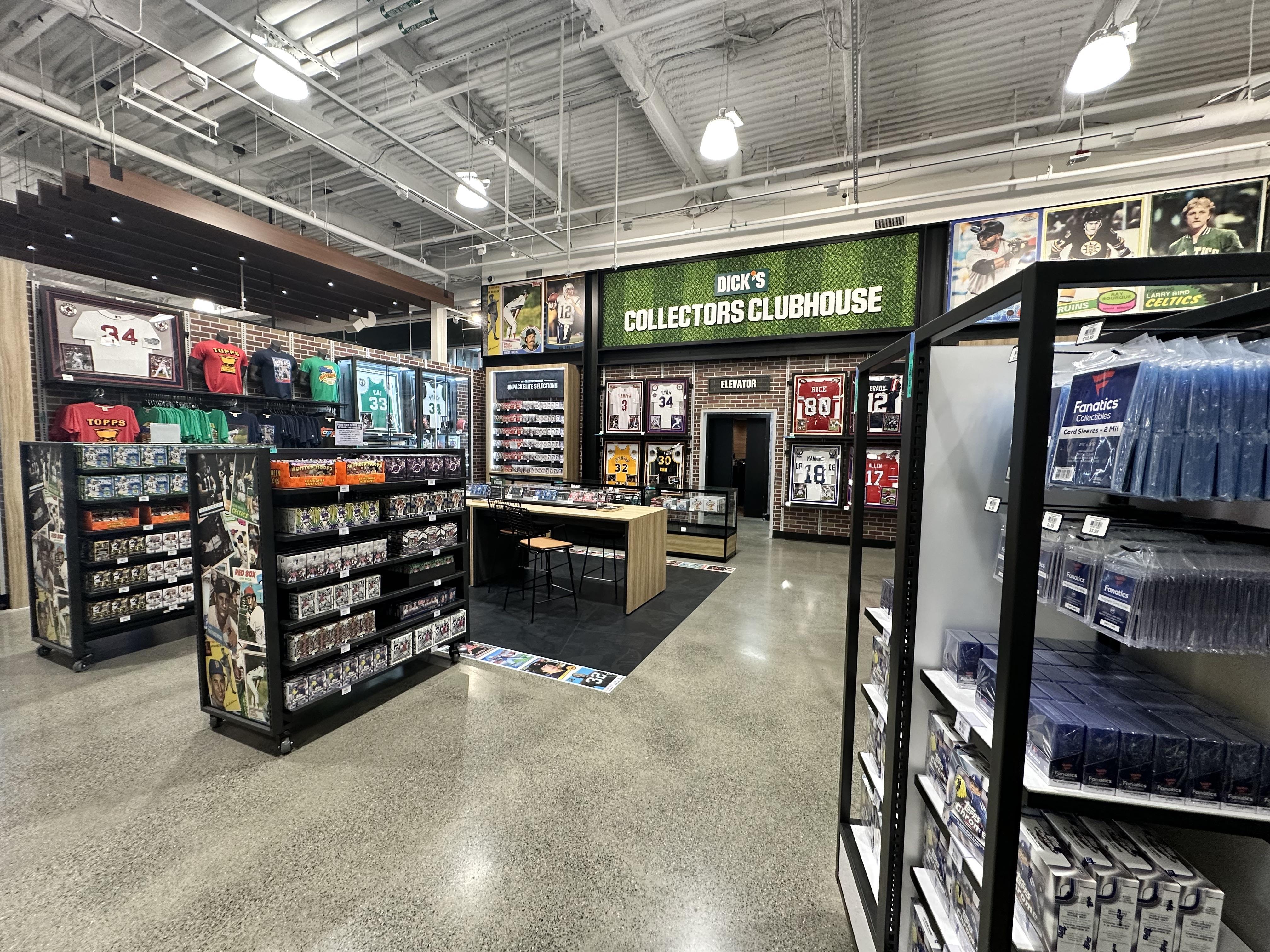
Dick's Sporting Goods bought a Paul Skenes Topps MLB Debut Patch Card and put its name on a $250 PSA mystery repack box. That is not a retailer dipping a toe in. That is an 850-store chain arriving with a product strategy already assembled, a loyalty program with tens of millions of members, and enough category credibility to negotiate manufacturer placement directly. The hobby has been through mass-retail entries before. This one is structurally different, and not everyone comes out the same side.
What Dick's Actually Built Before It Opened the Door
The PSA repack box is the tell. At $250 with PSA branding on the front, it is designed for the customer who recognizes PSA as a quality signal but does not know what a hobby box costs or why the difference matters. That customer exists in enormous numbers inside Dick's existing foot traffic — people who already buy cleats, training gear, and licensed apparel there, and for whom a graded card repack at the register or endcap is a natural adjacent purchase. Dick's did not have to build that customer. It already had them.
The Skenes Topps Debut Patch Card is a different kind of signal. It tells manufacturers that Dick's understands which names move product right now. Paul Skenes is the most talked-about young arm in baseball, and a Topps MLB Debut Patch Card is a specific, recognizable product tier: not a generic blaster. Dick's arriving with that card in its launch narrative is a deliberate message to Topps and Fanatics: we know the product, we know the player, and we are a serious channel partner.
The LCS Tension Was Already There
Four days before Dick's announced a single SKU, Ball Card Show was already running an episode titled 'Do LCS's Need TCG?': asking whether local card shops need Pokémon and other trading card games to survive as sports card foot traffic fragments. That conversation was not hypothetical. It reflected something shop owners were already feeling: the casual buyer, the one who comes in for a blaster or a hanger pack, is increasingly findable at Target, Walmart, or online. Every new mass-retail entry compresses the margin on that customer a little further.
Dick's does something Target and Walmart never quite managed, though. It adds a sporting goods context that makes cards feel like a logical purchase rather than an impulse grab near the checkout. A collector walking in for batting gloves passes a card display that is thematically coherent with why they came. That adjacency is genuinely powerful for driving trial among buyers who have not yet self-identified as collectors. The LCS cannot replicate that foot traffic or that context. It also cannot replicate ScoreCard, Dick's loyalty program, which turns every card purchase into points toward future purchases across the entire store. That is a retention mechanic no independent shop can match.
The structural risk is not that Dick's sells cards. It is that Topps and Fanatics now have a preferred mass-market partner with real buyer data: and that gives them leverage to tier their releases even more aggressively.
How Manufacturers Use This, and Who Gets the Shelf
Topps and Fanatics are the most likely beneficiaries of Dick's entry, for reasons that go beyond brand recognition. Fanatics has spent years building a vertically integrated operation, licensing, manufacturing, and distribution under one roof, and a preferred mass-retail partner with tens of millions of loyalty members is exactly the kind of channel that rewards that structure. Dick's gets a reliable supply pipeline; Fanatics gets purchase-behavior data on a buyer demographic it has never had clean visibility into. That data loop is worth more than the shelf space itself.
Panini, which still holds NFL and NBA licenses through the current cycle, is a plausible secondary beneficiary, though its channel relationships have historically been more complicated. What is almost certainly not happening: boutique manufacturers, independent set producers, or any brand without the production volume to stock 850-plus locations consistently. Dick's will want SKUs it can replenish predictably. That requirement alone filters the product universe down to the major licensees.
The deeper consequence is channel tiering. If Dick's becomes a preferred mass-retail partner for Topps and Fanatics, those manufacturers have a stronger incentive to draw sharper lines between what goes to mass retail and what stays hobby-channel protected. Flagship configurations, blasters, and retail-exclusive parallels flow to Dick's. Hobby boxes, high-end releases, and anything with a meaningful secondary market premium stays behind the hobby-channel wall. That bifurcation was already happening. Dick's accelerates it, and gives the manufacturers a business reason to defend it.
The Configuration Question Is the One to Watch
Here is the specific thing worth tracking at launch: which configurations Dick's actually carries. If the answer is blasters, hangers, retail mega boxes, and the PSA repack product, the story is LCS margin compression on the entry-level end. Painful for shop owners who depend on that traffic, but largely irrelevant to the collector buying hobby boxes or high-end releases through dedicated hobby channels. That collector's world does not change much.
If hobby boxes appear on Dick's shelves, the calculus shifts. Hobby-box placement at mass retail has historically pressured secondary market prices on those products by expanding supply access and reducing the perceived scarcity that supports premium pricing. It would also be a meaningful signal that Topps or Fanatics had decided Dick's was a full channel partner rather than a retail-tier partner. That has not happened at Walmart or Target at any meaningful scale, and there is no confirmed indication it is happening at Dick's. But it is the variable that matters most for collectors above the entry level, and it is worth watching the first few weeks of shelf sets carefully.
The PSA x Dick's repack box at $250 is its own category. Whether that becomes a recurring SKU or a one-time launch product shapes how much it matters to the secondary market. A recurring product with consistent PSA branding trains a new buyer segment to associate graded cards with Dick's specifically, which is a longer-term loyalty play. A one-time launch item is a press moment. Those are very different things, and that question is currently open.
Who Is Actually Insulated, and Who Is Not
Collectors who buy primarily at the hobby-box level and above, through dedicated hobby shops or directly from manufacturers, are largely protected from the near-term disruption. Their product channel is not what Dick's is entering, and the hobby-exclusive releases that drive that market are not going to Dick's shelves. The short-term impact on a Topps Chrome Hobby box or a high-end Panini release is minimal.
The collector with real exposure is the LCS owner whose shop runs on casual traffic: the person who comes in twice a month for a blaster, maybe a hanger, occasionally a retail mega box. That buyer now has an 850-store alternative that rewards them with loyalty points, sits inside a store they already visit for other reasons, and carries the same product at the same price. The LCS cannot win that competition on convenience or rewards. It can win on knowledge, community, and access to product the mass-retail channel will never carry. Shops that have already built that identity are in a different position than shops that have been competing on product availability alone.
The hobby's content ecosystem will process this for weeks. With over 18,000 sports card creator items tracked in the past week alone, the volume of takes, break reactions, and unboxing content that Dick's will generate is substantial. That attention is not inherently bad for the hobby. But the takes that treat Dick's as a uniform good for the entire ecosystem are missing the part where the boats do not all rise together. Some of them were already sitting lower in the water.
Follow the hobby in the app
Track the products and players you collect and get told the moment anything moves.
Open Collector Nation