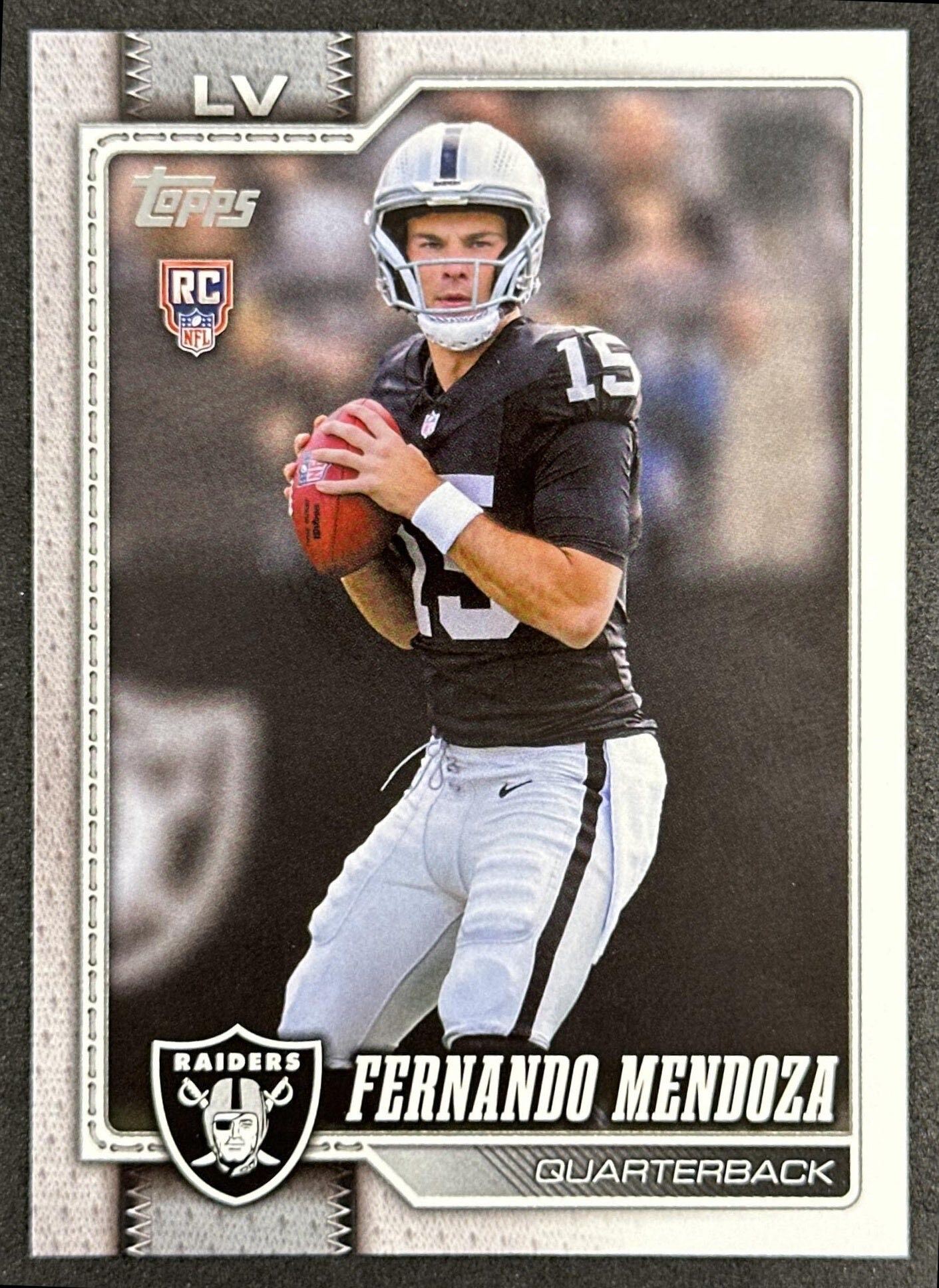
Fernando Mendoza's 2026 Topps Flagship Base Card Is Down 56%: What to Hold Instead
The velocity spike on Mendoza's base card is a product launch event, not a player signal. The price math points one direction, and it is not up.
Seven days ago, the 2026 Topps Flagship Football base card for Fernando Mendoza had zero recorded sales. Not slow. Not soft. Zero — for 23 straight days. Then Flagship launched on August 21, and 182 copies moved in a week. The velocity ratio hit 598, the highest in the data set by a factor of eight. The price is already down 56% from the opening pull premium and sitting at $10.24.
That is not a market discovering a player. That is a market discovering a product.
A Supply Event Wearing a Demand Signal's Clothes
The mechanics here are straightforward once you name them. A card that does not exist cannot trade. When Flagship Football hit shelves on August 21, Mendoza's base went from a zero-supply state to suddenly available in thousands of breaks simultaneously. The velocity ratio of 598 is enormous, but it is enormous because the denominator is zero: not because collectors are making a considered bet on Mendoza's NFL career. Box-break economics create exactly this pattern: a wave of supply hits the market at once, early movers pay a pull premium, and then gravity takes over as the float expands and the novelty fades.
The price chart confirms it. Down 56% in seven days, landing at $10.24, and the compression is not finished. Unproven rookie base cards on paper, guys without a confirmed Week 1 starting role, settle in the $4: 6 range once the launch window closes. Mendoza has not locked up a starting job entering September 9. Without that confirmation, there is no fundamental catalyst to interrupt the slide.
A velocity ratio of 598 is enormous, but it is enormous because the denominator is zero: not because collectors are making a considered bet on Mendoza's NFL career.
The Comparable Problem: 2015 Was a Long Time Ago
Here is where this situation gets genuinely complicated, and where most of the takes floating around right now are doing collectors a disservice. Every collector reaching for a historical price floor on Flagship Football base cards is doing it blind. This is Topps' first flagship football release since 2015. The modern secondary market, the grading boom, the rise of box-break culture, the infrastructure of real-time price tracking: none of that existed in its current form the last time a Topps Flagship Football rookie card hit the market. Any comparison to pre-2015 behavior is a structural mismatch.
That uncertainty cuts in both directions. If Topps ran a conservative print run on the first return of a marquee product, supply pressure may have already peaked and the floor could hold higher than the $4: 6 baseline from other products in other configurations. Conversely, if Flagship Football gets the wide retail distribution that a major Topps flagship product typically receives, the base card supply is substantial and the floor could settle below that range. The honest answer is that nobody knows, because there is no modern comparable. 'We don't know' is not a reason to hold a depreciating base card of an unconfirmed starter. It is a reason to price in the uncertainty and act accordingly.
The Card Worth Holding, and the One Worth Flipping
The position worth taking into kickoff is a numbered auto. Serial-numbered cards carry a hard supply ceiling that base cards do not. If Mendoza earns a starting role and produces in the early weeks, the upside on a low-numbered auto is real and the floor is structural. The base card offers neither: no supply ceiling, no confirmed role, and a price that has already compressed more than half from its peak with 18 days left before September 9.
If you are holding Mendoza base cards right now, the window to exit at a meaningful premium over the eventual floor is closing. The price has moved from a launch spike to something approaching fair value for an unproven paper rookie, and the next move down happens either gradually as more supply hits the secondary market, or sharply if Mendoza enters Week 1 without a confirmed role. Neither scenario rewards patience on the base.
The single variable that changes this read is depth-chart clarity. If Mendoza locks up the starting job in the final preseason week, that is a real signal and base card demand will respond. But that confirmation has not come, and the calendar does not leave much room. Watch the final preseason cuts and the official depth chart release. That is the last moment before the market reprices on actual football.
What This Launch Actually Tells Us About Flagship Football
Strip away the Mendoza-specific question and the Flagship Football launch itself is the more interesting story for collectors. Topps has not issued a flagship football set since 2015, and the appetite for paper football cards is clearly there: the Stacking Slabs crew spent an entire episode debating which Flagship cards will still matter, which is not a conversation that happens around a product nobody cares about. The hobby has been conditioned on Chrome and Prizm as the default football card currencies for years. A paper flagship with a full rookie class reintroduces a product type that a meaningful portion of the current collector base has never experienced in football.
That novelty is real, and it may sustain collector interest past the typical launch compression window. But novelty is not the same as structural demand, and it does not change the math on an unproven base card. The product launch is worth watching. The Mendoza base card, at $10.24 and falling, is not the way to play it.
Follow the hobby in the app
Track the products and players you collect and get told the moment anything moves.
Open Collector Nation