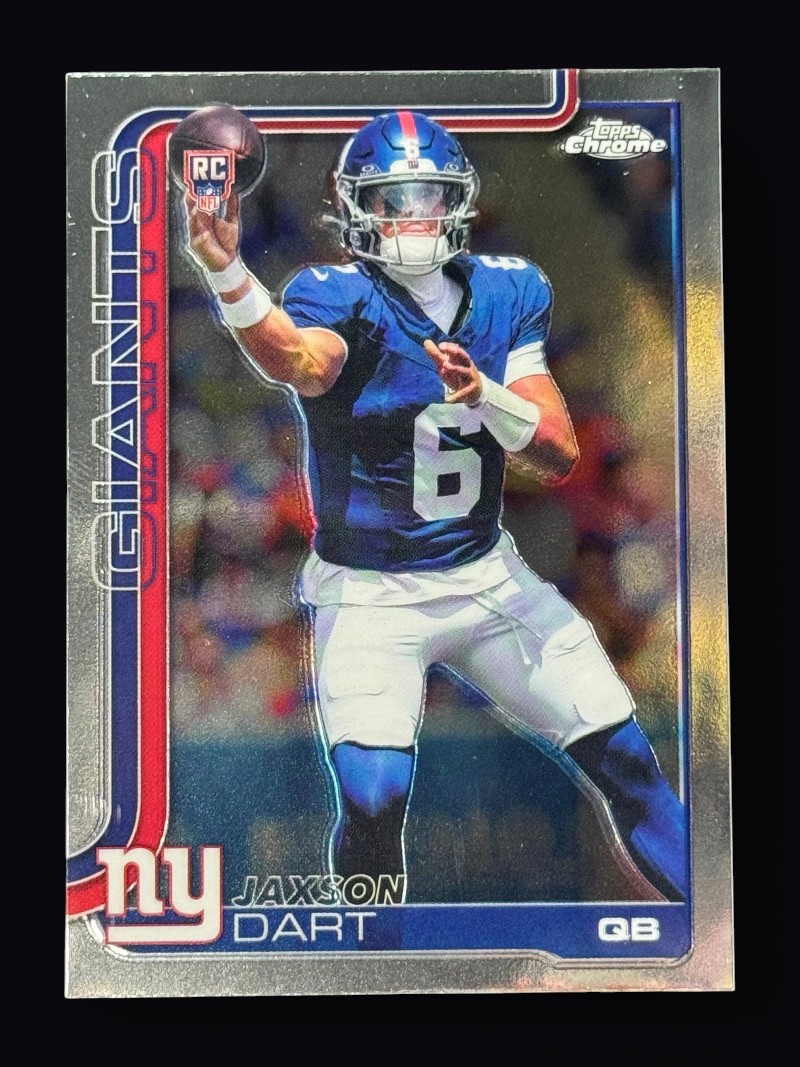
The $500K Dart Card Was Priced for a Healthy Season. Now What?
A 1-of-1 sold at auction hours before Dart left Monday Night Football with a knee injury. The record is not the problem. The liquid market is.
The hammer fell on a 1-of-1 Jaxson Dart rookie at $500,200 — a record, set hours before kickoff on Monday Night Football. By the second half, Dart was in the locker room with a knee injury and ruled out for the night. The card did not move. The market did.
That gap between the auction result and the secondary market is where every collector who bought graded Dart rookies in the last two weeks now lives. The $500,200 Goldin close is a headline. It is not a price you can act on today, because the 1-of-1 does not trade again until someone decides to sell it. What does trade, right now, in real time, on eBay, are Dart's PSA and BGS graded base rookies and short-prints, and those are the cards that will tell you whether the hobby is treating Monday night as a blip or a break.
What the $500K Sale Actually Priced In
Auction results for 1-of-1s are not market prices in the way that a PSA 10 rookie sold three times in a week is a market price. They are theses, priced by the two most motivated bidders in the room on a specific day. The thesis embedded in the $500,200 Goldin result had a very specific shape: healthy starter, full season, ascending narrative. Dart had already validated that shape once, with a record sale following the Giants' Week 1 win over Dallas. The second record in three weeks was momentum compounding on momentum.
Momentum markets are not fraudulent. They reflect genuine conviction, and Dart's conviction case was real: a young quarterback winning in New York, moving fast up the hobby's market weight rankings, sitting seventh among the most-traded players in the hobby this week. But momentum markets do not build floors the way sustained performance markets do. There is no comparable sale that was set under duress, no moment where the market tested and held. Every data point in the Dart market was set on the way up.
The Fork in the Thesis
The knee injury does not automatically break the thesis. It introduces a fork. One path: this is a one-game absence, Dart is back for Week 3, and the $500,200 sale looks prescient in hindsight. The secondary market for his graded rookies barely moves, because the market correctly identified that a single missed game does not change a quarterback's trajectory. Collectors who bought PSA 10 Dart rookies in the $500-$2,000 range over the last two weeks hold, the ask stabilizes, and the story continues.
The other path: the MRI comes back with a multi-week timeline, the Giants start a backup, and the ascending narrative that justified two consecutive records goes on pause at exactly the worst moment. In that scenario, the Dart market has no floor that was set under anything other than peak optimism. Sellers who need liquidity will have to find buyers who are willing to step in without knowing when Dart returns, and the graded liquid market will price that uncertainty immediately.
The honest answer is that both paths are real, and the MRI result is the only variable that resolves which one you are in.
The 1-of-1 is not actionable today. The cards that reprice in real time are the graded base and short-print rookies on eBay, and that spread will tell you everything the auction result cannot.
What to Actually Do Right Now
Do not move on the $500,200 result. It is a single illiquid data point from a specific auction on a specific night, and it has no actionable read until the card sells again. The decision facing collectors who bought graded Dart rookies in the last two weeks is entirely about the liquid market.
Pull eBay sold listings for Dart's PSA and BGS graded rookies as of September 23 and compare them to the pre-MNF ask. If the spread has not widened materially, the market is treating this as a short absence and holding is rational. The card market is seventh in weekly trading weight on Dart, which means any repricing will show up fast in the sold data. There is enough volume to read the signal clearly.
If sold prices are already running 20-30% below last week's comps, the market is not waiting for the MRI. It is already pricing in a longer timeline, and sellers who bought at peak momentum should ask themselves whether their original thesis still holds under that assumption. Buying a card because a quarterback is a healthy starter with a full season ahead is a different thesis than buying a card because a quarterback might be back in two weeks. Those are not the same bet, and the price should reflect the difference.
The collectors most exposed right now are not the ones who paid $500,200 for a 1-of-1. That buyer has no comp to sell against and no decision to make today. The most exposed positions are the graded rookies bought in the $500-$2,000 range on the back of two consecutive record sales, because those are the cards that will reprice publicly and immediately when the injury timeline becomes clear. Watch the eBay sold data. Wait for the MRI. Then decide.
Follow the hobby in the app
Track the products and players you collect and get told the moment anything moves.
Get the Collector Nation App