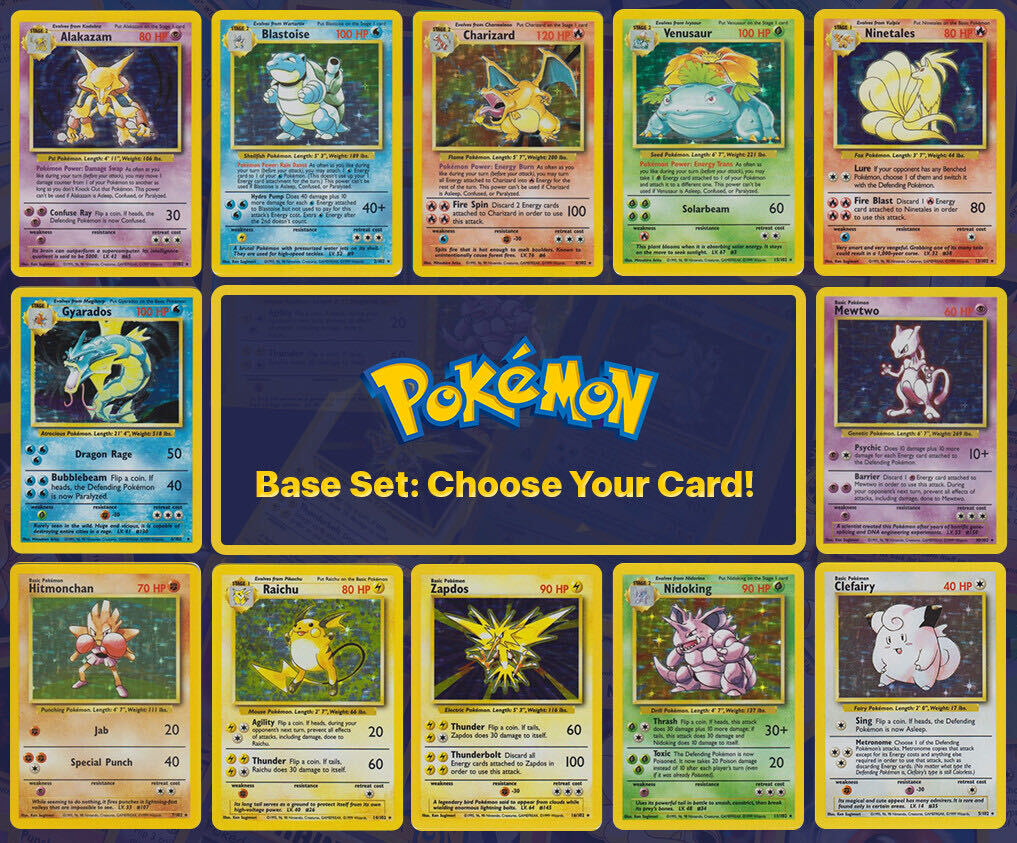
Why the Same 1999 Cards Top Every Most Valuable Pokémon List
The 30th Celebration checklist leaked this week and search volume on Pokémon valuations spiked. Here is the structural reason no new set can touch what a 1999 Charizard sells for: and what that framework means for every 'most valuable' claim you will encounter.
The Pokémon TCG 30th Celebration checklist leaked this week, and search volume on Pokémon valuations spiked alongside it. Somewhere in that traffic are collectors wondering whether anything in a new anniversary set can touch what a 1999 Charizard sells for. The answer is structurally no, and the reason why is more useful than any ranked list.
The Three Structural Drivers
The cards that hold the top positions on every 'most valuable Pokémon' list share three characteristics, and the most valuable ones check all three. First: print era and edition. The 1st Edition Base Set was printed in a quantity fixed in 1999. That number cannot increase. Every year that passes without a reprint is another year of attrition, cards lost to damage, mishandling, or simple disappearance, which means the ceiling on gradeable copies only compresses further.
Second: grading population ceilings. Holofoil cards from 1999: 2003 are notoriously condition-sensitive. The printing technology of that era left holographic surfaces vulnerable to scratches, print lines, and surface wear that modern cards largely avoid. The result is that PSA 10 populations for 1st Edition holos are genuinely scarce even for cards that were pulled in large numbers. A card graded PSA 9 and a card graded PSA 10 are not two versions of the same thing at different prices. They are effectively different assets, and the PSA 10 population is a ceiling that cannot be raised by finding more raw copies.
Third: card-specific scarcity. Promotional cards, tournament trophies, and error variants from that era have graded populations measured in single digits. The Pikachu Illustrator, awarded to winners of the 1997: 1998 CoroCoro Comic illustration contests, exists in a population so small that each confirmed sale sets a new reference point for the category. These are not rare in the way a short-print parallel is rare. They are rare in the way a specific historical artifact is rare.
Why New Sets Cannot Compress the Gap
Every new set TPCi prints increases the total supply of Pokémon cards in the world. The supply of PSA 10 1st Edition Charizards does not move. That asymmetry is the entire story. Nostalgia is real, but it is not the mechanism: the mechanism is a closed population of cards graded under manufacturing conditions that no longer exist and cannot be recreated.
The 30th anniversary arguably reinforces vintage value rather than threatening it. New collectors drawn in by a celebration set discover the category, learn what the ceiling looks like, and some percentage of them become buyers of the vintage tier. Anniversary releases function as top-of-funnel for the entire Pokémon market, including the part of it that trades in 1999 cardboard.
Modern Sealed Is a Separate Phenomenon
Pokémon is the second-largest category by market weight in hobby trading data, and modern sealed product has its own appreciation story running in parallel to vintage. A Pokémon 151 Elite Trainer Box moved from $180 to $600 in a single year. That is real secondary market activity, driven by collector demand for a specific modern product with its own supply constraints. It is not the same phenomenon as a PSA 10 1st Edition Charizard holding its value, and conflating the two leads to bad decisions.
The 151 ETB price movement reflects what happens when a modern set resonates strongly and sealed supply tightens. The vintage tier reflects what happens when a print run closes permanently and grading populations hit a ceiling. Both are real. Neither explains the other.
Any card that does not check at least two of the three structural boxes is not competing at the top of the value table, regardless of what a listing price says.
How to Evaluate Any 'Most Valuable' Claim
When a card surfaces with a headline price, run it against the three boxes. Is the print era closed and the edition fixed? Is the grading population for the top grade genuinely scarce because of condition sensitivity, not just because the card is new? Does the card carry a variant-specific scarcity, a promo, an error, a tournament award, that puts its population in single or double digits? A card that checks all three is competing in the tier where the 1999 Charizard and the Pikachu Illustrator live. A card that checks one is not, regardless of what a Buy It Now listing says.
For the 30th Celebration set specifically: evaluate it as a modern product on its own terms. If TPCi has designed any card in the set as a genuine limited-print tribute rather than a reprint aesthetic, that card deserves a closer look at the population question once grading data exists. Until then, the checklist leak is a reason to pay attention to the release, not a reason to project vintage-tier value onto it.
The List Is a Symptom
The same handful of 1999: 2003 cards top every most valuable Pokémon list because they are the only cards in the category that check all three structural boxes simultaneously. The list is not arbitrary, and it is not purely sentimental. It is the output of a specific manufacturing moment that closed permanently, a grading era that documented the surviving population, and a collector market large enough to price that scarcity at scale. Understanding that is more useful than memorizing the rankings, because the rankings will shift at the margins while the structure that produces them stays fixed.
Follow the hobby in the app
Track the products and players you collect and get told the moment anything moves.
Open Collector Nation