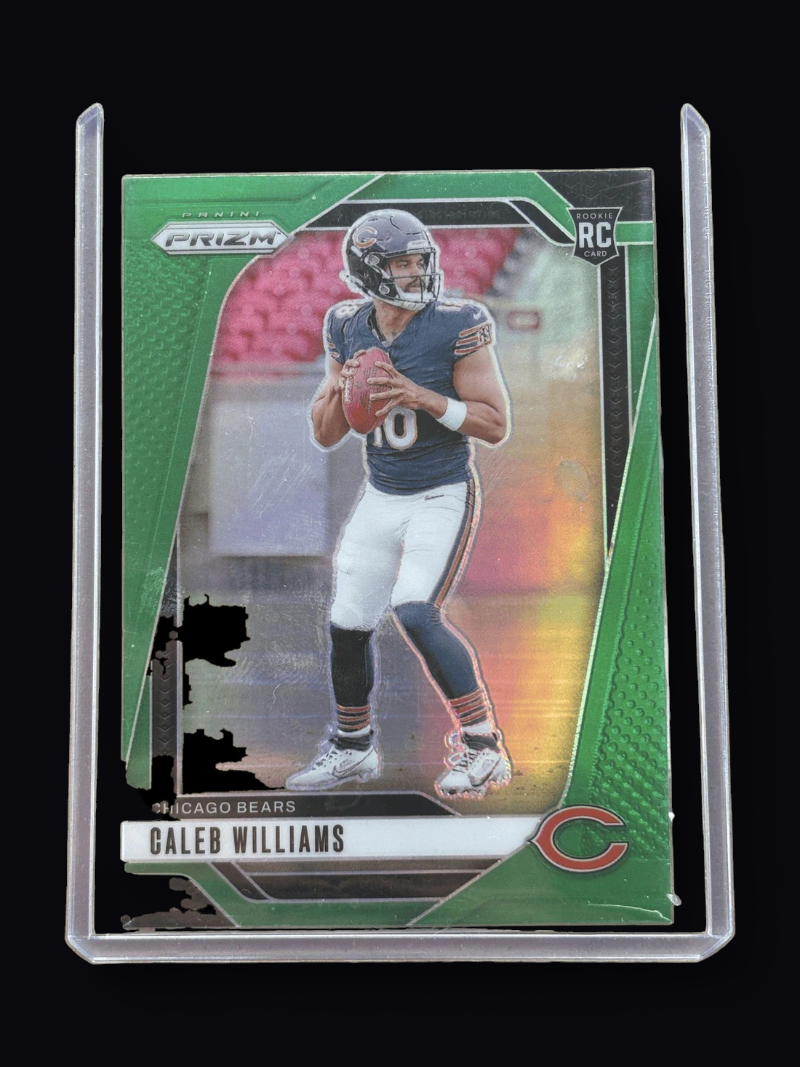
Caleb Williams' Card Market Has Already Priced In a Good Game
5,407 sales and $407,582 moved in 30 days. The buyers got in before Sunday. What that means for holders before kickoff.
5,407 Caleb Williams sales in 30 days. $407,582 moved. And in just the last seven days, 1,516 transactions running at 1.3x his own recent rate. The market did not wait for Sunday's Bears-Vikings kickoff to make its bet on Williams — it already made it. The question going into Week 2 is not whether Williams is in demand. It is whether the game can deliver what buyers have already paid for.
What a 1.3x Velocity Spike Actually Tells You
A velocity ratio above 1.0 means the market is buying faster than its own recent norm. At 1.3x, Williams' cards are not just active. They are running hot relative to his own baseline. That kind of pre-event acceleration is the card market behaving like an options market at expiration: the premium is richest right before the catalyst, and it collapses fastest when the catalyst disappoints.
The practical read is straightforward. Buyers who drove that 1.3x pace were pricing in a good Williams performance against Minnesota. A dominant game on Sunday may produce a modest additional pop, but the ceiling on that pop is lower than it looks because so much of the optimism is already embedded in current prices. The floor, on the other hand, is not protected at all. A flat game or a poor one hits a market that is already extended, and the unwind happens fast.
The 1.3x velocity spike means buyers are already in. A holder who waits for a strong performance to sell may find the bid has already moved on by the time they list.
The Asymmetry Favors Sellers, Not Holders
This is an asymmetric setup, and it cuts against holding. On the upside: Williams plays well, the market confirms what it already priced, and liquid cards see a modest additional lift. On the downside: Williams struggles, or the game is simply unremarkable, and the pre-game premium evaporates quickly as sellers chase a retreating bid. The risk-reward on holding through kickoff is not balanced.
Williams' Bears won in Week 1, with Bryce Young going for four touchdowns in a losing effort on the other side. The early-season momentum narrative is real, and it is part of what is driving volume. But momentum narratives are also exactly what gets priced in fastest: and unwound fastest when a game does not cooperate.
Minnesota adds its own wrinkle. Kyler Murray sat out the Vikings' Week 1 game in concussion protocol, which clouds the defensive context Williams is walking into. A Vikings offense that is itself unsettled changes the game script in ways the market may not have fully sorted through.
What to Do Before 1 p.m. ET Sunday
If you are holding Williams' most liquid cards, the window to sell into strength is open right now. The 1.3x velocity means there are active buyers in the market today. List before kickoff and you are selling into genuine demand. Wait for a strong performance and you are competing with every other holder who had the same idea, into a bid that may have already moved.
If you are looking to buy, the math runs the other way. The entry price today reflects maximum pre-game optimism. A disappointing result, or even a pedestrian one, brings that price down, and the repricing cycle typically completes within a few hours of the final whistle. Patience here is the position.
The Bears and Vikings kick off Sunday at 1 p.m. ET. After that, the market sets its own price.
Follow the hobby in the app
Track the products and players you collect and get told the moment anything moves.
Open Collector Nation