Dart and Skattebo Are Both Trading at 1.6x Velocity Before Monday. That Is the Problem.
When two completely different card markets produce identical velocity signals before the same game, the market has already made its bet. Holders are sitting on a position built before kickoff: and the asymmetry does not favor waiting.
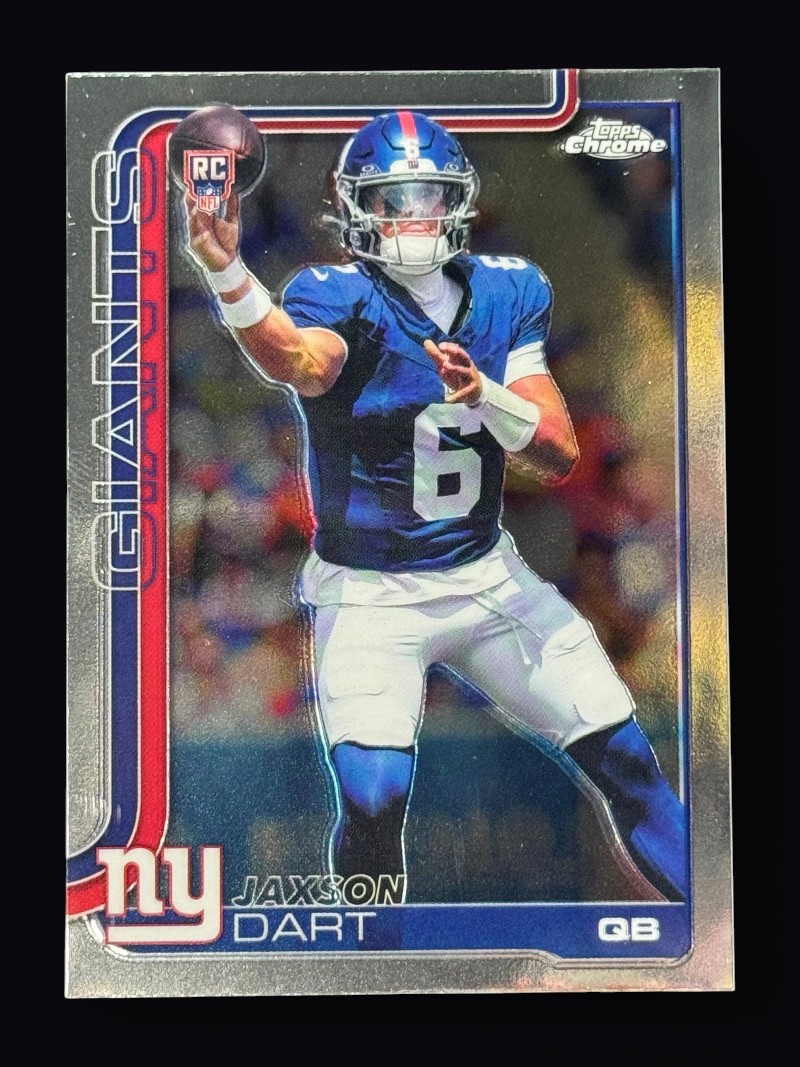
Somewhere right now, a collector is holding a Jaxson Dart rookie card and doing the math on Monday night. They watched a 1-of-1 Dart sell for a record price after the Giants beat Dallas in Week 1. They watched the broader Dart market absorb that energy and run — 7,646 sales in the last 30 days, $282,042 in total volume, and 2,493 of those sales arriving in just the last seven days. The math feels good. The Giants play again Monday night, in primetime, and if Dart plays well, the thinking goes, the cards go higher.
The problem is that the market already did that math. And then it already bought.
The Same Signal on Two Very Different Markets
Dart's seven-day sales pace of 2,493 transactions sits at 1.6x his own 30-day average rate. Cam Skattebo's seven-day pace of 983 sales also sits at exactly 1.6x his 30-day average. Two players, two completely different card markets, Dart's at $282,042 in total 30-day volume, Skattebo's at $47,501, and the same velocity reading to the decimal.
That symmetry is not a coincidence. It is the market responding to the same stimulus: a Monday night primetime slot, two players coming off a Week 1 that generated genuine attention, and buyers who do not want to miss the move. The problem with that behavior is structural. When buyers front-run an anticipated good performance, they pull the post-game price appreciation into the pre-game window. The pop that should happen after the game has already happened before it.
What 1.6x Actually Means for the Upside
A 1.6x velocity reading is not a buy signal. It is a description of how much of the upside has already been spent. When sales volume accelerates that sharply before a game, the buyers who move markets fastest have already entered. The collectors who push prices on post-game euphoria are competing against a baseline that is already elevated. A strong Dart performance Monday night will generate buying activity, but that activity lands on a market that is already priced for a strong performance: which means the incremental move is smaller than it would be from a neutral starting point.
The downside math runs in the opposite direction. If Dart struggles, or if Skattebo has a quiet game, sellers are repricing from an inflated floor rather than a neutral one. The unwind is larger than the upside is likely to be. That asymmetry, compressed gain, exposed loss, is the position both sets of holders are in right now, before a single snap is played Monday night.
Why Skattebo's Market Is the Sharper Risk
The velocity numbers are identical, but the markets are not. Skattebo's total 30-day volume is $47,501. Dart's is $282,042. That six-to-one difference in dollar depth matters enormously when a sell-side move hits. Dart's market has enough transaction volume to absorb a wave of sellers without a catastrophic price drop; Skattebo's does not. A bad game Monday produces a repricing in both markets, but in Skattebo's market, thinner liquidity means that repricing is sharper and faster. Holders in the Skattebo market are carrying the same velocity risk as Dart holders, with less cushion underneath them.
The Dart picture has its own wrinkle. The record 1-of-1 sale after Week 1 set a ceiling that the broader market is now pricing toward. That sale was real, and it moved the market legitimately. But a 1-of-1 is by definition unrepeatable, and when the broader market treats a landmark sale as a floor rather than an outlier, the baseline becomes fragile. The $282,042 in 30-day Dart volume reflects genuine demand, but some portion of that volume is speculative positioning built on the expectation of another record moment. If Monday is a good game but not a historic one, that speculative layer has nowhere to go.
What Holders Should Do Before Kickoff
For anyone holding Dart or Skattebo cards who built their position during or after the Week 1 run, the pre-kickoff window is the trim opportunity. Not because Monday night will necessarily go badly, and not because either player is a bad hold long-term. The case for trimming is purely structural: the 1.6x velocity means you are selling into demand that exists right now, before the game creates any new information. After kickoff, you are selling into a market that knows what happened, and if what happened was not good, the bid is lower and thinner than it is at this moment.
Buyers looking to enter either name have the opposite read. Waiting for post-game clarity costs you nothing if the game is bad, and costs you a manageable entry premium if the game is good. The risk-reward on entering before kickoff, against a market already trading at 1.6x velocity, does not favor urgency.
The primetime slot is real. The Week 1 momentum is real. The cards are real. What is not real is the idea that the market is waiting for Monday night to decide what these players are worth. It already decided. The question now is whether you are positioned on the right side of that decision.
Follow the hobby in the app
Track the products and players you collect and get told the moment anything moves.
Get the Collector Nation App