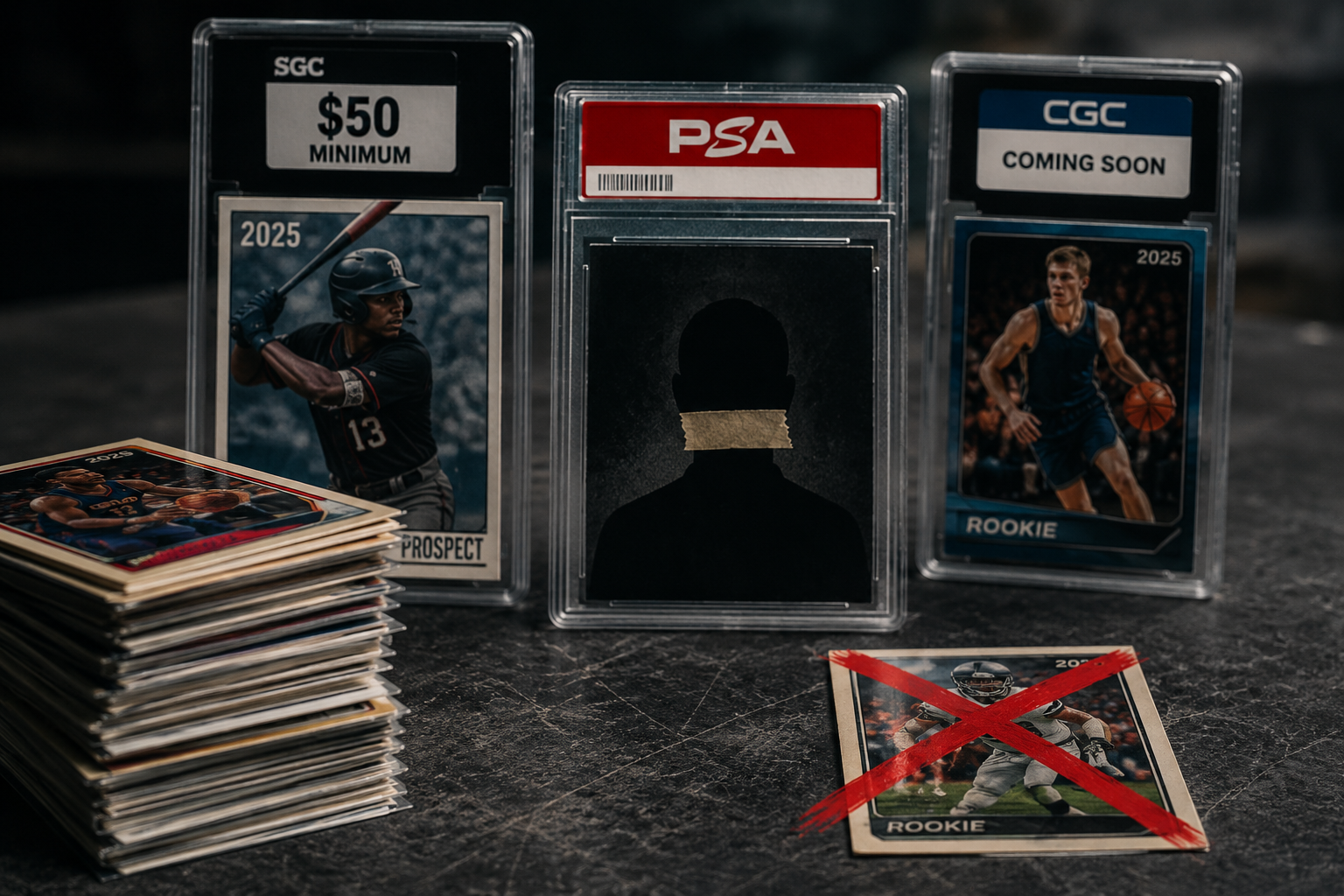
SGC's $50 Floor, PSA's Silence, and CGC's Timing: One Structural Shift in the Grading Market
Three events in 72 hours compressed the entire budget tier of card grading. The real consequence isn't the submission math: it's what happens to every raw card that used to clear the $15 bar but can't clear $50.
Somewhere in the 3.4 million cards that moved through grading companies in August, there is a stack that nobody submitted. The August volume number, already down 6% from July before SGC's announcement went live, is the leading edge of something the price change will now accelerate. The cards that didn't get submitted last month cost $15 to grade. The ones sitting on desks this week cost $50.
Three things happened in the same 72-hour window ending September 3. SGC raised its base grading tier from $15 to $50, describing the increase as temporary without publishing a timeline or a trigger condition for reverting. Industry-wide grading volume came in at approximately 3.4 million cards for August, down 6% from July. And CGC Cards, backed by Fanatics and Blackstone, announced it is positioning itself as a direct competitor to PSA. Taken individually, each is a news item. Taken together, they describe something the hobby hasn't seen before: a structural repricing of the grading market's entire budget tier, happening in real time, with a well-capitalized new entrant watching from the doorway.
The Binary the $50 Floor Creates
The submission math is simple enough that every collector can run it in their head, and that's exactly what's happening right now across every binder and box of raw cards in the hobby. A card worth $30 raw was a reasonable flip candidate at a $15 grading fee: grade it, sell the slab, capture the premium. At $50, that same card is a card you hold forever or sell raw at a discount, because the economics of submitting it no longer exist. The practical threshold for a submission to make sense has shifted from roughly $50-60 in realistic slab value to something closer to $100-120, once you account for the fee, turnaround time, and the spread between raw and graded comps.
That logic, applied across millions of cards, does something quiet and significant to the raw-card secondary market. A meaningful layer of raw-card demand was always submission-driven: collectors buying raw cards specifically because the graded version would be worth more than the card plus the fee. SGC's floor just eliminated that math for an entire value tier. Cards that sat comfortably in that zone don't disappear from the market. They just lose the buyer who was going to grade them. Their raw value follows.
The $50 floor didn't just raise one company's fees. It forced a binary question about every raw card in the hobby: is this worth $50, or is it worth nothing to submit?
There is a mirror consequence that gets less attention: slabs that were graded in the last 12 to 18 months at sub-$25 fees now carry a cost-basis advantage that the secondary market hasn't fully absorbed. If you hold a PSA or SGC slab of a mid-value card, something that would grade out at $60-80, and you acquired it when the submission economics were comfortable, that slab is now harder and more expensive to replicate. The replacement cost went up. The comp hasn't moved yet.
This is not a guarantee of appreciation. A $70 slab doesn't automatically become a $90 slab because the grading fee tripled. But in a market where buyers are increasingly aware that new submissions require a higher hurdle, existing slabs of cards in that mid-value range carry a quiet premium that is worth checking against current raw comps before you decide to sell. The window where that premium is invisible is the window where it is most exploitable.
Why CGC's Timing Looks Like a Calculated Read
CGC Cards, backed by Fanatics and Blackstone, announced its positioning against PSA at a moment that, in retrospect, looks less like coincidence and more like a read on exactly this market condition. When the incumbents raise their effective price floor, they hand a new entrant something valuable: a price umbrella. If CGC enters at a budget tier, it is not competing with PSA for the premium submission market. It is competing for exactly the volume SGC just priced away.
CGC's actual pricing structure has not been announced, so its competitive positioning against PSA remains stated intent rather than confirmed economics. But the strategic logic is clean. The collectors who were submitting $20-30 cards at $15 fees are now either sitting on their hands or looking for an alternative. A well-capitalized entrant with a credible authentication reputation and a lower fee structure would absorb that volume immediately. The question is whether CGC prices to capture it or prices to signal premium: and the answer to that question will tell you more about its long-term strategy than anything in the announcement.
The PSA variable complicates the picture further. Whether PSA has moved its entry-tier pricing in the same window is unconfirmed. If PSA held its budget tier, it may absorb the displaced SGC volume before CGC is even operational at scale, which would change the competitive calculus significantly. A collector who was submitting at SGC's $15 floor and is now looking for an alternative doesn't necessarily default to a new entrant: they default to the most familiar name with the best price. If that's PSA, CGC's entry-timing advantage shrinks.
What the August Volume Number Actually Tells You
The 6% decline in August grading volume, from July's level down to approximately 3.4 million cards: arrived before the SGC announcement went public. That sequencing matters, and it cuts both ways. On one reading, it is a leading behavioral signal: collectors were already pulling back on submissions before the fee hike, which means the hike accelerates a contraction that was already underway. On another reading, it is seasonal noise, or coincident with other market conditions, and the SGC announcement is the actual catalyst rather than an accelerant.
The honest answer is that one month of data doesn't resolve the question. What it does do is establish that the grading market was already softening when the structural change landed. Whether that makes the combined effect more severe or whether the two phenomena are largely independent is something the September and October numbers will clarify. For now, the 6% figure is an observation, not a trend, and the piece of analysis that treats it as confirmed evidence of collector behavioral shift is getting ahead of what the data actually shows.
Three Things to Reconsider Right Now
First, any raw card you were holding to grade at some point needs a fresh valuation against the $50 floor. The question is not whether the card is gradeable: it's whether the realistic slab value in the current market clears roughly $100-120 after fees. If it doesn't, the submission economics are gone, and you're either holding a raw card permanently or selling it into a raw market that is now competing with other collectors making the same calculation.
Second, check your existing mid-value slabs against current raw comps before selling. The cost to replicate a slab in the $60-100 range just increased substantially. That doesn't mean every such slab is underpriced, but it means the spread between raw and graded may have widened in your favor without any comp having moved yet. The collectors who notice that first will sell into it; the ones who wait will sell after the market has already adjusted.
Third, watch CGC's pricing announcement closely, and watch what PSA does or doesn't do in response. If CGC enters at a budget tier and PSA doesn't respond, the budget submission market bifurcates: PSA and CGC compete for volume below the SGC floor, and SGC's 'temporary' premium positioning either becomes permanent or it doesn't. If PSA moves its own pricing upward in the same window, the entire industry has repriced together, and the only remaining question is whether CGC absorbs the displaced demand or whether it simply doesn't exist at the volumes the incumbents once served.
Follow the hobby in the app
Track the products and players you collect and get told the moment anything moves.
Open Collector Nation