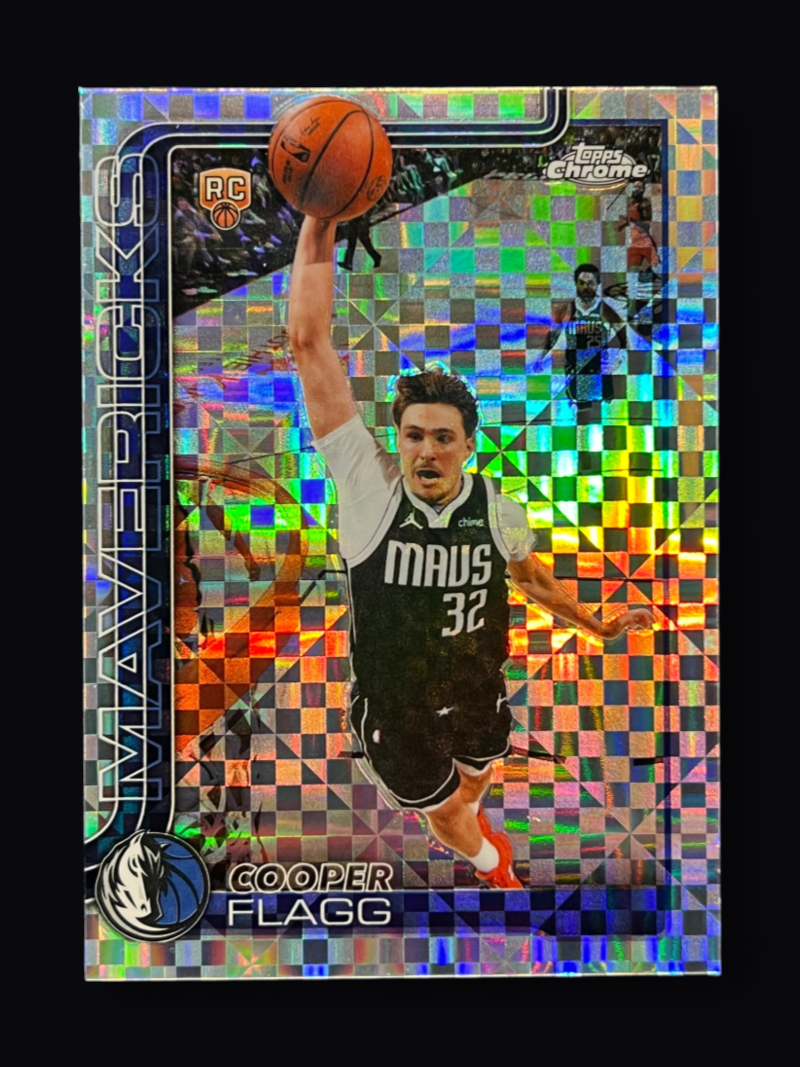
Cooper Flagg, Dylan Harper, Knueppel: Which Rookie Card Tier Still Has Room After the $20 Million Night
The 1/1s are trophies. The real question is what Thursday's auction does to the numbered parallels and base autos sitting in boxes right now: and the answer is different for each of the three players.
Somewhere in a hobby box that has not been opened yet, a Cooper Flagg base auto is sitting next to a number that just changed. Thursday's auction closed with $8.04 million attached to Flagg's debut patch auto, a figure that has never been printed next to an NBA card before. Dylan Harper's rookie card went for $2.88 million. Harper and Kon Knueppel's debut patches combined for $5.22 million. One night, three players, nearly $20 million. The mainstream press has the scoreboard covered.
What the scoreboard does not tell you is which tier of cards below those 1/1s still has room, which has already absorbed the signal, and which one has a preseason injury report complicating the entire calculation. Those are three different questions with three different answers, and the window to act on any of them closes fast.
The Halo Is Real. It Is Not Evenly Distributed.
A record auction result does not exist in isolation. It functions as marketing for every card in the same player's hierarchy that did not cross the block — the numbered parallels, the base autos, the raw rookies in cases that have not been cracked. The collector who wins a 1/1 at $8 million is not setting a comp for a /25 parallel; they are setting an atmosphere. That atmosphere raises ask prices, accelerates sales, and pulls forward demand that might otherwise have arrived over months.
The catch is that the halo is not distributed equally, and it does not arrive at every tier at the same speed. Flagg's market weight of 0.379 is nearly five times Harper's 0.078 and nearly seven times Knueppel's 0.056. That gap matters because a higher market weight means more of the signal has already been absorbed into accessible-tier pricing before any single auction result. Flagg's numbered parallels in Topps Chrome Update and Topps Definitive were already moving on pre-auction momentum. Thursday accelerates that clock rather than starting it.
Flagg: The Record Confirms What the Market Already Knew
At 0.379 market weight, Flagg is not a player whose accessible tier is waiting for permission to move. The $8.04 million sale is confirmation, not discovery. For collectors sitting on numbered parallels or base autos, the honest question is whether the repricing at that tier is already done. Ask prices on his Topps Chrome Update and Topps Definitive numbered cards will tell you more in the next 24 hours than any auction result analysis can.
There is also a new supply variable entering the picture. Topps Bob Ross: The Joy of Basketball includes Flagg rookie cards, adding another product vehicle to his accessible tier. Whether that functions as a separate collector segment or introduces genuine supply pressure on his existing Chrome and Definitive issues is worth tracking as the product gets closer. For now, it is a reason to be precise about which Flagg card you are evaluating rather than treating his accessible tier as a single market.
Harper's $2.88 million sale against a 0.078 market weight is a larger gap between trophy price and accessible-tier price than Flagg's numbers show. That gap is where the opportunity lives.
Harper: The Gap Between Trophy and Accessible Is the Trade
Dylan Harper's $2.88 million sale is the most interesting number from Thursday for a collector who is not spending eight figures. At 0.078 market weight, his accessible tier has absorbed far less of the pre-auction signal than Flagg's. A $2.88 million trophy price sitting on top of a 0.078 market weight means the distance between what the market paid for the 1/1 and what it has priced into his base autos and low-numbered parallels is proportionally larger than anything in Flagg's hierarchy.
That gap is where the halo has the most room to travel. Harper's base autos and low-numbered parallels are the tier most worth watching in the next 48 hours: not because the auction result guarantees they move, but because the signal-to-accessible-pricing ratio is more favorable here than anywhere else in this class. Watch the ask prices on his numbered parallels closely; if the market has not fully repriced them off Thursday's result by the time you read this, that window is closing.
Knueppel: One Injury Report Splits a Market in Two
Kon Knueppel's debut patch is part of the $5.22 million combined Harper/Knueppel sale, and at 0.056 market weight, his accessible tier has the most nominal room to absorb a halo effect. Under normal circumstances, that would make his numbered parallels and base autos the most underpriced tier in the class relative to the auction signal.
The circumstances are not normal. The Charlotte Hornets ruled Knueppel out ahead of the season start on September 26, the same day the auction results landed. A preseason scratch that resolves before opening night is a buying window on his debut cards: the market discounts on uncertainty, and uncertainty that clears fast creates a recovery trade. A scratch that costs him regular-season games is a different asset entirely, because his debut patch value is directly tied to when and how he actually debuts. The market will not wait for that clarity, which means any new buy on Knueppel's accessible tier before the severity and timeline are public is a bet on the injury being minor. That may be the right bet. It is still a bet, and it should be sized accordingly.
The 48-Hour Clock
The window between a record auction result and the full repricing of the accessible tier is 48 to 72 hours. After that, the halo is priced in, the ask prices have moved, and anyone acting on the auction signal is buying at the new floor rather than ahead of it. For Flagg, that repricing may already be largely complete at the numbered parallel tier given where his market weight sat before Thursday. For Harper, the gap suggests it is not. For Knueppel, the injury report is the variable that the market is pricing before anything else.
The $20 million night matters. It matters most for the cards that did not sell at auction, and it matters differently for each of the three players in the room. Read the ask prices, track the injury report, and be specific about which card in which product you are actually evaluating. A record is a headline. What it does to the card in the box is the only number that matters to a collector.
Follow the hobby in the app
Track the products and players you collect and get told the moment anything moves.
Get the Collector Nation App