I Pulled a $5,000 Jokić and It Cost Me the Same as a Griffey PSA 10 Rookie. They Are Not the Same $5,000.
My Alter Ego pull and my Griffey dream share a price tag. What they don't share is 36 years of proof.
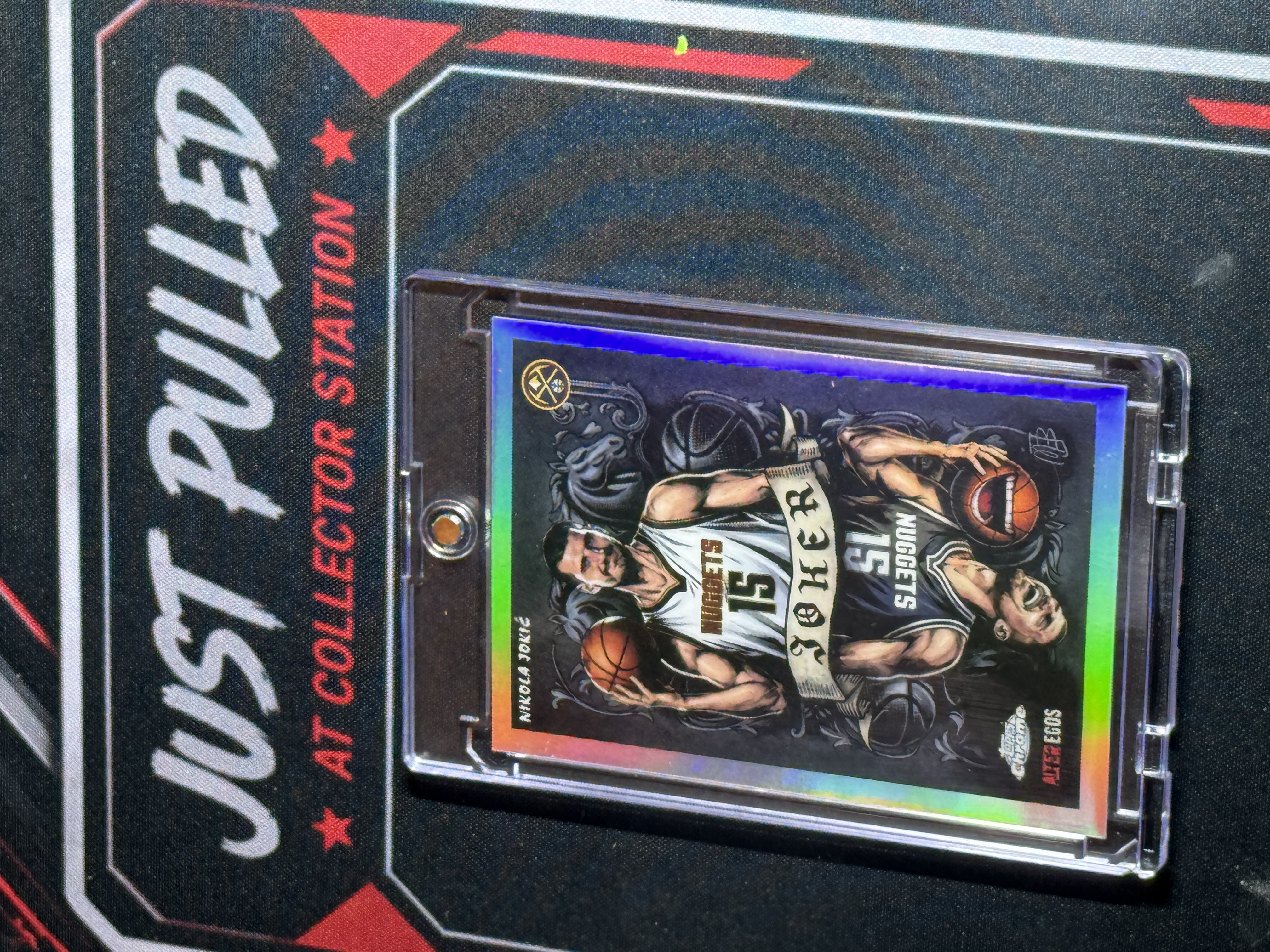
I set the Jokić Alter Ego down on my Collector Station Just Pulled mat and opened my phone. Growing up, Ken Griffey Jr. was my guy. I have been planning to buy his 1989 Upper Deck rookie in PSA 10 for years — one of the most iconic pieces of cardboard the hobby has ever produced, graded perfect, thirty-six years old. I pulled up the ask. The number on the screen was the same number sitting on the mat in front of me: a card printed this year, pulled from a value box, worth approximately $5,000.
My first instinct was to laugh. My second instinct was to think harder about it, because something about that identical price tag felt like it was trying to tell me something.
The Same Number, Built on Completely Different Ground
The 1989 Upper Deck Griffey rookie in PSA 10 did not arrive at $5,000 on a Tuesday in 1989. It got there the hard way. It survived the junk wax collapse of the early nineties, when the hobby nearly drowned in its own overproduction. It survived the steroid-era hangover, the 2008 financial crisis, the 2020 boom and the correction that followed. Every time the market reset, collectors looked at that card and decided it was still worth holding. The $5,000 you see today is not a price. It is a verdict, rendered over and over across four decades of stress tests.
The Jokić Alter Ego from 2025 Topps Chrome Update Basketball has not been tested by anything. It was born at $5,000. That is not a criticism of the card — it is genuinely scarce, Nikola Jokić is a three-time MVP who has a legitimate case as the best basketball player alive, and the Alter Ego case-hit structure is exactly what the modern hobby built to manufacture that kind of immediate gravity. But manufactured gravity and earned gravity are different materials, and right now they are wearing the same price tag.
The Griffey $5,000 is a verdict rendered across four decades of stress tests. The Jokić $5,000 is a verdict rendered across zero.
How the Hobby Learned to Front-Load Decades of Value
What manufacturers figured out, somewhere in the last ten years, is that scarcity does not have to be discovered over time. It can be engineered in advance. Case-hit odds structures, Alter Ego designations, short-print tiers stacked inside short-print tiers: these are the tools that let a card arrive at a price that used to take a career arc, a Hall of Fame vote, and a generation of attrition to reach. The hobby used to answer the question 'how much is this worth?' over decades. Now it answers it on the first day of release.
That is genuinely impressive engineering. It is also why I found myself staring at two $5,000 cards with completely different confidence intervals around where they will be in five years. The Griffey's range is relatively tight. The market has told us what it thinks of that card in every conceivable environment. The Alter Ego's range is enormous, and that is not a knock on Jokić. It is just the honest accounting of what 'zero market cycles' means when you are trying to model a price.
What I Am Actually Holding, and What You Should Know If You Are Too
If you pulled an Alter Ego, or if you bought one, you are holding it at its highest-confidence moment. The novelty premium is fully intact. The hype is fresh. There has not been a wave of comparable sales to establish a secondary baseline, which means the ask is still being set by the most optimistic participants in the market. That is not forever.
None of this is a sell signal by itself. Jokić is the kind of talent whose cards have a real argument for long-term durability. The card is scarce in a way that matters. But the question I keep coming back to is whether the $5,000 is a starting point or a peak, and the honest answer is that nobody knows yet, because the card has not lived long enough for the market to tell us. The Griffey has lived long enough. That is the only difference, and it is not a small one.
Before I treat these as the same trade, I need to know which one I am actually buying. The Griffey at $5,000 is a floor with a documented history. The Alter Ego at $5,000 is a ceiling with a documented pull date. Both are real money. Only one of them has been proven to still be real money after a market cycle, a career retrospective, and thirty-six years of collectors deciding, again and again, that it belongs in the conversation.
Follow the hobby in the app
Track the products and players you collect and get told the moment anything moves.
Open Collector Nation