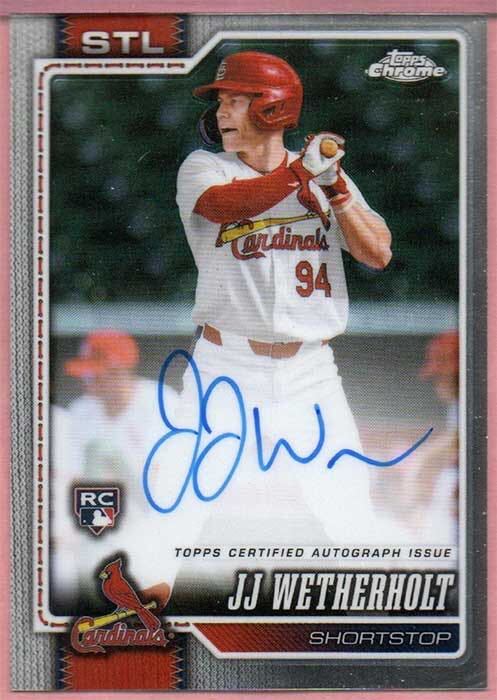
The NYT Put JJ Wetherholt's ROY Case in Front of a Million Casual Collectors. His Cards Haven't Moved Yet.
A marketWeight of 0.21 is the highest of any active baseball player not already in a velocity spike. The mainstream press just noticed. The gap between those two facts is closing faster than most collectors realize.
On August 19, the New York Times ran a piece framing the NL Rookie of the Year race as a two-man debate between JJ Wetherholt and Sal Stewart. That same week, Wetherholt posted a career-best performance for the Cardinals, detailed in Sports Illustrated the same day. And sitting quietly in the market-weight rankings, Wetherholt held a 0.21 score — the highest of any active baseball player not already caught in a velocity spike. Three signals, same week, none of them yet talking to each other in the card market.
That gap is the trade. Not the award, not the vote in November, not the moment a winner is announced and every outlet runs the same recap. The gap between a market that has assigned Wetherholt serious weight and a price structure that still reflects a prospect in a ROY conversation rather than a frontrunner. That is what closes in the next several days, not the next several weeks.
How the Sequencing Actually Works
The hobby has learned to front-run award announcements. That is not speculation. It is the observable behavior of a collector base that has watched the ROY premium materialize before the vote enough times to stop waiting for confirmation. By late September, the narrative is either live or it isn't. If it's live, the price has moved. The November announcement is, at that point, a formality that either sustains a price or corrects it.
What the NYT piece did on August 19 was not create the Wetherholt narrative. Collectors who track marketWeight as a leading indicator had the signal before that piece published. What the piece did was deliver that narrative to an audience that does not track marketWeight: casual fans, lapsed collectors, people who open a hobby box twice a year and know roughly what a Bowman Chrome auto is worth. Those are the buyers who push prices from 'recognized' to 'repriced.' And they read the Times.
The Cincinnati Enquirer ran the same Wetherholt-vs-Stewart framing on August 20. Two major outlets, two consecutive days, the same two-man race. The narrative is now in front of a general audience in a way it was not a week ago. That is the clock starting.
The Cardinals Variable
Wetherholt's ROY case does not exist in a vacuum. It exists inside a Cardinals season, and whether St. Louis is in a playoff race through October matters enormously to how this plays out. A team fighting for a postseason spot keeps its rookies in the lineup, keeps the national feed pointed at them, and gives the award narrative oxygen through the final weeks of the regular season. A team that fades out of contention by mid-September compresses Wetherholt's media surface area at exactly the moment the hobby needs sustained attention to push prices.
The Cardinals' playoff position is a genuine variable here, not a rhetorical hedge. If they're in it, Wetherholt's at-bat count and coverage stay high through October, and what would otherwise be a slow award-season drift becomes something that moves with urgency. If they're not, the narrative loses the amplifier it needs.
The ROY premium is increasingly built into prices by late September. Collectors who wait for November confirmation are buying the aftermath.
Which Cards, and Why It Matters Which
Wetherholt's Bowman Chrome prospect autos and 1st-edition parallels are the natural targets when a ROY narrative goes mainstream. They carry the right combination of collector recognition, auction visibility, and the kind of scarcity that makes a price move legible. Base rookies will move too, but they move differently: higher volume, lower per-card upside, easier to exit but also easier to get caught holding when the narrative peaks.
The critical point is that these formats are not one market. A Bowman Chrome auto and a base parallel of the same player can behave in completely different ways during an award-season run, depending on which format has active buyers, what the current price floor looks like, and how liquid the recent sales history is. Treating them as a single trade is how collectors end up buying the illiquid version of the move and wondering why it didn't work.
Current price points and sales velocity across Wetherholt's specific cards need to be confirmed before sizing anything. The thesis points at the right player and the right window. The execution depends on which format is actually trading.
Where This Fails
The thesis has two clean exits on the downside, and neither is small. The first is Stewart. If Sal Stewart's card market is already moving faster than Wetherholt's: if the velocity data shows Stewart's buyers acting while Wetherholt's are still waiting: then the market may have already picked its ROY favorite, and the gap being described here belongs to the other player. Stewart's current pricing and sales velocity are the number that would confirm or break this read.
The second failure mode is performance. Wetherholt posted a career-best in August, per Sports Illustrated, and a red-hot stretch is exactly the kind of peak that a market eventually corrects against if it doesn't continue. If his numbers cool in September, the narrative softens, and the casual buyers who read the NYT piece find reasons not to act. Both risks are real. Neither should be dismissed as unlikely.
The cleaner version of this trade has two exits: sell into the late-September peak if the Cardinals are in contention and the ROY narrative is still the dominant baseball story, or hold through the vote if Wetherholt is the clear frontrunner by October. What it does not have is a comfortable third option: wait for the award and see. By then, the move has already happened, or it hasn't, and the price reflects whichever outcome arrived first.
Follow the hobby in the app
Track the products and players you collect and get told the moment anything moves.
Open Collector Nation