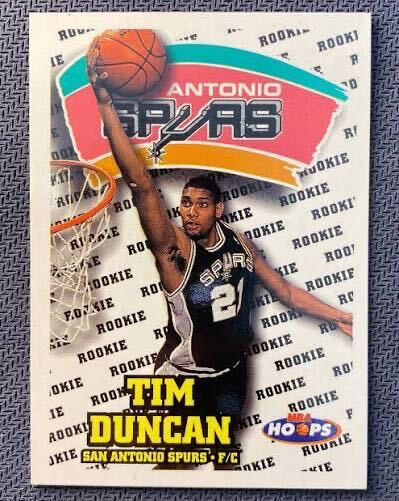
The Vintage NBA Big-Man Market Is Moving as a Category, Not as Two Player Spikes
A 1997 Hoops Tim Duncan base rookie selling at nearly 15 times normal velocity is not a Tim Duncan story. It is the clearest signal yet that a category rotation is underway: and the window to buy below the new floor is closing faster than most collectors have noticed.
A 1997 Hoops Tim Duncan rookie, base card, no autograph, no serial number, sold at 14.9 times its normal weekly velocity over the last seven days, with the average price up 43.1%. Not a PSA 10. Not a short-print. The base card. That number does not make sense unless something larger than Tim Duncan is moving.
Sit with it for a moment. Velocity ratios that high on a base card from a 29-year-old set do not come from a single large purchase or a collector who just discovered basketball. They come from a category that has started moving as a category. And when you place that Duncan signal next to what has been happening with Shaq: the 1992 Topps Stadium Club rookie up 75.1% at 2.8x normal velocity, the 1992 Upper Deck Fanimation running at 2.4x: you stop seeing two player stories and start seeing one market story.
Two Data Points, One Thesis
The Shaq move is not new. His market has been building since mid-July, roughly six weeks of sustained momentum that has already doubled prices on key cards. The Sports Card Lessons podcast on August 24 named seven specific Shaq cards under $525 that still had room to run: a citable, testable claim. Those prices have had days to move since the episode aired, so treat them as a starting point for research rather than a live price sheet. The point is that the Shaq spike had already been identified, discussed, and partially priced in before this week.
The Duncan spike is different. It is newer, sharper, and has not been the subject of the same podcast coverage. A 15x velocity surge on a base rookie is the market in the early recognition phase, before the conversation fully catches up to the data. That asymmetry matters for anyone trying to decide where to act: the Shaq move has six weeks of momentum already baked in; the Duncan move looks like it is still in the first chapter.
What makes both moves significant together is the structural argument they create. These are not two popular players happening to spike in the same week. They are two of the defining big men of the same era moving in the same direction at the same time, one with a slower build and one with a sudden surge. That pattern is consistent with a category rotation rather than individual player catalysts.
The Buyer Who Does Not Think in Rings
The non-sports market has been described as 'nuclear' in hobby coverage this week, with the concentration of money in vintage and pre-war paper driving prices across multiple categories. The collector profile at the center of that market thinks in scarcity, condition sensitivity, and long holding periods. They are buying paper age. They are not buying a narrative about a player's legacy or a team's championship window.
That buyer profile is a natural fit for vintage NBA. A 1992 Topps Stadium Club Shaq rookie or a 1997 Hoops Duncan base card is, from that perspective, a scarce physical object from a specific print run at a specific moment in time. The player on the front is context, not the primary thesis. If that collector type is rotating from non-sports into vintage NBA: and the simultaneous movement across multiple big-man rookies is at least consistent with that read: then the new floor being set is more durable than the one created during the 2020-21 NBA boom. That cycle was driven by sports fans and new collectors who thought in player narratives and championship rings. When the narratives cooled, so did the floor. A floor set by pre-war paper buyers who think in print runs and holding periods is a structurally different thing.
This is the read, not a confirmed fact. There is no documented transaction trail linking non-sports collectors to this specific vintage NBA movement. But the timing: a 'nuclear' non-sports market running simultaneously with a multi-player vintage NBA surge: is not a coincidence that deserves to be ignored.
A floor set by collectors who think in paper age and print runs is structurally different from one set by collectors who think in championship rings. When the narratives cool, the first type does not leave.
What the Duncan Signal Tells You About the Broader Tier
If the thesis holds. That vintage big-man cards are moving as a category rather than as individual player stories: then Shaq and Duncan are the first two data points, not the complete list. The vintage big-man tier of the 1990s includes players whose rookie cards have not yet shown the same velocity signals: Alonzo Mourning, Patrick Ewing, David Robinson. These are players from the same era, with comparable scarcity profiles on their base rookies, who have not yet attracted the same attention. Whether the rotation finds them next is a genuine open question, but the logic of a category move suggests they are worth examining before the conversation gets there.
There is also the question of whether there is a confirmed external catalyst for the Duncan spike specifically. A Hall of Fame milestone, a media moment, or a single large purchase could explain a velocity surge without requiring the category rotation thesis at all. That catalyst has not surfaced in the data available. The absence does not confirm the thesis, but it does mean the simpler explanation, one collector, one big buy, is not obviously the right one when the numbers are this large.
The NFL season opens September 9. Collector attention, media coverage, and market liquidity will shift toward football as that date approaches, and vintage NBA will compete for fewer eyeballs. The next ten days are the cleaner window to act on this thesis before that seasonal gravity takes hold. That is not a prediction that prices will fall after September 9; it is an observation that the conversation will get harder to have.
How to Think About Acting on This
If you hold vintage Shaq, the Sports Card Lessons episode from August 24 named seven cards under $525 with room to run. Pull current comps before treating any of those figures as live: two days in a market moving at 2.8x normal velocity is enough time for prices to shift meaningfully. The Shaq move is real; the question is how much of the upside is already gone.
The Duncan signal is the more actionable entry point right now, precisely because it is newer. The 1997 Hoops base rookie is where the 15x velocity is registering, and the early recognition phase is exactly when the gap between data and conversation is widest. That gap tends to close quickly once the conversation catches up.
For collectors watching the broader tier: Mourning, Ewing, and Robinson rookies from the same era have not yet shown the velocity signals that would confirm they are part of this rotation. Watching their sales data over the next week is a more useful exercise than waiting for the podcast coverage to arrive.
Follow the hobby in the app
Track the products and players you collect and get told the moment anything moves.
Open Collector Nation