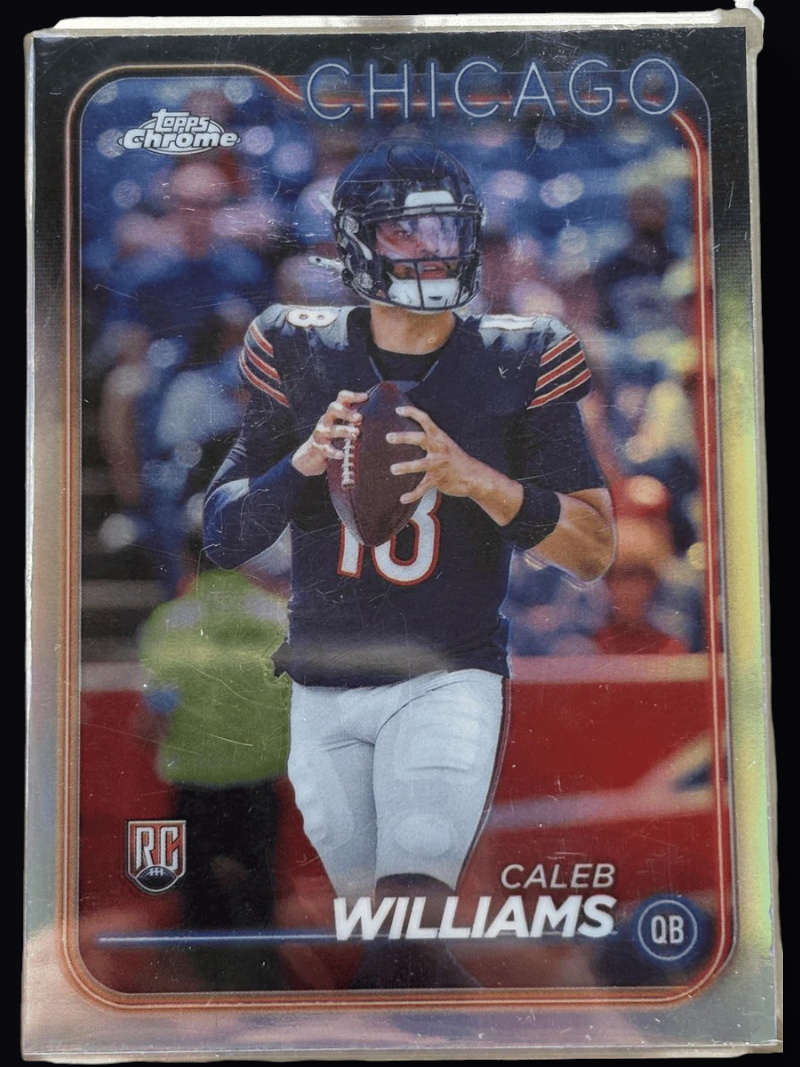
Caleb Williams Just Scored 59 Points. Which of His Cards Move First?
The Bears' historic season opener opens a repricing window. Here is which tier of Williams cards moves fastest, which lags, and what a holder should do before the 48-hour clock runs out.
The Chicago Bears put 59 points on the board in a season opener on Saturday, a number that has never appeared in that context in NFL history. The final score was 59-37 over the Carolina Panthers. Caleb Williams was the quarterback. His rookie cards are sitting in binders and submission queues right now, and the people who own them have a narrow window to decide whether to move into strength or bet that this is the beginning of something sustained.
Which Cards Move First
The cards most exposed to an immediate reprice are his high-print-run base and chrome rookies. These have the sales volume to generate new comps within hours of a performance going viral. Prizm base, Topps Chrome base, and similar high-liquidity issues will show movement on the platforms before most collectors have finished watching highlights. That is the tier where the 48-hour window is real and measurable.
Low-pop autos and numbered parallels behave differently. Sellers in that tier tend to pull listings rather than accept offers into a spike, which compresses visible supply without producing a clean new comp. The result is a quieter, slower move that can actually produce a better exit point two or three days after the initial wave, not during it. If you are holding a numbered parallel or a low-population auto, watching sell-through rate and listing behavior over the next 72 hours tells you more than the first day's noise.
Why This Catalyst Is Both Powerful and Fragile
A 59-point season opener pulls in a category of buyer that does not normally move the hobby market: casual flippers and sports fans reacting to a number they have never seen before. That creates real volume, but it is volume built on a single data point. The hobby has seen this pattern before — a historic team performance inflates a quarterback's cards for a week, and then the market recalibrates when the next game arrives without the same headline.
The Panthers' defense gave up 59 points. Whether Williams's individual statistical line, passing yards, touchdowns, completion percentage, reflects a dominant performance or a favorable matchup against a collapsed defense is a genuine open question, and it is the one serious collectors will be asking before they revise a floor price upward. A blowout win and a dominant quarterback performance are not always the same thing.
There is also the question of how much of this was already priced in. The Bears made meaningful offseason roster moves, and some portion of the pre-game Williams market had already adjusted for the expectation of a stronger offense around him. If that is the case, the spike's ceiling is lower than the raw score suggests.
The historic context of the game is real. Whether it resets Williams's floor among serious collectors who had already priced in 2025's disappointment is the question that determines whether this spike holds.
What a Holder Should Do Right Now
If you are holding high-liquidity Williams cards, the window to sell into strength is the next 48 hours. Not next week. The casual-buyer wave that a historic score generates does not persist past the next major sports news cycle, and Week 2 is one game away from resetting the conversation entirely.
If you are holding low-pop autos or numbered parallels, do not panic-list into the first day's volume. Watch whether sellers are pulling listings. Supply compression in that tier can create a cleaner exit a few days out, after the base-card noise settles and the remaining buyers are the ones who actually want the card.
Do not buy base Williams cards into this spike unless you have a specific price target and a plan to exit before Week 2. The 59-37 score is confirmed and historic. A new floor for Caleb Williams as a collector asset is not. That requires a pattern, and one game is an observation, not a pattern.
The Bigger Picture on Williams's Value
Williams entered this season with serious collectors still processing a 2025 that underwhelmed relative to the hype that surrounded his rookie cards at launch. The durable value question was never whether he could have a big game. It was whether he could produce at a level that justified the premium his cards carried at peak. One historic team performance reopens that conversation without settling it. If the Bears sustain this through the first month, the floor revision among serious collectors becomes real. If Week 2 looks like a regression, the spike will be remembered as a selling opportunity that closed fast.
For the QB hype versus performance dynamic in the broader hobby, the CN episode on that topic is worth revisiting before making a move.
Follow the hobby in the app
Track the products and players you collect and get told the moment anything moves.
Open Collector Nation