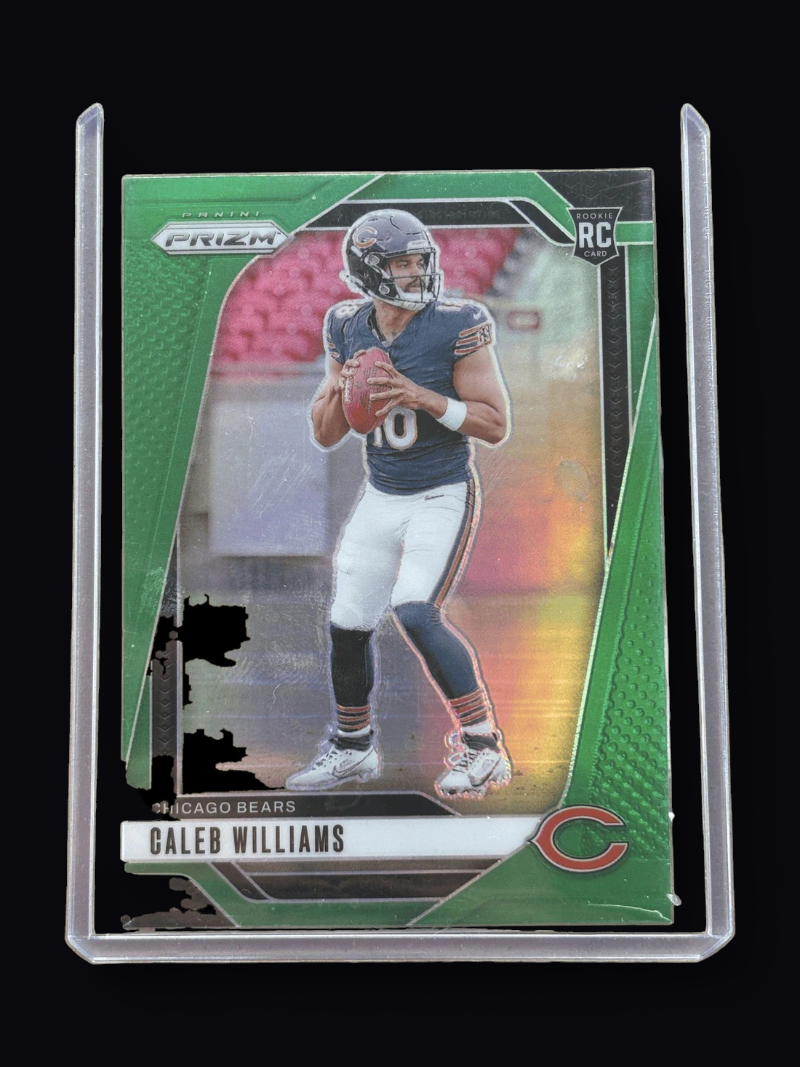
Caleb Williams Is Ruled Out With a Hamstring Injury: What Holders Need to Do Before the Market Finishes Moving
Hamstring injuries reprice cards in two moves. The first already happened. Holders of liquid Williams cards are running out of time before the second one lands.
Caleb Williams is ruled out for Week 2 with a hamstring injury. The Bears' franchise quarterback took the hit, and within hours the card market that spent months pricing in his upside as a generational No. 1 pick had to start recalculating. Not just for this Sunday, but for however long hamstrings decide to be hamstrings.
Why Hamstrings Are the Worst Injury Type for Card Holders
Hamstring injuries have a specific market signature that separates them from, say, a sprained ankle or a bruised rib. They recur. They linger. And the market has a documented pattern of pricing in one missed game and then repricing harder when the designation escalates from ruled-out to IR. The ruled-out tag moves the needle once. The IR tag moves it again, and the second move is bigger.
Nico Collins this same week is the exact template. His hamstring ruled-out designation landed and the market adjusted. Holders who treated that first move as the full repricing found out it was not. Williams holders are now at the same fork: the first move has happened, and the question is whether they act before the second one or after it.
Which Williams Cards Are Most Exposed Right Now
Base Prizm, Optic, and Silver parallel rookie cards are the most immediately exposed. Liquidity is deep on those — sell orders clear fast when the market is moving. That same liquidity is the problem: the repricing happens fast too, and a seller who waits a day or two on a high-volume card is selling into a market that has already moved.
Low-pop autos and superfractors sit in a different position. They will lag the repricing because buyer pools are thinner and transactions are slower. That lag cuts both ways. A holder has more time, but when the IR designation lands and a serious buyer disappears from the market, there may not be another one ready to step in at anything close to pre-injury prices.
Williams' cards are not priced on one season's stats. They are priced on franchise-QB upside. Durability doubt on a year-two quarterback is a different kind of repricing than a one-game absence.
The Deeper Repricing Risk: Durability Doubt
Williams is a rare case where the card market and the football market are almost perfectly correlated. His Prizm and Optic rookies are not trading on 2026 box scores. They are trading on the idea that he is the Bears' franchise quarterback for the next decade. That premise has not been challenged before now.
A hamstring that recurs or costs him three or four weeks does not just erase a game. It introduces a question the market had not been asked to answer: is Williams durable? That question, once in the market, does not fully leave when he returns. It becomes a discount that sits in every future sale until he plays a full season without it.
What Holders Should Do
Holders of base Prizm, Optic, and Silver parallels have the narrowest window. Those cards sell fast when momentum is there and slow when it is gone. If you are holding and you believe the hamstring becomes a multi-week situation, the time to list is before the IR designation, not after. Waiting for confirmation is waiting for the second and larger repricing to land on you as a seller.
Holders of low-pop autos and one-of-one superfractors have more runway but face a real risk: thin buyer pools mean one serious buyer exiting the market can stall a sale entirely. The play there is not to panic-list at a discount, but to have a realistic number in mind and be ready to move at it if a buyer surfaces before the injury picture clarifies.
The one thing to watch above everything else is whether Williams receives an IR designation. That is the signal. If it comes, the market moves again, harder, and sellers who are still holding at that point are on the wrong side of the trade.
Follow the hobby in the app
Track the products and players you collect and get told the moment anything moves.
Get the Collector Nation App