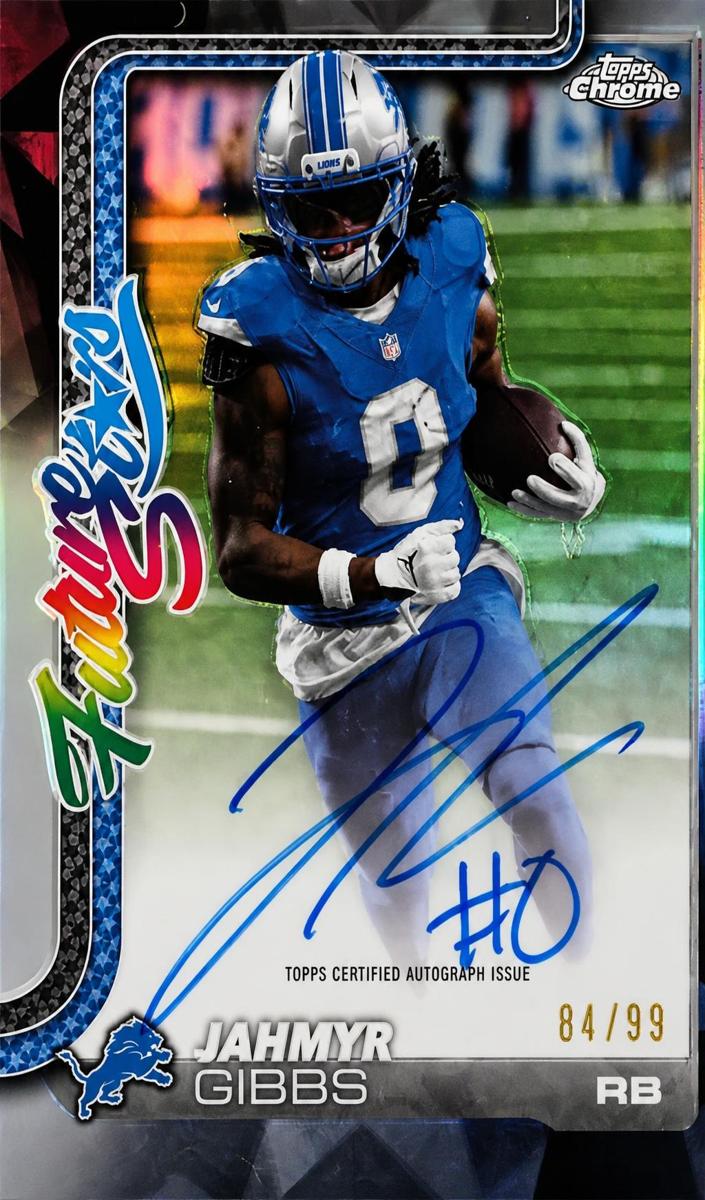
Gibbs's 156-Yard Game Opens a Repricing Window. Which Cards Close First?
Twenty-nine carries, two touchdowns, and a Saints defense that made it all look easier than it was. The window to act on Gibbs's card market is measured in hours, and it is not closing at the same speed across every card.
Twenty-nine carries, 156 yards, two touchdowns, a long of 21, and five catches for another 30. By the time the final whistle cleared Ford Field on September 13, Jahmyr Gibbs had produced the kind of box score that triggers a specific, predictable sequence in the card market: Buy It Now prices climb 15 to 20 percent above last week's comps before a single new sale clears, and sellers who were sitting on the fence at noon are listing by midnight.
That sequence is real. It is also not uniform, and the difference between selling well and selling late is understanding which part of the Gibbs card spectrum moves first.
The Cards That Move First
When a performance like this drops, the buyers chasing the highlight are not browsing. They are searching the same three or four cards: the low-population graded rookie cards, the numbered parallels with print runs in the single or double digits, the short-printed inserts that already had thin supply before Sunday. Those are the listings that get found first, and they are the ones where BIN prices get accepted fastest because the buyer does not want to lose the auction.
For a holder sitting on a graded Gibbs RC with a low census count, or a numbered parallel in the /25 or /10 range, the repricing window is already open and it closes faster than most people expect. Liquidity on those cards peaks before the next meaningful news cycle, which in an NFL week is roughly 48 hours out. If you are going to sell into this spike, the time is now rather than Wednesday.
The dynamic flips for base rookie cards and high-print parallels. Those cards will see a bump, but they lag the graded market by a full news cycle because the buyers who drive base volume are less reactive and the supply is deep enough that urgency does not build the same way. The ceiling for base Gibbs RCs will be set by whatever the graded market does first. Once the graded spike stalls, it functions as a ceiling for everything below it, and the base bump typically arrives softer and shorter.
The ceiling for base Gibbs RCs will be set by whatever the graded market does first. Once the graded spike stalls, it functions as a ceiling for everything below it.
The Number Nobody Is Discounting
Here is the part of the box score that will not appear in the listings. Tyler Shough had a career-high turnover game for New Orleans. Every turnover is a short field or an extra possession for Detroit, which means Gibbs was running against a defense that spent the afternoon in reactive mode, defending from behind, with its front seven unable to load up against the run the way a team protecting a lead can. The 156 yards and the 29 carries are real. The conditions that produced them are opponent-specific in ways that a tougher matchup would not replicate.
The card market will not make that distinction for at least 48 hours, and probably longer. Performance repricing is almost entirely mechanical: big number goes in, card prices go up. The nuance of how the number was generated is a variable that even sophisticated hobby buyers rarely apply in real time. That gap is where the asymmetry lives for a holder deciding whether to sell into the spike or hold through it.
Selling into this spike means selling a line that had a significant assist from the opposing offense. Holding through it means betting that Gibbs repeats or exceeds this output against a defense that does not hand Detroit four extra possessions. Both are defensible reads, but they are different bets, and the market is currently pricing only the first one.
What Buyers Chasing the Line Are Actually Paying For
If you are not already holding Gibbs and you are thinking about buying into the spike, the Saints context is the reason to wait. Entering a new position at post-game BIN prices means paying for a ceiling that was partly built by an opponent having one of its worst days. A one-game correction, or even just a quiet next performance, typically gives a better entry point within the week. The graded market will set its new comp floor based on whatever sales clear in the next 24 to 48 hours; if those sales are driven by emotional buyers rather than value buyers, the floor they set is unstable.
The more durable question for Gibbs's card value is whether Detroit's coaching staff sustains this usage rate against a stronger front seven, and whether his role in the passing game grows alongside the rushing volume. A 29-carry game with five receptions is a workload that suggests genuine feature-back status. That is a real and positive signal for his long-term card trajectory. It is just not the same thing as this specific line being a reliable ceiling, and right now the market is treating it as though it is.
The Practical Read for Holders
If you hold graded Gibbs rookie cards with low census numbers, or numbered parallels in the short-print range, the window to sell into peak liquidity is open right now and it is not wide. List before the graded market's momentum stalls, because that stall sets the ceiling for every other Gibbs card in your collection. If you hold raw base RCs or high-print parallels, you have slightly more time, but the bump will arrive softer. Decide your exit price before the graded market peaks, not after, because the graded ceiling will compress your room.
The one variable that overrides all of this is Gibbs's health. An injury designation before the next game would immediately flip every upside calculation in the opposite direction, and it would do so faster than a performance spike ever could. Watch the injury report with the same attention you are giving the sales data.
Follow the hobby in the app
Track the products and players you collect and get told the moment anything moves.
Open Collector Nation