The Hobby Has Outgrown Its Name
The National revealed a collecting world that now functions as marketplace, media event, entertainment platform, social network, business school, and cultural gathering, all while we continue calling it “the hobby.”
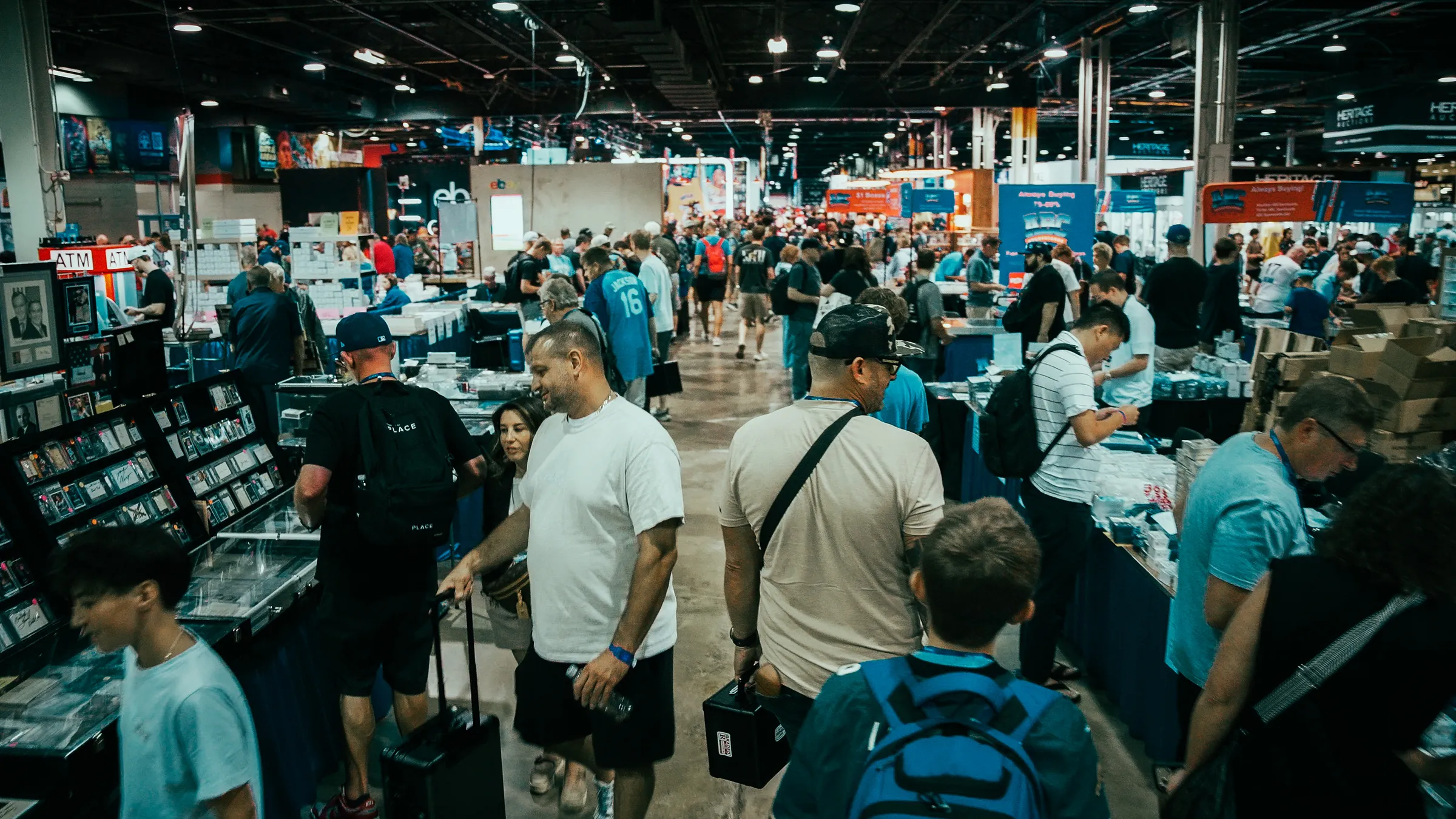
Somewhere around aisle 300, a kid who looked about fourteen was working a deal out of a case worth more than most of the cars in the parking garage. He was polite, unhurried, and completely fluent. He knew his comps, he knew what he would take, and he knew exactly how long to let the silence sit before he answered. Two aisles over, a man who had been setting up at this show since before that kid was born was writing prices on a card in pencil, the way he always has, waiting for someone to pick something up.
Both of them were at The National. Neither of them was doing the same thing.
That is the part I could not stop turning over on the flight back to Greenville. Not the seven-figure showcase, not the lines, not the size of the floor. It was that I walked past a dozen versions of this hobby in a single afternoon and several of them barely acknowledged the existence of the others. Somewhere in the last five years, without any announcement, the thing we all still call “the hobby” stopped being one thing, and almost nobody stopped to rename it.
The change did not come from manufacturers finding a new parallel, or grading companies adding a service level, or one card resetting the market. It came from the people. A vintage collector studying centering on a prewar card, a teenager chasing a Pokémon hit, a livestream audience watching a break at two in the morning, a dealer moving six figures before lunch, a family waiting ninety minutes for an autograph—every one of them was participating in The National. Almost none of them were participating in the same version of collecting.
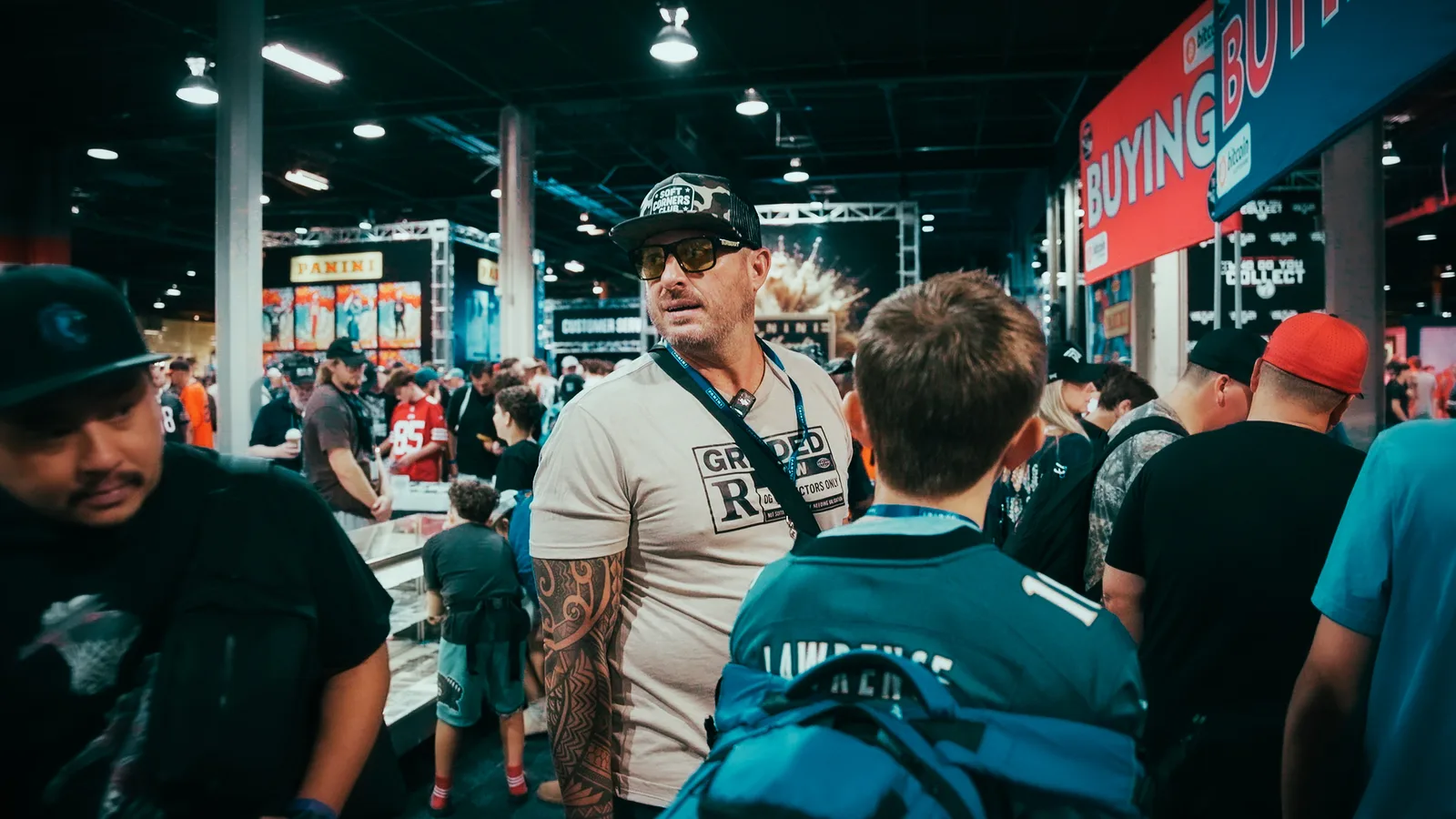
You could feel it change under your feet depending on where you stood. One aisle was the card show a lot of us grew up in: quiet negotiation, handwritten prices, people studying one card at a time. A few hundred feet away the lights were brighter, the music was louder, cameras were running, and every interaction was one good reaction away from becoming content. Neither of those rooms was fake. Neither of them was the whole story. And the honest question the weekend kept asking, the one nobody at the show says out loud because it sounds ungrateful, is whether a word like “hobby” can still hold all of it.
The National did not prove the hobby is growing. It proved the hobby has become too big to be only one hobby.
The Old Collector-versus-Investor Debate Is Over
For years, hobby conversations were organized around a simple argument: collector versus investor. One side supposedly bought for love, history, and personal connection; the other bought for profit. That distinction was always too neat, but today it is almost useless. Most people move between motivations. A collector can love a card and still care what it is worth. An investor can begin with a thesis and develop a genuine emotional connection. A breaker can be buying entertainment in one moment and building a serious collection in the next.
A better way to understand the modern hobby is to think in terms of experience. There are traditionalists who value history, condition, provenance, and the ritual of the deal. There are asset-minded collectors looking for culturally durable cards with liquidity and long-term demand. There is an entertainment audience that values suspense, community, spectacle, and the possibility of a hit. And there is a growing creator economy that shapes discovery, interpretation, and demand by turning the hobby into an always-on media product.
These groups often frustrate one another because they use the same language while assigning different meanings to it. “Value” might mean historical importance, resale potential, expected return, visual appeal, personal relevance, or simply the amount of entertainment delivered for the price. The modern hobby is not confused because collectors have lost their way. It is complicated because many different people have found their own way into it.
Entertainment Is Not the Enemy: OG Dealers Shouldn’t Smack the Hand Feeding Them
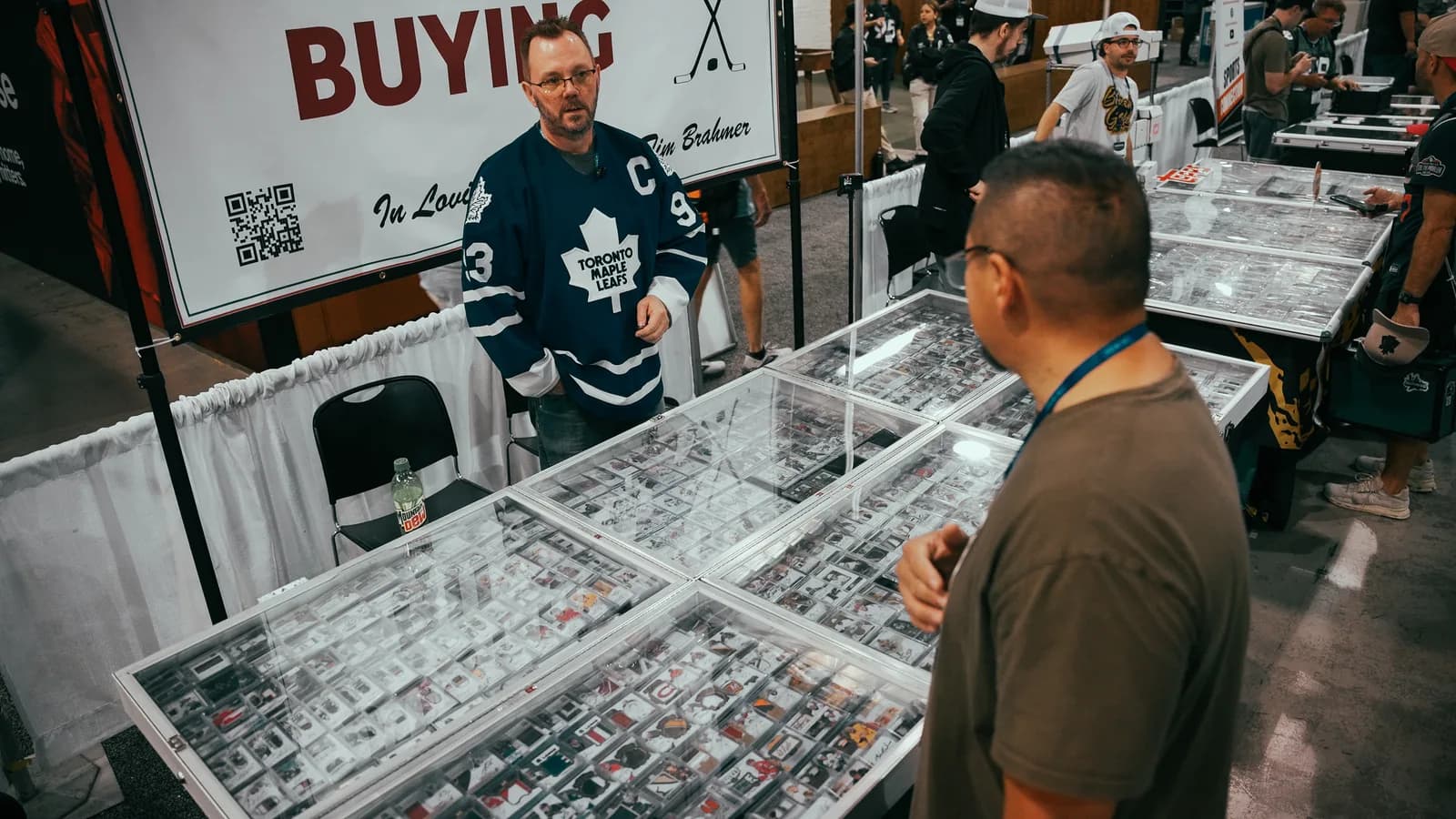
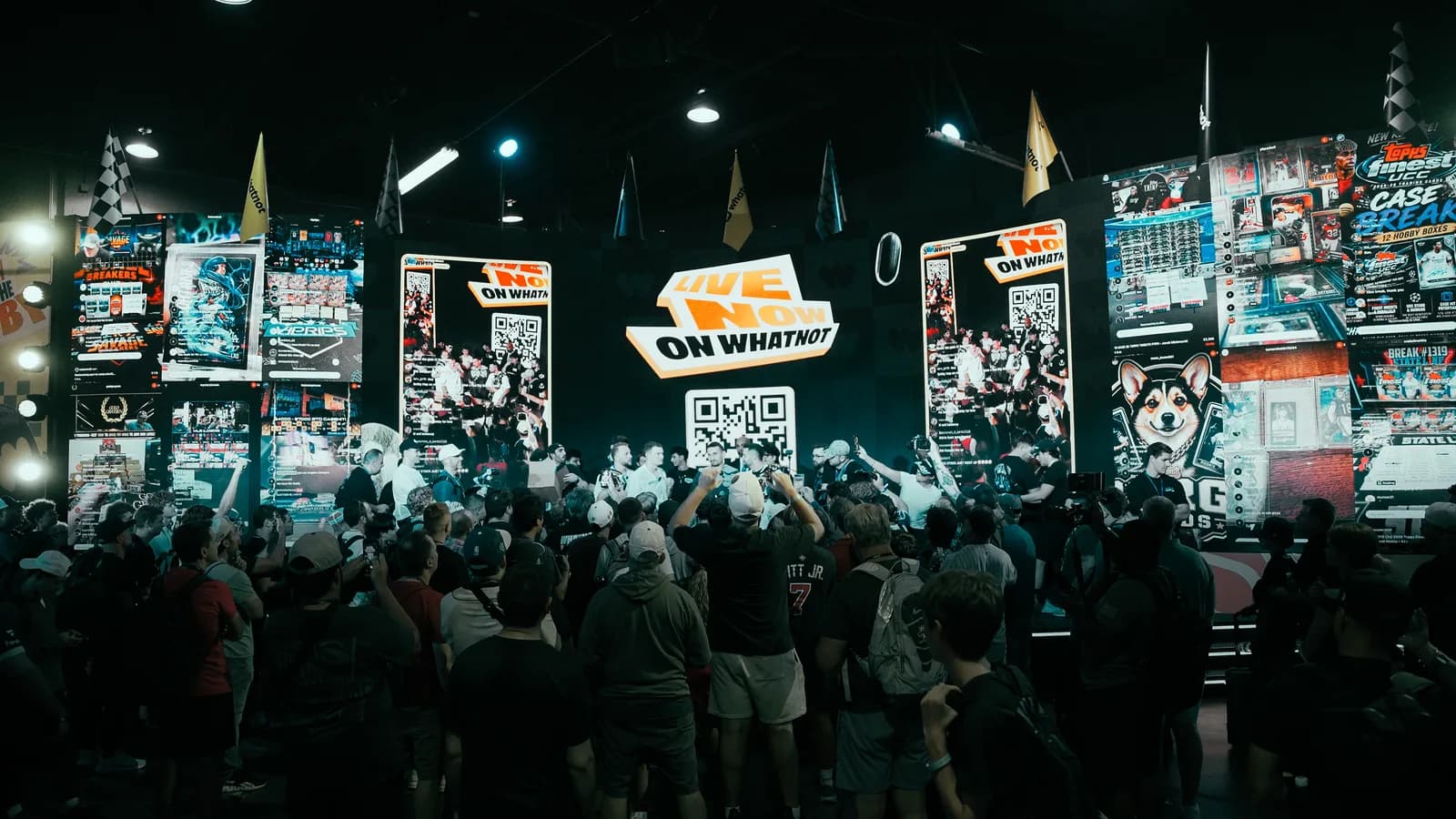
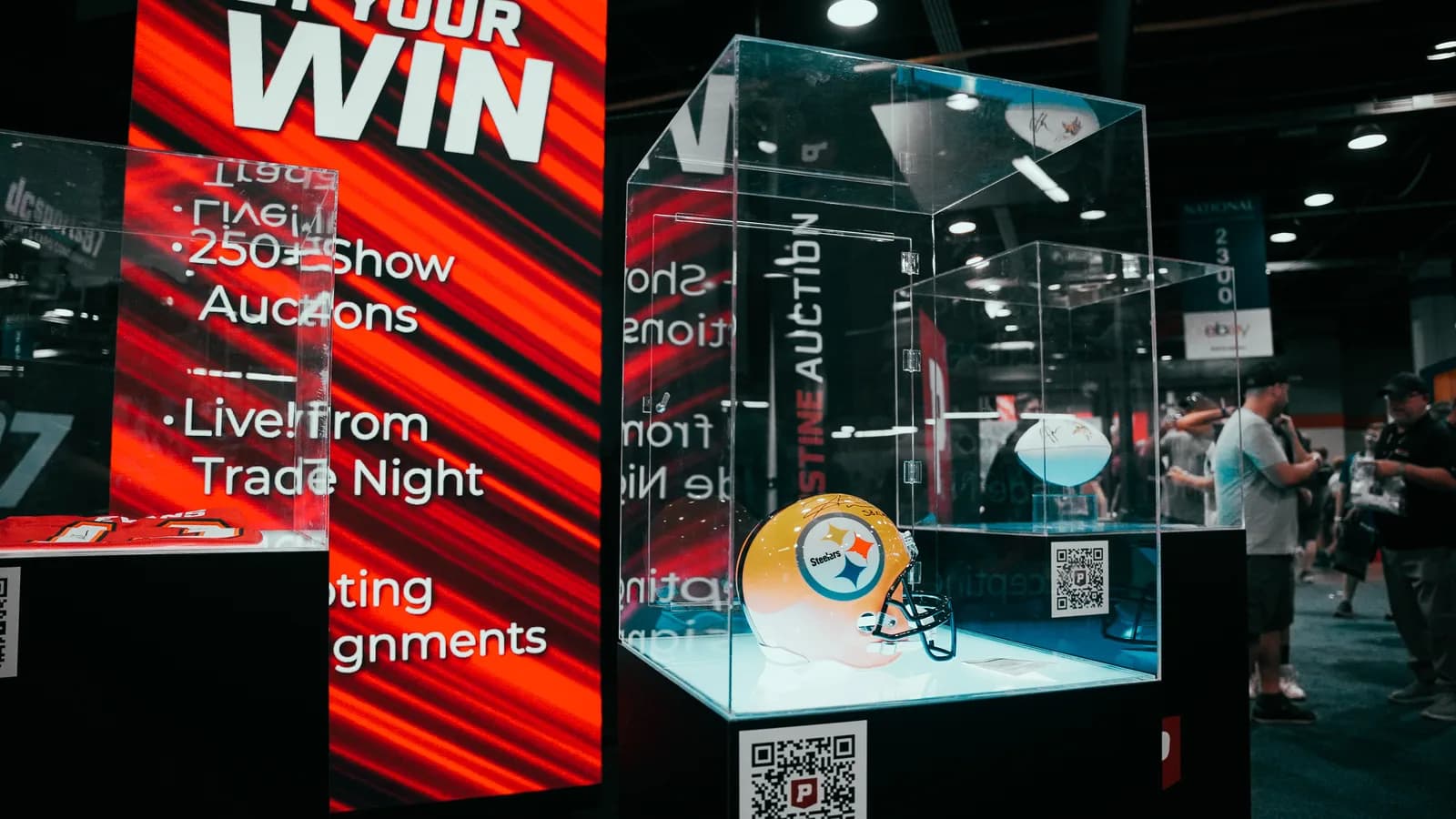
The sharpest tension at The National was not really between collectors and investors. It was between the traditionalist economy and the entertainment economy. You could see the divide physically. One part of the floor felt measured, archival, and almost museum-like. Another felt like Las Vegas had been rebuilt inside a card show: bright signage, wheels, games, stages, live cameras, constant movement, and odds attached to nearly every interaction.
Many longtime dealers are uncomfortable with that shift. They dislike repacks, breaking economics, manufactured urgency, and the fact that larger live sellers can receive allocations an independent shop could never touch. Some of those complaints are legitimate. Any ecosystem built around variable rewards needs transparency, responsible mechanics, and a clearer distinction between entertainment and value. When the experience depends on participants misunderstanding the odds, the hobby is not creating collectors; it is extracting from customers.
But the criticism can also become selective. Dealers may dislike the noise while benefiting from the audience the noise helped create. They may resent higher acquisition costs while celebrating the fact that their sales are multiples of what they were five or ten years ago. They may want the hobby to retain its intimacy while also wanting larger crowds, stronger prices, more liquidity, and more buyers. We cannot have every benefit of growth without accepting that growth changes the culture that produced it.
The entertainment economy did not replace traditional collecting. It expanded the top of the funnel. It gave people more ways to enter, more reasons to watch, and more moments that feel participatory rather than transactional. The task now is not to wish it away. The task is to make sure the experience has somewhere healthy to lead. The best entertainment creates curiosity, then knowledge, then collecting conviction. The worst entertainment ends when the dopamine does.
The real question is not whether entertainment belongs in the hobby. It is whether entertainment creates future collectors, or merely produces repeat customers for the next rush.
Trade Night Is a Marketplace and a Stage
If the show floor reveals what the hobby owns, trade night reveals what the hobby wants to believe about itself. The events have become one of the most anticipated parts of National week, and the appeal is easy to understand. Thousands of collectors gather in one place with cards in hand, deals happening in every direction, and the constant possibility that the next case contains something extraordinary. It is loud, social, competitive, and far more participatory than walking past rows of showcases. For many younger collectors, trade night may now be the emotional center of the entire trip.
But trade night should not be mistaken for a representative sample of the broader hobby. It is a highly concentrated environment shaped by affluent families, serious dealers, sponsored creators, established collectors, and a visible minority of young participants carrying inventories that would be exceptional in almost any local card shop. Seeing case after case valued at tens or even hundreds of thousands of dollars can create the impression that this is how an ordinary generation of young collectors participates. It is not. Trade night (at The National) is its own world: a temporary economy assembled from the most active, best-funded, and most performative corners of the market.
The economics are equally complicated. A card bought at 80 or 90 percent of the most recent comparable sale may feel like a win, especially when it changes hands again an hour later. Yet many participants are not measuring shipping, grading risk, platform fees, taxes, travel, the cost of capital, or the possibility that the quoted comp cannot actually be realized. When the same card is flipped at the same price, or even slightly less, the activity can look like entrepreneurship without producing meaningful profit. The collector has generated motion, social proof, and perhaps a better story, but not necessarily income.
That does not make the experience fake or pointless. The mistake is assuming profit is the only product. Trade night allows participants to rehearse the identity of a dealer: negotiating, evaluating, presenting inventory, building relationships, and feeling the immediate validation of completing a transaction. A small percentage are disciplined operators who consistently find edges and produce real side income. Many others are paying a modest economic tuition to learn the market, while some are simply purchasing entertainment through the language of business. The danger begins when paper gains, inflated case values, and constant deal volume are confused with sustainable earnings.
Trade night may look like a market, but much of what it sells is the feeling of being in business.
The healthiest interpretation is neither cynical nor naive. Trade night matters because it converts collecting from a private possession into a public, social act. It teaches confidence, exposes participants to new cards, and creates relationships that can outlast any individual transaction. It may even produce the next generation of legitimate shop owners, dealers, and entrepreneurs. But collectors, especially younger ones, should understand the difference between revenue, profit, portfolio value, and liquidity. A busy night can be memorable and worthwhile without being financially productive. In many cases, the point of the game may not be to win money at all. It may be to belong, to perform competence, and to feel like an active player in the hobby’s economy.
Michael Jordan Has Become the Hobby’s Language of Certainty
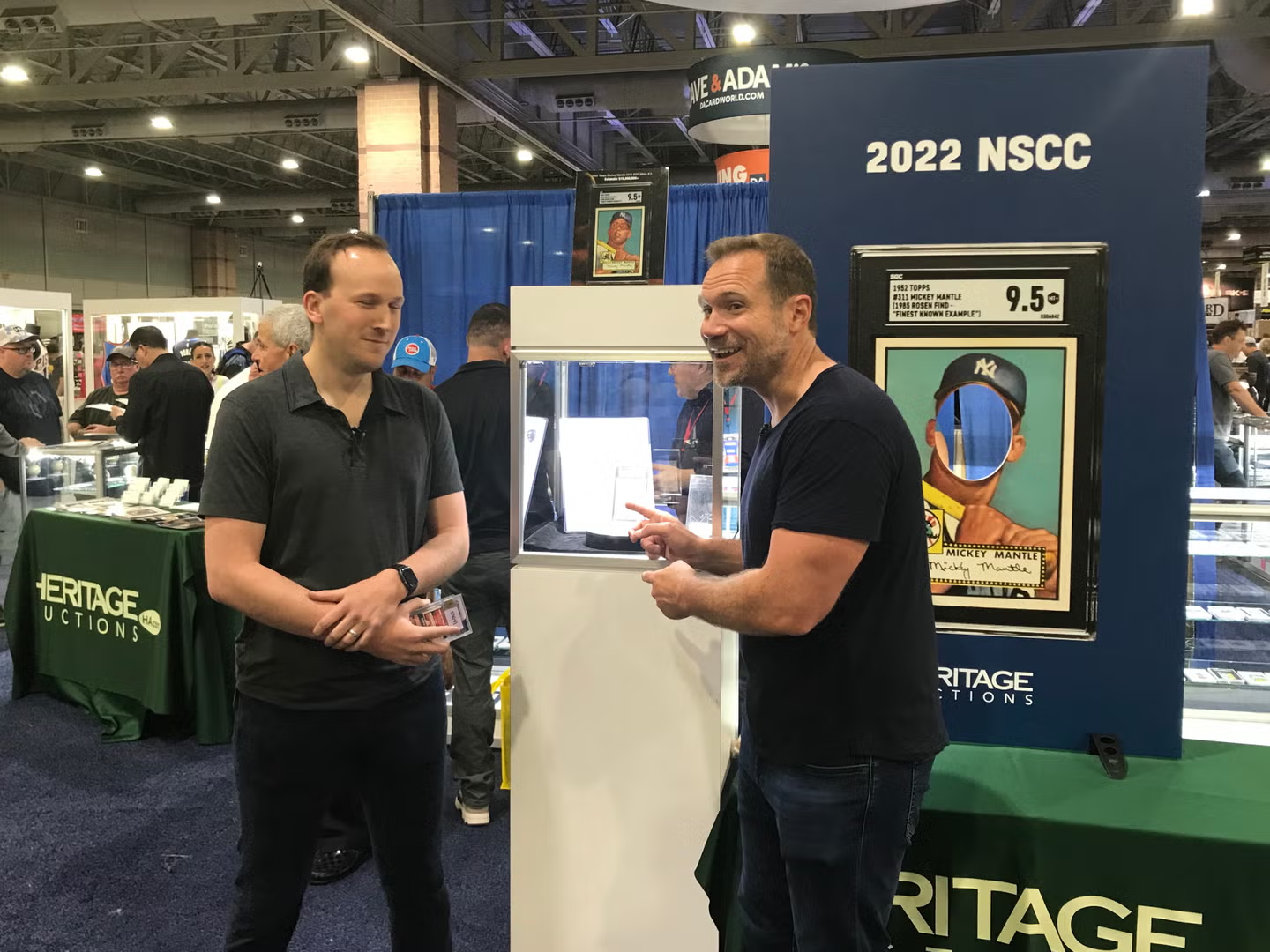
If one athlete seemed to define the show, it was Michael Jordan. His presence stretched from inexpensive cards in bargain boxes to museum-level pieces carrying seven-figure asking prices. That range matters. Jordan is not confined to a single price tier, product, generation, or type of collector. He can be someone’s first recognizable card and someone else’s ultimate grail.
It would be easy to call that nostalgia, but nostalgia alone does not explain it. Mature collectible markets eventually organize around cultural anchors: assets whose importance does not need to be reintroduced every time the market changes. Jordan has become that anchor for sports cards in much the same way Charizard functions inside Pokémon. Neither character is valuable only because of scarcity. In fact, many of their most popular cards are widely available. Their power comes from universal recognition and durable relevance.
That changes the way population reports should be interpreted. Scarcity still matters, especially at the top of the market, but high population does not automatically destroy demand when the subject has a global and multigenerational audience. A card can be common relative to a rare insert and still be scarce relative to the number of people who eventually want to own one. Jordan’s market is increasingly a demand story rather than a simple supply story.
Collectors paying up for early Jordan cards, iconic designs, strong eye appeal, and historically meaningful issues are not merely chasing what is hot. They are buying an asset whose place in the hobby feels settled. In periods of uncertainty, that certainty commands a premium. The overlooked lesson is that the strongest cards of the next decade may not be the ones with the smallest serial number. They may be the ones that require the least explanation.
Collectors are not paying more for Jordan because they will never see another Jordan card. They are paying more because they will never have to explain why Jordan matters.
The Most Important Deals May Have Been the Cards Collectors Sold
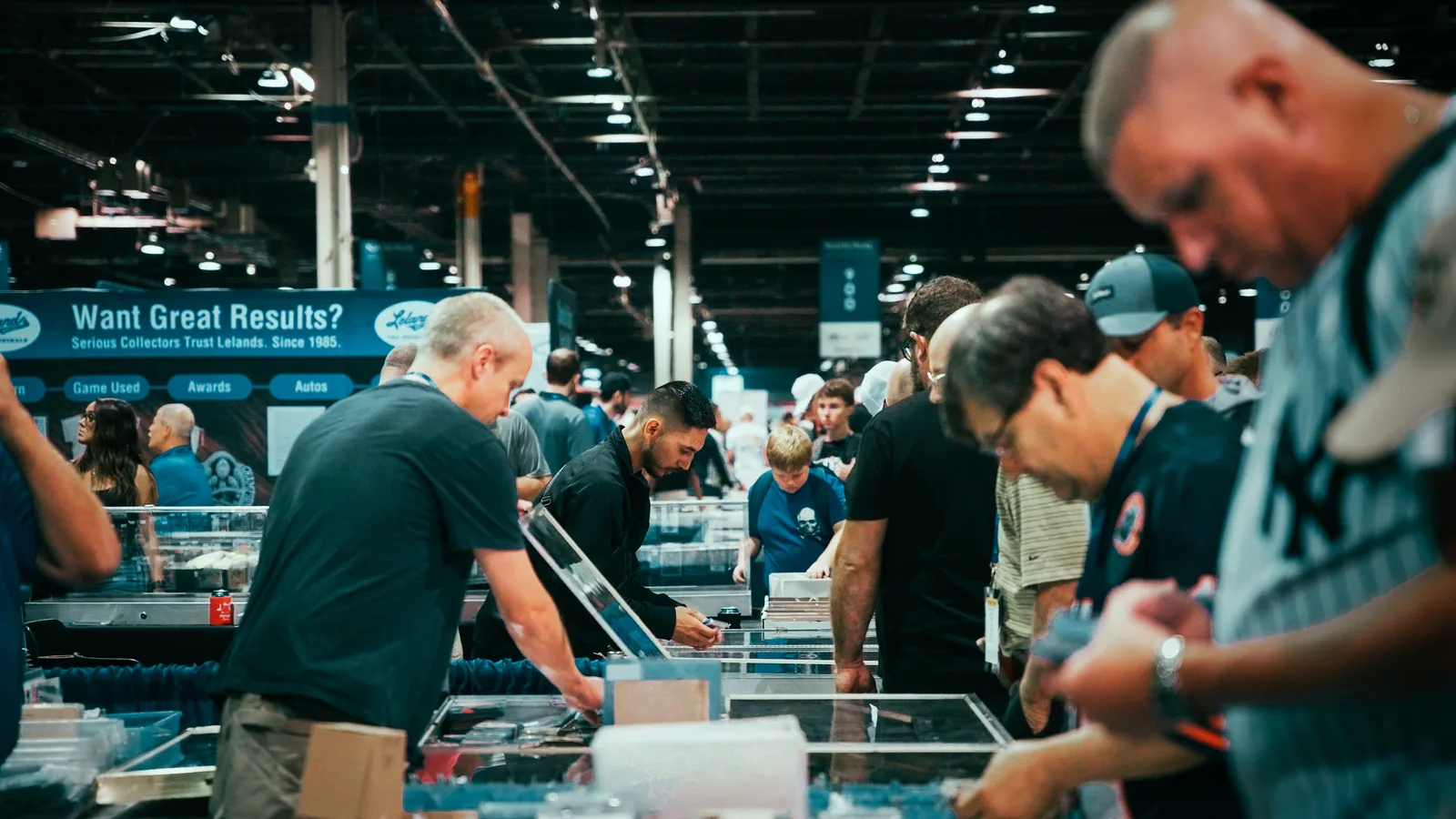
One of the least visible but most meaningful themes of the week was the number of experienced collectors selling significant cards. In past years, conversations with established vintage collectors often centered on what they hoped to add. This year, many were discussing what they had moved, what they planned to move, and how they intended to redeploy the money.
That should not automatically be read as weakness. Many were not leaving the hobby; they were concentrating their conviction. A collector who once wanted a representative run of postwar stars may now prefer fewer, rarer prewar cards. Someone who accumulated dozens of modern parallels may decide to own one defining example. Others are using gains from Ohtani, vintage baseball, or another successful segment to fund a collection that better reflects who they have become.
This is what maturation looks like in a collectible market. Early participation is often additive: more cards, more boxes, more categories, more experiments. Over time, serious collectors become editors. They learn which objects continue to matter after the excitement fades. They stop asking whether a card is good and start asking whether it belongs. The collection becomes smaller in scope but stronger in identity.
That shift has implications for the middle of the market. Cards that are recognizable but abundant, historically relevant but not essential, may face more competition for collector dollars. When experienced owners consolidate, the market can become more polarized: truly iconic and truly scarce material attracts deeper demand, while “pretty good” cards must work harder to justify a permanent place. The future may reward significance more than simple age and selectivity more than accumulation.
The hobby is moving from accumulation to curation. The next status symbol may not be how much you own, but how clearly your collection says something about you.
Eye Appeal Is Quietly Reasserting Itself
The concentration trend also helps explain why collectors are paying closer attention to the card inside the holder. A technically lower grade with exceptional centering, strong color, and clean presentation can be more satisfying than a higher-grade example that looks ordinary. Vintage collectors have understood this for years, but the idea is expanding into modern and late-20th-century material as prices place the highest grades beyond the reach, or beyond the common sense, of many buyers.
This is not a rejection of grading. Authentication, condition assessment, and liquidity remain foundational to the modern market. It is a rejection of the idea that the number on the label should do all the thinking for us. As collectors become more selective, visual quality and personal judgment regain importance. The slab provides information; it should not replace taste.
For collectors, that creates opportunity. The market’s obsession with grade can produce meaningful discounts on cards that present beautifully one point lower. It can also produce risk when a buyer pays a record premium for a label without considering whether the card itself is exceptional. The most durable collections will likely combine third-party confidence with first-person discernment.
The National Is Now the Hobby’s Annual Operating System Update
Calling The National a card show no longer captures what it does. It is increasingly the hobby’s annual operating system update: the moment when companies launch products, platforms demonstrate new features, manufacturers test experiences, creators collaborate, dealers reset expectations, and collectors recalibrate what they own. The transactions matter, but the information transmitted through thousands of conversations may matter more.
Technology has CES. Apple has WWDC. Entertainment has festivals and upfronts. The collectibles business has The National. It is where the industry sees itself at full scale and decides what it wants to become next. A booth is no longer simply a place to sell. It is a statement about brand relevance. A creator appearance is not just a meet-and-greet. It is audience validation. A crowded activation tells competitors where attention is moving before quarterly reports ever could.
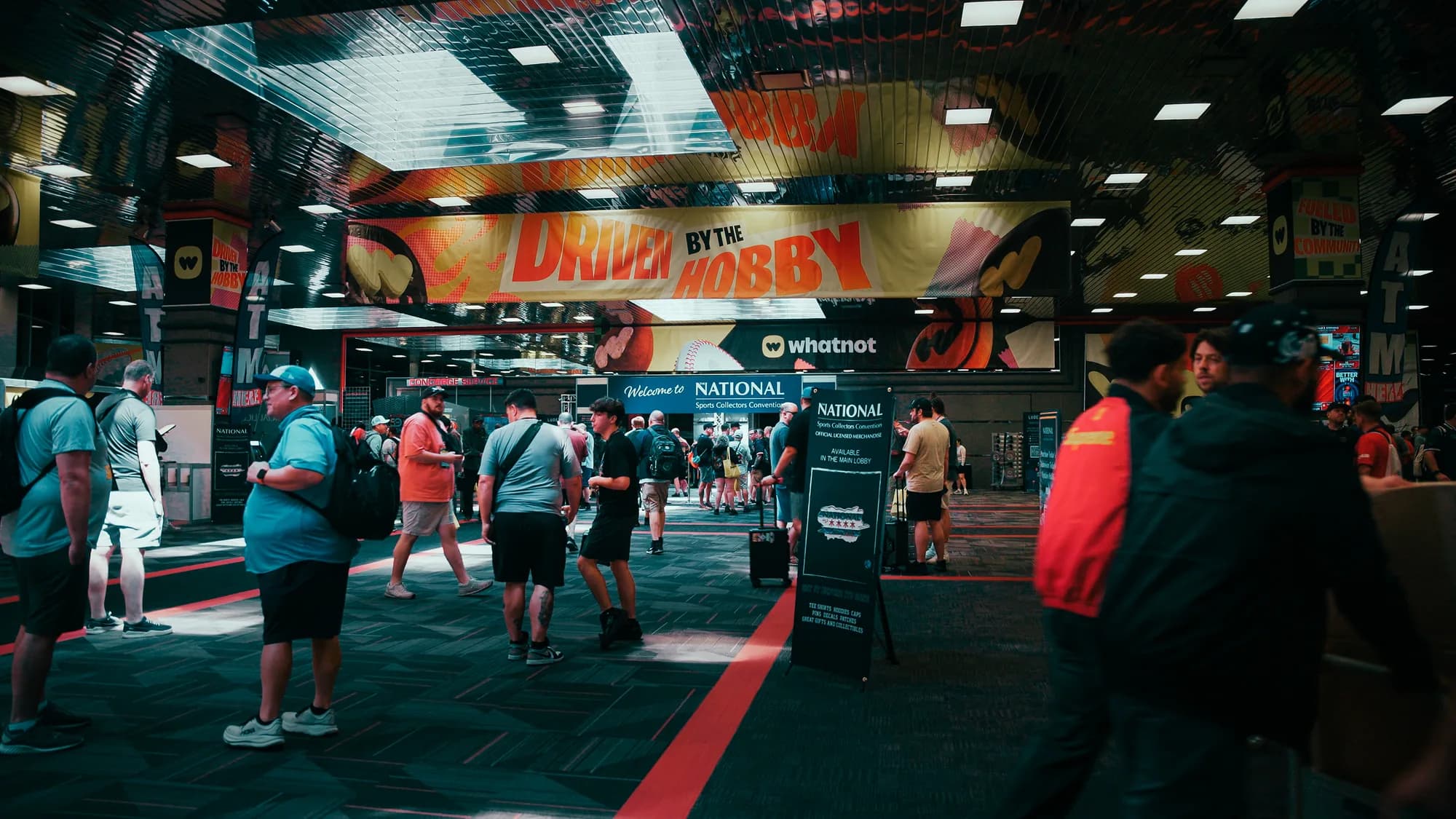
That also explains why the show matters even to people who do not make a major purchase. The National creates a compressed view of the market that cannot be replicated by watching auctions from home. You can observe which showcases attract prolonged attention, which experiences pull families in, which categories feel over-supplied, which creators produce real-world lines, and where enthusiasm survives after the camera is turned off. It is less a marketplace snapshot than a live diagnostic of hobby behavior.
The National has become the hobby’s annual operating system update: part marketplace, part media event, part product launch, and part cultural census.
Content Is No Longer Covering the Hobby. It Is Building It.
The scale of content production was impossible to miss. Large creators drew visible crowds, but the more revealing signal may have been the number of professional crews and independent channels that were unfamiliar even to regular hobby viewers. Boom microphones, multi-camera setups, podcasts, livestreams, short-form video teams, and documentary-style production were woven into the floor rather than positioned outside it.
That matters because media does more than document demand. It helps create the context through which demand forms. A collector may discover a card through a video, learn its history through a podcast, verify the market through data, and then see it reinforced across social platforms before ever encountering one in person. The path from awareness to acquisition is increasingly mediated by content.
The danger is that an expanding content economy can reward repetition more easily than insight. The hobby does not lack recaps, box openings, transaction videos, or clips of large cards changing hands. It lacks enough interpretation. Collectors can see what happened almost instantly. What they need is help understanding whether it matters, who benefits, what behavior it may change, and which apparent trends are merely the result of concentrated attention.
That is the opportunity for the next generation of hobby media. The goal should not be to become the loudest amplifier of activity. It should be to become the clearest interpreter of meaning. Reporting tells collectors what moved. Editorial judgment helps them decide whether they should move with it.
The hobby does not have an information shortage. It has an understanding shortage.
The Next Generation Does Not Recognize the Old Boundaries
Older collectors tend to organize the world into categories: sports cards, Pokémon, Magic, memorabilia, comics, gaming, autographs, and entertainment collectibles. Younger participants move between those categories with far less friction. To them, collecting is often one connected culture expressed through different intellectual properties and experiences.
That fluidity was visible in the families moving from vintage showcases to trading card game activations, from autograph lines to live stages, and from sports products to non-sports cards without treating those transitions as unusual. The growing presence of new TCGs and the expanded footprint of experiential concepts such as the Bo Jackson Battle Arena suggest that competition will increasingly be for attention, not merely for shelf space.
This creates both opportunity and pressure. A strong brand can recruit collectors from adjacent categories faster than ever, but loyalty may be more portable. The next generation will not support a product forever simply because it occupies a traditional category. It must offer compelling characters, community, play, story, collectibility, or status. Products that rely only on artificial scarcity will struggle when the audience can redirect its attention instantly.
The same is true demographically. More women were not merely accompanying collectors; they were negotiating, buying, selling, and managing inventory. More families were treating the show as a destination rather than an obligation. Growth becomes durable when new participants develop agency inside the market. Attendance is encouraging. Ownership, knowledge, and repeated participation are what change the hobby’s future.
What Collectors Should Do Now
The easiest response to a show this large is to chase whatever appeared most visible. That is usually the wrong lesson. The National amplifies everything: real demand, temporary excitement, marketing budgets, creator influence, and social proof. Collectors should use the event as a source of signals, not instructions.
First, decide which hobby economy you are actually participating in. There is nothing wrong with buying entertainment, but entertainment spending should not be confused with collection building or investment. There is nothing wrong with buying for appreciation, but expected returns should not be disguised as certainty. Clear intent makes it easier to judge whether an experience delivered what you paid for. At trade nights in particular, track actual cash in and cash out rather than relying on the changing sticker value of the case. A transaction is not profitable simply because another collector agreed with the comp.
Second, review the collection as an editor rather than an accumulator. Identify the cards you would buy again at today’s price, the ones that still feel meaningful without a market narrative, and the pieces that exist only because they were once convenient to acquire. Selling is not a betrayal of collecting. Sometimes it is how a collection becomes more honest.
Third, prioritize cultural durability, visual quality, and personal conviction over manufactured urgency. A low serial number is not a substitute for significance. A high grade is not a substitute for eye appeal. A crowded booth is not proof of long-term demand. The best purchases are often the ones that remain understandable after the show lights, content cycle, and promotional energy disappear.
Finally, remain open to new ways of participating without surrendering judgment. The hobby needs energy, experimentation, technology, and entertainment. It also needs standards, memory, and informed collectors capable of distinguishing innovation from extraction. The healthiest future will not come from one side defeating the other. It will come from building bridges between discovery and education, excitement and stewardship, liquidity and lasting meaning.
The National Did Not Change. We Did.
So: is this even a hobby anymore? The honest answer is that it is a hobby, and it is also five other things, and the friction almost everyone is feeling comes from expecting one word to carry all six. It is a marketplace with real money and real consequences. It is a media business that manufactures the attention the marketplace runs on. It is an informal business school where teenagers learn negotiation faster than most adults ever will. It is an entertainment product sold by the minute. It is a social network with a physical address four days a year. And underneath all of that it is still a hobby—people who love objects, keeping them.
None of those is the imposter. That is the part worth sitting with. The instinct when the room gets loud is to decide which version is the real one and defend it, and that instinct is why so many arguments in this hobby go nowhere: two people using the same word for different activities, each convinced the other has lost the plot. Nobody lost the plot. The plot got bigger than the word.
Walking out of the show, I was not thinking about the largest asking price or the longest line. I kept thinking about the range of people who now see themselves somewhere inside this world: the father teaching his son to negotiate, the experienced collector selling excellent cards to pursue one extraordinary card, the dealer learning to livestream without abandoning the fundamentals, the creator speaking to an audience that did not exist a decade ago, and the newcomer looking around in disbelief that a card show could possibly become this large.
The National did not reveal a hobby chasing another temporary boom. It revealed a culture broad enough to support historians, investors, gamers, entertainers, entrepreneurs, families, creators, and traditional collectors at the same time. That breadth is its greatest strength and its most difficult challenge. The hobby can no longer be governed by the preferences of one group, because no single group can credibly claim to represent the whole thing.
The future will not belong exclusively to breakers or vintage dealers, sports cards or Pokémon, investors or purists. It will belong to the companies, communities, and media platforms that understand how these audiences differ, and how to move people from attention toward knowledge, from participation toward belonging, and from a transaction toward a collecting identity.
That is the deeper meaning of The National 2026. The hobby is alive and well, but “alive” now means something more complicated than higher prices and crowded aisles. It means constant reinvention. It means multiple cultures learning to share one marketplace. It means accepting that the noise, opportunity, risk, and energy are now inseparable.
The cards still matter. They always will. But the next decade will not be won simply by whoever sells the most cardboard. It will be shaped by whoever helps collectors understand what the cardboard means, and what their participation in this expanding world says about who they are.
The next decade will not be won by whoever sells the most cards. It will be shaped by whoever helps collectors make sense of a hobby that has become far bigger than cardboard.
Follow the hobby in the app
Track the products and players you collect and get told the moment anything moves.
Get the Collector Nation App