Jun 8, 2026
PSA’s Pokemon Problem & How To Fix It; Huge eBay News And Raw To Grade Opportunities!
CALL IN TO THIS MOMENT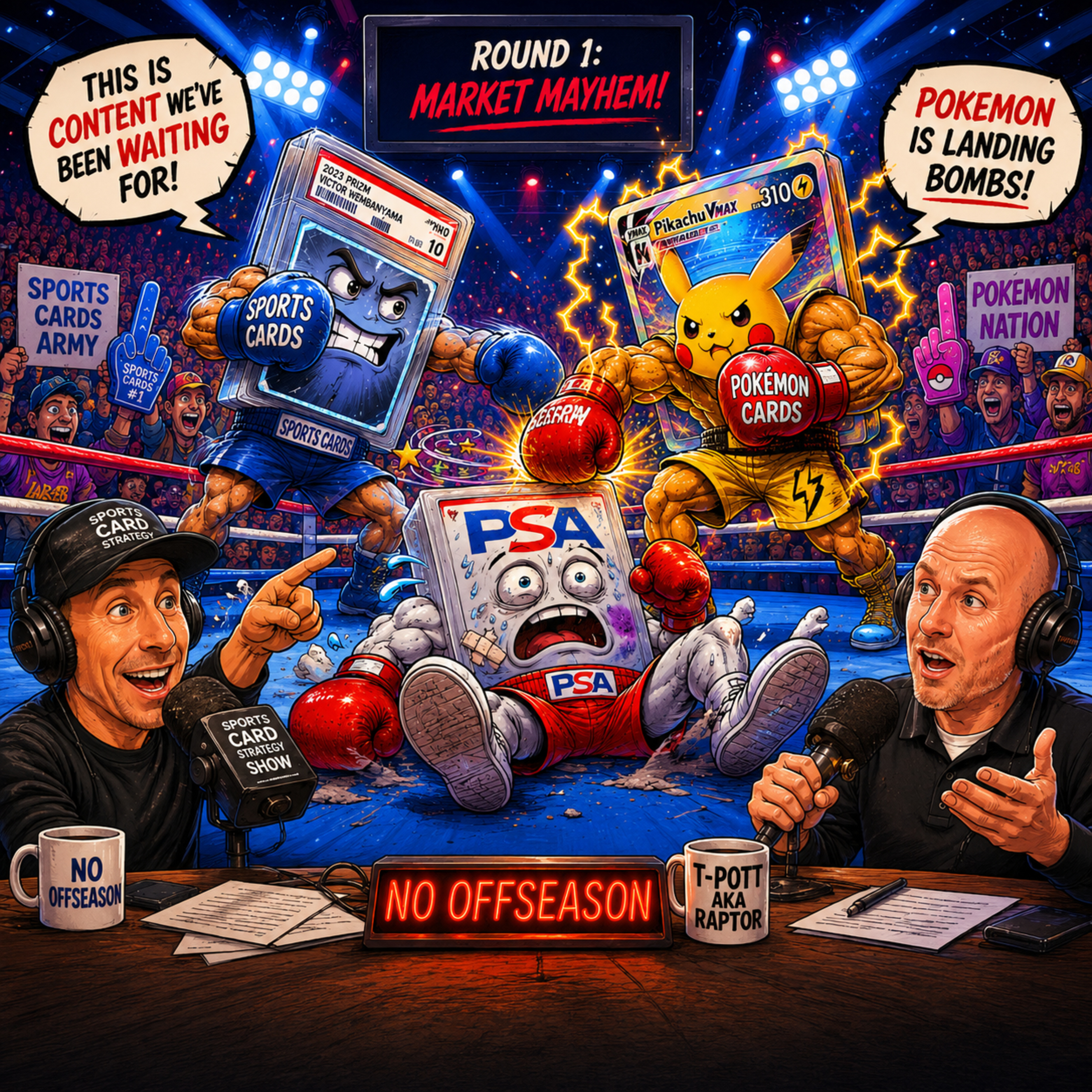
0:00
-0:00
Chapters
/ tap to jump
Searchable
Full Transcript
Every word from this episode, transcribed in full — search the page (Cmd/Ctrl+F) or let Google find the exact moment you’re looking for.
This is what everyone's talking about. Everything's on the table. This is what champions come to take. This is what everyone came to see. No do overs, no second chances, no more Mr. Nice Guy. This is winner take all. The NBA Finals continue on ABC and the ESPN app. What's up everybody? It's Gary Vee and this is the Sports Card Strategy Show. Because you know this, there is no off season, no off season when you get into this game. The reason why you pay someone like Paul Hickey to get your sports Card strategy together is because when you're starting out, you need perspective, you need wisdom, you need insights. And so he's been around the track enough times where he can actually coach you up and guide you. Doesn't mean he's going to take you to the promised land tomorrow. But you now have a coach by your side that can advise and kind of even create these pathways where you can get the education yourself. And that's a lot better than dugging it out on your own. What the kids better buy my rookie card now because after this year, the price ain't coming down. Welcome in everybody. I'm your host, Paul Hickey. It's time to sit back, listen, learn and earn with me on the Sports Card Strategy Show. Welcome in no offseason.com family. We're so happy to have you with us to help you make money flipping sports cards using data driven sports card investing. On today's show we have a special guest, co host, Ty Nethercott, who you know as Teapot from Sports Card Investor and Market Movers. He's the senior vice president of product. He doesn't really throw that title around but we need to, we need to give him his, his fair share of props on that title. You can find teapot on YouTube at sports card Investor and Market Movers as well as his own Instagram @t potspc. Teapot, you are one of the most versatile men in the hobby. Great to have you back on the Sports Card Strategy Show. How you doing, man? Thank you very much. Thanks for the kind words. And you're right, I'm not really a title projector or whatever, title dropper. What's really exciting though, we just announced, you know, Cards hq, Sports Card Investor becoming one company formally. So I, we're working through that transition from a, you know, systems perspective and everything at now what is, I guess we'll say Cards hq. I'm getting a new title, actually getting a promotion. So my new title will actually be EVP of Technology, which is really exciting. So it's been an awesome journey. Six years, six and a half years now with, with SEI and now Cards hq. And it's just been constant growth, really exciting and honestly a real privilege to get to work every day in the hobby and get to interact with so many awesome people and collect awesome cards and buy Tiger Super Fractures and just living life. It's fun. Yeah. Congratulations, brother. That's amazing. Yeah, you definitely well deserved. I mean, for those of you who don't know, I mean, because, because a lot of people see Teapot as a content creator, but I mean, he is basically running the show with Jeff and, and a great team. I mean a great, great team of people. We could spend so much time talking about each individual over at Cards hq. I'm very excited to see how that, you know, the formalization of the companies play out over there and I like to geek out on that stuff with you behind the scenes. So I look forward to talking to you more behind the scenes on that. On today's show, we're going to discuss a lot of grading strategy because as you all know, we have experienced a ton of changes in a rapid period of a short period of time in the hobby with the grading landscape. It seems like things are changing daily in terms of announcements from PSA and then what is that going to mean for the other grading companies? So we're going to talk a lot about grading. I also want to discuss how smart flippers actually use data, the data behind winning sports card investments. And then in terms of the grading discussion, like a few different specific topics, I think when to buy, grade and sell sports cards for maximum profit. One thing I want to talk about is with the changing grading landscape raw versus graded, which is going to make more money in 2026 and into 2027. Want to get Teapot's take on that. And then of course just an overall new grading strategy, including ebay's recent announcement about how they're the ability to do the PSA grading at checkout is changing and it is not changing based on ebay's relationship with psa. If you're sick of getting slaughtered, ripping wax and buying into breaks and want to actually profit flipping sports cards, join Nooffseason.com it's less than a dollar a day and you can make between this is proven. This is proven, everybody. I can honestly say this now. That's why I'm being very outspoken about it. Proven methodology. You can make between 30 and 130% ROI consistently flipping singles using our tools and advice. No offseason.com helps you make real profits flipping sports cards. Check out nooffseason.com to see if there's any spots available in our membership or join the wait list to get in on the next drop. And finally, Sports Card Strategy is sponsored by Slab Dynasty Cards, a next gen sports card platform built for collectors that includes a 2% marketplace fee and a choose your chase feature. Start your dynasty today using code no off season for 20% off your first Slab Dynasty purchase. And then actually before, before I asked Teapot the first question on today's show. I do want to remind everybody, Market Movers is obviously a tool that I use consistently for looking at historical data and trends and a lot of other things. And you can use the promo code no off season to save 20% at Market Movers. And it's actually like an incredible value. There's a tier that's 9,99amonth, which is incredible value. We're going to talk about. Let's talk about Market Movers. So first question, T pop, I want to know, because you basically architected this platform obviously with a good team, but it's true to say you're one of the visionaries behind Market Movers. So what's underrated inside Market Movers that most users ignore? Okay, I'm going to screen share. There's a couple of things that, that I think get ignored. So the first one I'll share is it's useful to everyone and it's available to every member tier. So maybe that's the most relevant. So I'm going to share my screen. And that tool is just Movements. So movements. What it does is it takes advantage of this database, 7.3 million cards. And this is honestly like from a competitive differentiation perspective, this is what Market Movers offers that no other app offers. Like this. We go through great pains to write these queries so that when you look at a card and you get the charted data, the sales are, you know, going to be right 90 plus percent of the time, you know. Yes. Other weird outliers, people get crazy with their titles and things don't always match perfectly, but it's very reliable. And so we have this big database of 7.3 million cards that you can chart, that you can track. And when you go to Movements, what that means is that you can filter by all these different categories. So if you're like, hey, I want to laser in and I want to look at, you know, maybe I want to look at football for next season, you can filter by that. Maybe you're Thinking I only want to look at rookies from, you know, two, I don't know, let's say you want to look at 20, 24 rookies because you think, oh, there's going to be some hype around them. And maybe you only want to see graded versions of those cards. And then you can just hit search and this will kind of show you data around cards that have gone up and down. You can set price parameters, but the big thing I always start at is with player because I want to know which players are going up and down the most over time. So if you're thinking back to like, okay, when did football end last year? Maybe you want to go back like into the fall of last year or maybe you just want to go back, actually I'll switch to 90 days. And maybe you want to look at, you know, which players have gone up or down the most since football kind of ended, since the season wrapped up. If you're looking for buy opportunities, you know, you can kind of switch and go to price change by percentage. I guess the toggle that I didn't put in place was you can also put rookie cards in place if you only want to look at rookies and not like non playing days, Emmett Smith cards. And then this will load in a moment here. Normally it's immediate. I don't know why it's slow. Might be because we're video streaming too, but so J.J. mcCarthy's down, you can. And then this is where you start to use your own intuition, your knowledge of these players. What the buzz that you're hearing, what's the hype around these players? Okay, I'm not gonna get too excited about JJ McCarthy. I'm honestly surprised he hasn't gone down more knowing that Kyler is signed with the, with the Vikings. But you know, you can kind of just start to look, okay, who's gone up and down the most, you can start diving into their cards. So this can be a really powerful tool. Pretty much every market movers video that I use where I'm like thinking about speculation and investment opportunities and things. I'm starting in price movements and then kind of diving into specific cards. And then the other tool, just briefly, this one is actually only available to unlimited members. So it is our highest membership tier. This is kind of for the data geeks, but it's this ratios page. I know you talk a lot about pricing, Paul, Pricing, grading and like opportunities with grading. But you can come in here and you can kind of start to get a, an understanding for. If I do like PSA 10. And then I want to compare that to Raw and then I want to look at, you know, a specific player. Maybe I want to look at, I don't know, throw a player out there for me, Paul. All right, let's go, Joe Burrow. Okay, so you want to know which cards of Burrow are gonna, you know, have the best, the best ratio of PSA 10 to raw and it will pull that up. It makes all these price comparisons so that you're looking at these things. And I will tell you that gem rate data, I don't know exactly when will be embedded into Market Movers. This year we're working on a project to get gem rate data so you'll have even more. But even just clicking this open and seeing, okay, pop 528 PSA 9 is 307. So that tells me the gem rate on these cards is over 50. Now are you gonna find a gem mint condition card, raw every time when this card came out six years ago? Not necessarily, but you can use this. I've used this very effectively. I use this to look at cards, for example, for like Shohei Otani that you can, you could buy Raw, his Allen and Ginter rookie card. It was like I was buying those at like 50 bucks a pop and they were selling for 250 as a PSA 10. It was a car with like a 73 gem rate. So this is a very powerful tool to make those, to identify those gaps. Super powerful right now on Pokemon for those of your audience who may be dabbling in that space. But that's also a kind of a trigger word for the sports fans, knowing that Pokemon's a big reason why PSA is backed up pretty badly right now. Very interesting. I will say. I did not even know about ratios, and I consider myself somewhat of a market movers power user. But I think, I think it. So the ratios is an amazing tool, obviously. And I think movements is what I use all the time. I use movements like it's. It's like my daily ritual to look at movements because of, you know, the way that you gave an overview of the process is great. And I, and I look, I like to look at. See, one of the things that, that I don't know, that everybody understands is that like ebay only allows 90 days of historical data. And so what. One of the, one of the many things Market Movers has done is stored all of the, all of the historical data and gone back in time with the. What was the other feature you guys added? It's it's escaping my mind. The price history, the hit. There's like, there's a price history and the movements. Yeah, but the movements. What, what that does is put it into the, into the charts where you can see the historical trend line on the cards that you're digging into. And then like Teapot said, you can use your own knowledge to say, okay, well, if this Joe Burrow PSA 10 Optic Hollow 2020 is, you know, say $300 in December and June, but I see that it's going up to closer to $500 in August, you can infer that that $500, the bump up to $500 in August is due to just the hype of the NFL season starting. And then you can say, okay, well, it doesn't really take an event for that to go up in value. So I'm pretty safe trying to get that card in the months when it's closer to $300. Now, it's not always going to be exactly those prices, but historically that's been the trend. And then conversely, you wouldn't want to assume that Joe Burrows card would reach the level that it went to when he went to the Super Bowl. Right. So you wouldn't want to assume that because it's going to take that event for that to get there. So. But the historical data just that the movements provides and the ease of use that Teapot showed, I think is, is great. Now I'll be digging into the ratios more for sure and I'm sure our listeners will as well. So again, not that this is an infomercial for any product, but no off season is the promo code if you want to join market movers. It's a great compliment to no offseason.com and the stuff that we have there. So talking about metrics and data, Teapot, like in your opinion, what, what metrics? There's so much data and you and I love to geek out on it and you're also a collector. So you're thinking I mentioned at the beginning of the show, like, I really do believe you're, you're one of the most versatile minds in the hobby, if not the most, because like I, I don't. My niche is, is strictly using data to make unemotional moves to flip sports cards. And that's not for everybody. I think a lot of people obviously like that about me, but that's not, I don't get into collecting or anything like that. So from your point of view, collecting, flipping to fund your PC or just trying to make money Whatever, Whatever floats your boat. Or just loving to go to card shows and pick up cool cards. What metrics do you think like the sharpest market movers subscribers pay attention to? Man. I did a video like three months ago on the right way to speculate and I looked at basketball, baseball and football. There's obvious things that are kind of like across the board for all, all sports. And that's like the run up before the regular season, you know, try to buy in the off season, you know, for those leagues, of course not for the hobby because there is no off season. But you know when you, when you see cards there is, there is sort of a right and wrong time to buy. And I know you know that and you talk about it a lot. So that's, those are some of the more like obvious things. But there are other things that people don't necessarily think of as often or that really only using data and actually looking at it or just being in long enough and actually having enough introspection and analysis to think about what's happening. Football, for example. We know that rookie quarterbacks are often always super hyped. Even ones like, it's like there's always got to be like four or five of them. No matter where they were taken. They may have all been taken in the first 15 picks, one of them may have been taken in the second or third round. But there's like got to be enough quarterbacks for people to be like, ah, I gotta go crazy. That's not the time to buy. When their cards come out in the season of their rookie year, ultra juiced, ultra hyped, that is not the time to buy. One of the times to buy is a player like right now, Caleb Williams, you're, you're just like using your ear to like listen. You're in maybe your eyes on social media, but you're going to shows and just listening. When people walk up to tables, who are they asking for? Or when you talk to dealers, who's everybody asking for today? Oh, Caleb Williams. Or you're seeing everybody's got, you know, Caleb Williams out because these, they're super hot. Or really it's the opposite. When you don't see any cards of a player that's still like young and has hype, that's also a signal. It's like that's a data point. It's not the data in the conventional sense of sourcing through some API or scraping or something. It's like I'm taking in data going, there's a void of a certain Player here. What's going on? Oh, these dealers are all waiting. They're waiting for the national, they're waiting for the, for August to sell these cards. So I should be actively hounding and looking for those cards. So that's one thing with football. Another thing with football is in every season invariably there's some player that used to be super hyped, like as a rookie or their second year that performed poorly and just fell off the map. And now they're in their fourth or fifth or sixth season in the league and they have a change of scenery. They go to another team. Okay, Sam Darnold, Baker Mayfield, Daniel Jones, like these guys, even back, back in the day, like Jimmy Garoppolo, like there's like these players every year. Their, their, their prices bottom out. And so what the data shows you is these cards are borderline at floor. When you're buying PSA graded cards, sometimes you're getting PSA 10 base rookie cards of these players for like 20 to 30 bucks, which is borderline floor for any player who's still active doing or less than the grading fee. Yeah. And if they went and when they get traded, when they go, if they're going to be the starter. If you sort of surveil the landscape every NFL season, there's at least two or three guys like that that are just in that position or they're one injury away from being there. If you sort of broad sweep and you put whatever your budget is, let's say you've got fifteen hundred dollars to spend and you just spread it out across those five guys almost for sure. Like not financial advice. One of them is going to like catch a heater even for a game or two and they're going to go up and then that's your sell marker. Like you sell and then you've got the other ones and you're like, okay, maybe I'm at floor, maybe that means I'm eating fees or I'm trying to just move these at a trade night or whatever you're trying to do. But the upside drastically outweighs the downside. So I start looking for like what's the next level down? And you can see that I showed that in the chart, I showed that in the video I did three months ago. You can see it in the data. You got to go back and look at these players who have been hot. When you see a player hit the top five on, on sports card investors, you know, weekly top five Tuesday or Saturdays now, I guess it is look at those things and Go, why is that player hot right now? What happened? And is it a one off? Is it something unique to this player or is there something broader here to like, you start putting the, like the little pointillism painting together and now all of a sudden you see a really, a much clearer picture. And that applies individually to different sports as well as to bigger things. Basketball is very similar. I talked about players hit their stride, their peak at like age 25 to 29 in the NBA. And so a player like Shay Gil just Alexander, it took him a little bit to blossom and then he took off. And you see that with a lot of players in the NBA too. So I start looking at NBA players around age 23 to see what have they been doing, have they been showing signs of progress, Are they due for more minutes next year? What's their situation, Are they going to a new team? And that can be a really good indicator that you're not even going to see that in the charts necessarily. They're going to look very flatter even on the decline. But you're looking at their numbers and their age and other, other metrics. Yeah, I really, I really like all of that. And I think on the, the first thing you said about like the data points that are out in the world where you're listening to people at card shows, I think back to my Darius Garland kaboom. I had two Darius Garland kabooms. And at the, and this was several years ago, it was leading up to the national in Cleveland. And my thought was, okay, Darius Garland at the time was kind of like starting to hit that age that you're talking about in the NBA. And he was, they had just traded for Donovan Mitchell. So he was now kind of the number. He didn't really, the Cavs didn't really have a number one. They had Garland, they drafted Evan Mobley, they traded. Then when they traded for Donovan Mitchell, it was kind of like, okay, now I've got like the number two on an NBA team that's like average, fighting to make the playoffs. But I've got his kaboom. And I had PSA 10 and a PSA 9 of his kaboom. And they didn't sell very often. So my thought was, okay, this is a rookie kaboom. It's a guy who doesn't have any rookie autographs that are licensed. This is his probably biggest rookie card or one of his biggest rookie cards and he's an up and coming NBA player. So I was prospecting on Darius Garland and I remember the trouble with trying to sell that card online was the lack of sales volume, the lack of pop count. So there was like a decrease in buyer confidence. And then the problem in trying to sell that card in person at the national, even in Cleveland, was that the online sales data didn't give anyone confidence enough to buy it at the show either. And so that was an indicator for me in the negative direction moving forward. Don't necessarily buy cards for the second guy on a team that's fighting to make the playoffs, even though it's his best card and even though there's some hype around him and potential there. Because the risk is that, you know, lack of sales volume, lack of buyer confidence, and then even at a show in Cleveland, nobody wanted it. Yeah, I had to trade out of it. So the lesson learned from that was like, to your point, I listen to that in person data. To not make decisions like that moving forward, I think that's very important. Like those indicators where you're at show. And I would talk to the dealers, like, why don't you want this? Like, what's the. And so, so understanding that. And then what you said about, you know, kind of spreading budget around, like reverse engineering the top five cards on sports card investor, basically. Yep. Which is one of the things I started doing back in like 2021 when I started really consuming. I first was a consumer of the sports card investor content and then I started working with the sports card investor team as a writer. So I really got familiar with how to do that. And one of the things I learned is that is a great strategy, but you do have to have patience. So here's an example. We've started to see these regurgitation of quarterbacks that were drafted in the first round, getting another chance first as a backup somewhere and then emerging as a starter. Like, you named a few of them. Right. There could be a couple more in the near future. There could be J.J. mcCarthy, there could be Mac Jones, there could be other guys that were drafted in the top 15. That. And so my point is, I love the strategy that you just outlined where, see, when their base PSA 10s come down to that 10 15, $20 mark, scoop up a few for those prices. But then you. The key is you have to make that only a certain portion of your portfolio. And you have to be patient. You have to wait for that to happen. You can't just. And you have to be okay with them going to zero, which you should be because you only paid, you know, 20 bucks for them. I do love that sports card strategy. Though I mean I think like that, that being part of it because we've seen those cards easily go up to over $100, $150 based on them being named the starter, them performing well and that sort of thing. So yeah, you touched on something really important with that price confidence when people need, when they, they see a trend. If you're, if, if your goal is like short to midterm speculation, that's why like buying these cards that are more commodity cards, liquid cards makes sense. That's like it's very clearly the chosen vehicle for that segment of the hobby who are trying to do that with those cards. It's, it's just like a, it's yes, people like to collect those but we live in a time now where from a collector persp of really people go more after for collecting purposes like the high end or they go after niche that they like with a collector profile, almost like a style like I have mine. And then there are a subset of people who like to collect just whatever the most flagship, you know, rookie is and like a PSA 10 or something like that. But those people are patient and they wait over time for those cards to come down and settle down past the speculation crowds like interaction with them. So you know, you know having that price confidence is very helpful with one caveat and the caveat is if you are really well connected. I know people who have built a network for kabooms for other things, the repack buyers, they want those kabooms, they need that. So if you build that network, if you are more of a high, higher net worth individual, you just have a bigger budget to play with. Maybe you've built it over time and you want to get into those. Those can be the lowest amount of work and the biggest payoff for players who blow up. If you have the right connections trying to get it up on ebay or do something else or just shop it casually at a show, that can be really challenging. But if you've got a guy on speed dial and you're like hey Garland's popping off or whatever, you know like. Or you guys are trying to build a national, you know, slab pack or something, you know like themed thing that can be a way that you can do it and that I always tell people that depends on just knowing yourself and what your personality is like. If you have more of that naturally networked sales personality, try to do that. Try to get like really integrated with, with different groups that buy a lot of volume. If you're more introverted and you don't want to do that. Then you need a different strategy that lends itself more to just selling anonymously through consignment or through your own ebay store or whatever that looks like. That's a great point because at the time, and this was a few years ago, I was focused on like flipping out of things to get into like. Basically the strategy is you either win in the first six to 12 months as you find yourself starting to hold a card that you're seeing a decrease in interest in for whatever reason, like player performance, etc. You like, you punt on it to refuel your bankroll to get into other things. But I'm glad you said what you just said because in hindsight I probably could have held those garland kabooms and just said, you know what, I'm going to stay patient and try to, at the right time, reach out to some of the DG super collectors. And you know, he gets traded to the Clippers this year and, you know, maybe that, you know, that refuels his market just a little bit or maybe even going to the next season, you know, with the, as a, you know, younger member of the, of the sort of retooled Clippers, you know, you never know. You just never know. So that's a good, that's a great point. And then the other point you made about like the commodity type cards, you know, I like to look at the prism silver PSA 10s of the top guys. And we touched on that with Jeff on the cards on the table a couple months ago where we were talking about Shohei and on one hand you're, we were talking about kind of a higher dollar Shohei that you had invested in. And then kind of the, the mic got passed over to me and I was like, well, I'm winning on these pop. 30,000 PSA 10s, you know, that had like doubled. So it's, it's exactly what you said. It's like, it's, it's, it totally depends on, you know, what you're trying to do. And the thing that I love about it is like you can, you can be kind of the collector that you are, but you can still make a lot of the moves that I'm making to fuel maybe some of your bigger purchases and that kind of thing. So I want to ask you, I want to get into another data question and then I want to get into grading. So data question that was not in our show notes, but I know that you can always handle these things. Recently I found myself thinking about how to quantify, and I've had a couple ideas how to quantify the size of the sports card market growing with new people coming in. Because we talk about supply and demand a lot and we really try to play on the tangible data, which is like rising pop count, for example, or sales volume sort of slowing down maybe 12 months after a new release. Like those kinds of things where it's like the supply is starting to level out and now we can play the game of knowing when the demand is going to increase based on the calendar, you know, so that's one kind of supply and demand along with of course like PSA 10 pop count growing and then leveling off and then being able to play that on the calendar. But one of these interesting things, and like I've talked with a couple other guest co hosts about this recently, is like what if we started to quantify, say for the Michael Jordans of the world or the Kobe Bryant's of the world, or even the Victor Wembanyama, even the active guys, the size of the hobby growing and the size of individual player markets growing as new people come into the hobby. Now all of a sudden there's can the demand actually meet the growing supply, giving even more opportunities for just sort of buying and holding and just selling at the price that you want to sell at. What are your thoughts on how to quantify the growing not only overall market of people coming in, but even like individual sort of player or niche markets? It's such a good question. It is tough to quantify. I'm going to do something on the fly and pardon my clacky keyboard, but it's all good. I want to, I want to look at, let's look at something here. This is not something I prepared as you said, but if I go over here to. I like to use Google Trends. Mm. So I might have added you to the stage a little early. So there you go. No, no, you're good. That, that just auto filled that. I don't know what that was. So we can type in like sports cards into Google Trends and then this is showing the past 24 hours. But let's look at the past five years and what this is showing for those who aren't familiar with Google Trends is it's, it's showing like interest over time, like relative to the rest of the rest of time. And so it'll always peak out up at a hundred. I mean we just over the last five years, interest in sports cards, in searching for that term peaked last month. And so you can Sort of even use this and go, okay, it was at 40, 40% of the interest back in 2024 and now it's at 100. Now another term that gets searched a ton is just baseball cards, which is a bit odd. You see baseball cards actually get searched for even more than sports cards and that also peaked out. What if we add in Pokemon cards and you can see, Holy Hannah. Holy crap, that is wild. Like Pokemon cards is dwarfing sports cards and baseball cards. So Google trends, I mean super, super nice of them to allow us to have visibility to what's getting searched on their platform and see, you know how what this looks like, this is pretty revealing data in and of itself. So I think that's really useful. You can just look at the number of sales. So actually let's see, I was going to try to find a card. It's hard to do with a, with a given player. But like another indicator I would say is just let me actually reshare this. The. You look at a card like a RAW Tops chrome refractor. That's for a rookie. So like here's Dylan Harper and I start trying to look at like the dollars, just how many sales and at what price point are being spent on these players and you're. This is just a raw version of one of many different refractors. For a guy who I think has a ton of potential but only averaged 11 points a game this last, you know the spurs are on a, on a rocket ship. They're hot. But I just, I like to look at sales volume and how these things are moving over time. And so this card just came out. I guess it would be a bad example to go over time frames. But you can look at that, you can look at like ebbs and flows and see okay, this player's card, you know, only sold this many times. Maybe let's look at something. Yeah. While you're doing this, I mean I'll just say that like the Google Trends thing is brilliant. Then what you're doing with the Dylan. I'm just going to extrapolate what you're doing with the Dylan Harper. What you could do is you could take say the, the top five overall picks in any sports league and you could say like the, in like I think we could all agree that like the interest level is always highest at a new release and you're taking out the variable of player performance. Yeah. You could look at the, the, the window of maybe like the, the 90 day window of total sales volume for each of the top five picks. In each league after the first major releases of their cards. And you could, you could, I would think that would actually be close to apples to apples comparisons because again, you know, you've got the, the Resashe and Zachary and, and Alexander Sar year, which is a down year, but you could still, you could still do a comparison and it would give you somewhat apples to apples. You've got the Brock Purdy year versus like the, you know, the Caleb Williams year. You know, there's different things there but, but you could still. It's going to even itself out if you compare like over time, going back five years or something like that. So. Yeah, that's very interesting. What were you going to, sorry, what were you going to say there? No, I mean we, you know, we have obviously sales data related to kind of ebay and what's happened there. It's, it's something we want to build out in the market movers to have more like broad speaking data available for how many sales are happening and that type of stuff. But even you look at something like just us Market Mover subscribers, for example, our number's been growing faster this year for subscriptions to the app than any year prior by, by more than double year to date, which has been really exciting. We have a, you have a churn rate with any subscription, you have a churn rate. So people come and go. Some of those people are just seasonal or month to month. Like they might turn it on, turn it off kind of thing. I do. We, I think a lot of us do that with our streaming services and things like that. Other people are kind of flashing the pan. They come in, they have some interest, they get in, they're here for a month or a year or whatever and then they're like, ah, I'm out. They lose interest. But you're sort of like always building that core group and it's always expanding. And I think that's what's happening with the broader hobby. I think it's safe to assume and extrapolate that. You can also just look at ebay's like quarterly shareholder reports and see, you know, here's Delt. They publish a lot of information about their leading categories and how important collectibles is to their growth and to their performance. And so, you know, all these companies are putting out varying degrees of transparent information to us to look at. And it just keeps going up, up, up. Everything keeps growing. And I think that's the piece that a lot of people are almost underestimating. Like they're looking at this and People scream junk, slab era, junk variation era, box prices, too expensive, whatever. This is a bubble is like the number one thing I've been hearing. It's a bubble, it's a bubble, it's a bubble. And I'm like, I don't think it is, I don't think it's a bubble. I, I do wonder where a lot of this money comes from at like a certain level. And when you look at like extrapolated market caps of different cards, but we have just scratched the surface. I think was. I don't know if it was the video you did or it was a different. I think it was a different one we did with on cards on the table. I talked about fanatics posted. What did they say? They said it was the primary markets for their stuff. Like their valuation was like $8 billion and there was some analysis of secondary markets. Just like online public transactions, not private deals, sales, Instagram, Facebook, all of that stuff, you know, card shows. And that was like another 8 billion maybe you extrapolate it all out and you're like, there's $20 billion worth of transactions going on in sports cards. That was just sports cards for the year. But the sneaker industry is like 150 billion a year and the sports betting industry is 250 billion a year. It's more than that now. Those were 20, 24 numbers. So like the number of sports fans and then you laser in on the Venn diagram to the number of sports card people is like such a potential growth. It's so small. And that's largely focused into the big three. Baseball, basketball, football. Yeah, you start getting a bigger market share of these other sports that like soccer and cricket and other things that are like in F1, there's a lot, there's a lot of potential, I think, I think to grow. Yeah. I still think that in the next five years when we're watching baseball, basketball, football and some of these other sports, we're going to start to see in, in the lower third graphic as one of the top players is shooting a free throw or being interviewed or whatever. We're going to see their rookie card pricing tick on the ticker. In the lower third graphic, we're going to start to see some of those things because, you know, fanatics is partnered with the three major sports leagues. They're partners. So it would only make sense that, you know, they start promoting cards as much as they're promoting the sports betting and everything like that. So huge, huge area of growth. Great, great. Talk about kind of how to quantify that there's there's definitely some stuff there to, to build some tools that show, show the increased demand for the supply that's out there. And to your point about bubble, like, you know, there's always going to be these, there's always going to be reasons why people justify doing or not doing something that they really wanted to do or not wanted to do anyway. And you're right about the churn. Like, you know, I have personal experience with like building this membership program and product and, and so it's definitely like it's hard to take sometimes personally when people leave, but I have a little thing when people, when people leave. No offseason.com to get feedback on why you're leaving. And I will say an overwhelming majority of the time it's like very complimentary about the product and the community and it's just more like you're saying I need to pause my subscription for blah blah blah reason due to family or this or I'm just not enjoying the hobby anymore. But I love, I love what you're bringing to the hobby and all that stuff. But recently I will say, and actually recently I will say that some of the reason is because of the PSA but value grading pause and I'm going to get into that with you in a second. But first let me just say what no offseason members are saying about the premium product. So Anthony says, hey Paul, just got back into the hobby after collecting in the junk wax era of the late 80s early 90s. I came across the Sports Card Strategy show and wish I would have found you earlier. Your content and insights are great and have really re educated me about the current state of the hobby and how I should view it. I think sports card flipping fits with my background in my day job in finance and I really enjoy being a member of nooffseason.com so I like to kind of talk about nooffseason.com as being like this mix between like an entertainment and actionable insights data tool to help you make money flipping sports cards. And so thank you Anthony for that. Now. So Teapot, I like to be fully transparent here. Like we've had like four or five people leave our community recently and the reason they have stated is because of the PSA value shutdown or pause and I want to talk about a few things and get your take on them and then I want to talk about like the ebay news from this week which is interesting. So we provide a service to our members where we and we like you don't have to do this, but we just provide a service where you can ship us your cards, we put them together and we grade them for you. I mean, there's a million people that do that in the hobby. And we also will crack your slabs and we will submit to multiple grading companies, show you a little dashboard of updates on where your cards are. So we're constantly receiving cards from members, preparing them for grading, shipping them to the four major grading companies, getting them back, and either consigning them or, or sending them back to the members whatever they want. And so we are. Our sports card rankings@noallseason.com are basically set up in a few different ways and we're constantly evolving these. But we have, we have raw to grade rankings, which is like our biggest one. There's PSA9 to BGS9.5 rankings because there's a lot of opportunities there. We have a little calculator where you can put in your own if you don't see it in the raw to grade rankings. And then we've already graded, and we do already graded for baseball, football, basketball, hockey for now. Well, the raw to grade rankings up until this PSA value shutdown were based on grading at PSA, right? Grading at PSA and grading at like roughly a 30. We in our formula for the rankings, we put in roughly a $30 grading fee and then we do a lot of other calculations in the formula so that the fee, all of the fees, whether it be taxes, shipping, ebay, marketplace fees, things like that on the sale side, are taken into account in the ROI number. What I've decided to do since the PSA value shutdown, and obviously since I don't want people leaving our community based on that because there's so many other opportunities, is I've updated the grading fee in the formula in the rankings to reflect the PSA regular service level. So that is now showing you a different, a completely different ROI number based on that fee. And so that has rearranged the rankings, but there's still so many opportunities to buy and grade at the regular service level. The other thing I've done is I've created the grading costs and the turnaround time for the BGS base submission and SGC standard submission as of this recording are close enough to be able to combine an average grading fee between the two companies and then now reflect kind of what used to be the lower dollar value levels that PSA had open. And I've adjusted the formula to reflect a more accurate final sales price of a gem Mint card for SGC and bgs. So now we have the. We have a lot of. My point to the audience is, and I want to get Teapot's take on all of this, we have a lot of opportunities here still that exist. We've had to, We've, we've all had to pivot before. There was a PSA complete shutdown other than like a Super Express or a walkthrough or something back in 2021 and 2022 for a while. And I may be getting the details on that a little bit off, but we've had to pivot through that. We've had to grade with other grading companies. But there's. My point is there's still ways to make plays to make money flipping sports cards. You're just going to have to adjust for a little While. And no offseason.com is helping you do that with our updated ranking. So before we get into some questions for Teapot, Teapot, what. What do you think kind of about the, like, are people panicking in your eyes about, like, what has been kind of the, the just anecdotal response on your side in terms of the overall PSA news from, like, first, we're gonna bear. We're gonna bury the headline and we're gonna say we're making this $200 million investment. But, oh, by the way, we're increasing turnaround times by double. And then we're gonna come back and say we're pausing all the value stuff. Yeah, there's a lot of. As with anything to do with PSA, if you put PSA in the title of a YouTube video, it's an instant cheat code to 3x whatever views you normally get on your video, if not significantly more. A lot of, like I said, strong visceral reaction to people. The number one comment on any video, including psa, is the phrase PSA is a scam. I. I do not agree with that statement, in spite of things I've shown in videos that I've done. Yeah. And let me pause you there real quick. For those of you that don't know, you got to go watch the market movers video that Teapot has done. He's done a couple brilliant ones. One with the Ken Griffey Jr. Star rookie, and then one, unfortunately, with a Grant Hill card. So go. Go check those out for sure. Anyway, back to you. Yeah, there's. There's some good content. I always say, to be realistic, just be a realist. Don't. And people throw that word around scam. And they don't really consider what the definition of a scam is. Scam tends to include like nefarious or deceptive intention. And I don't think that's what PSA is doing. PSA, I think maybe oversells their consistency or the, their expertise. Every company does that. Every company does that. All the grading companies do that, including the small guys who are trying to like, dethrone or take market share from, from psa. So there's a lot of strong visceral reactions. Another thing that people keep asking, they've asked me this on the market movers ama, they've asked it on our live streams, they've asked it to me in person. Why do you think PSA doesn't just hire more people? And I'm like, it's, that's not that easy either. Like, there's. If you haven't, if you haven't worked for a, for a business, a large business, a growing business, if you haven't been a senior manager, a director, an executive in one of these companies, if you didn't study business management and business growth and, and things like that in school, business administration, you don't understand economies of scale. You don't understand like these principles. I'm not saying that to sound like elitist or condescending. I'm saying these are realities. It's not just wave a magic wand and get all these. There's another lineup outside the door for people to like, come in and just be like, I've been wait. I've been waiting for you to say you'll hire me PSA to come work for you for 15 bucks an hour in your warehouse or, you know, to be probably underpaid, you know, as a grader. And maybe those are the things that PSA needs to be looking at, as every business does, is like practice profitability overall versus scale and growth and how you compensate and retain people. But I'm kind of digressing and going down a different path. The point being, like, there's a lot of strong response to that, to that type of stuff. And then there's people who have, they've had a bad experience. The most people go to psa. So therefore the greatest number of people are also going to be, have had a bad experience with PSA, like whatever that subset, even if it's 0.5% or 0.1% of everybody. It's obvious though, PSA has a lot of fans and a lot of people who really like them because you see it in the gem rate numbers. You see it every Every month in the number of cards graded, you see it in the secondary market values. And so I think people are, a lot of people are frustrated. They're more angry maybe about Pokemon and about. Yeah, you mentioned that earlier and I didn't even think about that. But you. But talk about that. Well, so if you look at the gem rate data like it's Pokemon is the, is the stuff that's up massively there. The Pokemon grading is up massively. And if I were to go back into market movers to the ratios page, what you would see. Pokemon has these cards called Illustration Rares and Special Illustration Rares in the English version. And there's a slightly different. They're Art Rares and Special Art Rares in the Japanese, but it's the same thing. They're basically like the SPS and SSPs of Pokemon. Okay. You can get these cards and you can get, you know, whatever a Charmander or a Trubbish or whatever, you know, Illustration Rare. And it's a 5 to 15 card rare raw. And if you get a PSA 10, it doesn't even matter if there's 9, 000 of them in PSA 10. It's like automatically 100 bucks. Like it's a hundred bucks or more. Like the Multiple is not 2 to 3 to 4x like it is for sports cards. It is quite literally 7 to 12 to 15x for Pokemon. So people are scooping, they're just going and buying. You find, you go to, you go to Collecticon, you go to any TCG show, you go to your local TCG card shop, they'll have these binders of all these raw Illustration rares that you can just buy or like topload it or whatever. What do they do? They look at them. Oh, centered, centered, centered. They look at gem rates on different sets and they just buy in volume. They go on TCG player and they just buy them all out, send them to psa. Next thing you know, PSA just got this submission of a hundred copies of the exact same five dollar illustration rare. If you get a nine, they might be 15 to 20 to 25 bucks. You're probably losing money, but you're hitting 50, 60, 70% and just making money. And I think a ton of people have gotten into that space to the detriment of the sports card community. They, that these, these things are just mixed into one big pot. And so that's the piece that I think people who are aware are like, come on psa, like separate them, separate them. Yeah, yeah, yeah, Company. But Build a department for. Build a department. Build a separate warehouse and receiving team. Do whatever you have to do to keep these things separate. Honestly though, Paul, like, it doesn't even, it doesn't even need to be that complicated. Like, when you go to submit to fill out your PSA submission form through their online website, they should know they should have a ticker. I heard Sports Card Clubhouse, I heard Mike Junk Wax Hero and Greg from Midlife Cards talking about this. Why can't they just turn it off after a certain number of cards have just been submitted for the day for Pokemon or for whatever sport and like have a fixed Alex, they know they literally get the data before it even goes into the post office, before it's ever received. They could go, this is done for the day. We can't take any more today. And you control it. Or, or what that those guys suggested is flex pricing throughout the day. Oh, demands up, demand's down. Flex and people are going to be checking it like it's a stock market ticker. You know, like, buy, buy, buy. Like get your submission in. Like, there's options. Oh, that would be interesting. Yeah, there's. That's a good point. And then just to add to that, like not rep. You could, in addition to those things, you could charge up front. I mean, SGC charges up front. Yeah, you could. So, so if. I'm not saying this is the case, but if collectors or if they're worried about needing to get grading submissions out to get their revenue, they could charge up front and then that would fix that problem. And then, then on top of that, what you're saying, shutting it off at the day they get their money and they're limiting what the backlog would look like. Yes. So that would be, I have to imagine, like for whatever disdain and whatever people have for, for Nat, for, for Ryan, for the leadership at PSA and collectors, they can say what they want. One thing is for sure, those are not dumb guys. Those guys are very, very smart. They're more experienced than me. They know they've been growing a business. They're smart business guys. They made a ton of really smart, savvy moves and I think they're. They have to be considering all this stuff. It's just, it's just not wave a magic wand. You know what I mean? Like, yeah, and sorry to cut you off. Here's the other thing. Because you're absolutely right. Here's the other thing. They really care about all of us. They, they really. They care about the hobby. So they. Because they really care about the hobby. They care about all of us. Like, they want us to have a good experience. So I, I believe they're doing the best they can. Yeah. And I'm, I'm rooting for everyone. I'm rooting for every company in the hobby to, to do the best they can and, and try to win and succeed and everything. And PSA just happens to be. Here's the deal. PSA happens to be the one that we all rely upon the most, along with ebay. And we'll get to ebay in a second. But my point is. And t pot, you made some great, great points there that I didn't even know. I didn't realize about the Pokemon thing. The point is that, like, we can all still do the same thing in the hobby that we were doing before the PS news. I think a lot of people. I'm not, I'm not trying to force people to come back to no offseason.com that left because of the PSA value shutdown. The reality is they probably were looking for a reason to leave whatever they were doing, and this has gave them the reason. That's just kind of how life is. But the point is, like, for all of you wanting to make plays, there's so many other ways to make plays. Even raw to grade and even paying a little bit more to get, you know, to get the regular service level is always an option option. I mean, you got like most of our cards are the top guys anyway and sell for a premium like Ohtani Wembanyama, Jordan, Tom Brady. So, I mean, a lot of, a lot of the stuff you can still do. Another thing you can still do that I want to talk to you before, before our time's up is ebay has announced there was like speculation about what would happen with this. And then ebay did a good job coming out and announcing it. Okay, what happens with the PSA grading at checkout? So according to ebay beginning, we're recording this actually on Wednesday, June 3rd, it's going to air. You're listening to this on June 8th. So maybe things have possibly changed between now and then, but ebay's PSA grading service will reflect updated estimated completion time ranges. This is interesting. So value plus 60 to 80 business days regular 40 to 50 business days express 20 to 30 super express 7 to 10 walkthrough and hire 5 to 7 super express pricing increases $50. What's. Here's what's. I think the biggest news is that value plus service on eBay PSA announced A pause on grading for their value Tier starting on June 2nd. This change will not impact the PSA grading services offered on eBay. EBay customers can still opt into PSA value plus grading for trading cards $250 or more. And I will say this has to be like, if you're buying in the U.S. it has to be a U.S. seller. You have to toggle the authenticity guarantee in your search. That is like, that's what they need to include in these announcements. So I'm including that for you because if I buy from a Canadian seller, unfortunately, or somewhere over in Europe, it's not going to. They're legit. They could still be legit sellers, but it's not. You're not going to be able to use this grading service at checkout because they don't have the authenticity guarantee check. I think that's a discussion for another day. But to me, the point is, like, you can still make the plays that we were talking about on the Sports Card Strategy show and at NoOffSeason.com sports card rankings at the PSA Value Plus Grading. If you're going for these cards that meet the authenticity guarantee at checkout 200, it has to have $250 or more. And it has to be. There has to be like two very good photos, one of the front, one of the back of the card. So to me, that's actually huge news. What do you think, Teapot? Yeah, I mean, it's interesting that they are taking a different approach. I'll be honest. I. I tried. I tried to make a video, actually, when they first announced that that ebay was offering the grading service, I tried to make a video like, of what that was like the. I was going to do a video of the process and just be like, oh, are my results good? Because you're going on images, you're going on pictures of the card. You don't get the chance to look at it and look at the surface in hand and know, is this a good idea? Am I wasting time and money, you know, with this? It didn't work out. There was some kind of weird bug and it like, I just gave up and got frustrated. So I have not sent the actual PSA greeting at checkout. Didn't work. Yeah, it was like they were early on, it was very unclear of, like, how it worked. And I had this card that was. Should have met the criteria, but then they were like, oh, but it's not actually rolled out to every card. Right. That criteria. I'm like, what the. They're like it needs to say, like, eligible for grading or whatever. I was like, forget about it. So it does say eligible for grading. Yeah. In any event, I mean. Yeah. Interesting. Maybe not surprising. I don't know if I have any super strong reactions to it other than just at least they put out information and made it, made it clear that's a, that's a, that's a positive. I think you made a good point. Like you're going to go through the process, everyone and you're going to see this should meet the criteria. But for whatever reason, it's not giving me the option. I've experienced that. I've also experienced where I've been able to do it. And I have gotten Rod, I got a raw to 10 on a Jaden Daniels kaboom. Horizontal kaboom. Which is obviously huge. And it's one of those things anytime. You know, we talk about this all the time@nooffseason.com it's like it's a volume game on this because you're not gonna like your own. If your own personal gem rate on our plays is like close to 30%, which everyone would be like, ooh, 30, that's really low. That's like, you're gonna make a lot of money. And so like you go through the process of maybe not every card meets the criteria. Okay, punt that one, move to the next one, find one that meets the criteria, still continue to try to make these plays and you're going, it is possible to win. I've, I've gotten, I think I've only done it maybe five or six times and I've gotten all nines in 110, that 110 on the Jaden Daniels kaboom. So again, that's about right. Like you got, I mean, again, I think it's like managing expectations here. You're buying, you're buying high dollar singles. So the theory there is back to our, our talk earlier about like the liquidity and the buyer confidence. The cards that you're seeing in our sports card rankings are ones that even if you get an eight, even if you get a nine, that's gonna be, you're gonna be okay. You keep going, you get a couple tens. That's where your profit comes in. So I'm just, I'm personally excited that we could still do that. Remember that Nooffseason.com is the only place on the planet with sports card rankings updated every Friday, sorted by the ROI percentage you're likely to make in the future. Of course, like I said earlier, evolving based on the changes with the grading companies to still give you the opportunity to make plays. Check out nooffseason.com to get in on the next drop. If you like the content on this show and want more, go premium@nooffseason.com now to get unlimited advice answered on our Friday podcast for Premium members called the Premium Pod. It's kind of like the the AMA that T Pop mentioned a second ago that Market Movers does. They do a great job with their Premium members as well on the Ask Me Anything. Thanks to my man Teapot of Sports Card Investor Market Movers Cards HQ for being on the Sports Card Strategy show today. Teapot, you get the last words man. Any anything else you want to add or just shout outs? What do you want to say here man? Well, we're recording this as the NBA Finals are getting ready to start. I am largely and almost entirely disenchanted with the NBA these days. I try to watch it. I feel like it's not the same product that I used to watch and so it's been difficult. But I'm gonna leave by saying like hype is very, very real. Hype over actual substance is very real. And I think it's going to be really interesting to see what the story is around Shea Gilders Alexander over time. I personally I hate the flopping. I hate it across the board in the NBA. I hate it across the board. It is not a shape problem. I agree problem is not a shade problem. It's a league problem. And I could rant about this more and more and more but what I will say is I've been re watch. I've been watching all these like 90s and 2000s basketball documentaries and like I'm just started the Allen Iverson documentary on prime and I'm like super geeked out about like I'm like this was such a different time and such a different sport at the end of the day. And to me, to me, Shay is everything the NBA is missing today in a player outside of yes, he falls when he drives and he gets calls and things. He's a two way player. He plays mid range and hardly shoots any threes. He's incredibly consistent. His scoring efficiency is through the roof. He's a team player. He passes the ball, he does it all. He does everything that you could want in a player on your team and he's a winning player. And he was the only person who showed up in game seven for the Thunder. And I don't get it. There's a weird anti Shay propaganda thing going on and I would encourage everyone to be aware of it. But if your goal is to speculate and flip, then I don't know, like, you're seeing it with Wemby. I think Wemby is just starting. I don't know that Wemby's going to come down in the off season. So Wemby, I think, I mean, I feel like I said this before Jeff, but Jeff, like, has a much bigger audience, so probably everyone's gonna definitely like. And I give him credit for it too. I'm not trying to take credit away, but like, I believe I agree with Jeff when he recently said that Wemby is the otani of the NBA. Oh, yeah. It's 100. Like. And the reason I say this because I agree with you, like, he's not going to come down in the off season. He's proven that he can do everything. Like, he's lived up to the hype. Like, he, he, he's. I think a lot of people thought, okay, like non basketball fans, but like fringe fans, like, thought about the hype and like, oh, this is cool. This is a 7 foot 4, 7 foot 5, number 1 overall pick for the spurs. Like, cool. But they didn't really believe. They thought maybe he would be more Greg Odin or maybe more like Minute bowl or somebody like that. And. But the dude is Steph Curry, but he's seven foot four. Like, he can do everything from a basketball standpoint. And he's tough and he's strong. He's not like, he is not just like a pushover. So say what you will about like, you know, what he looks like and the stereotypes and all that. The dude truly is completely different than any other basketball player we've ever seen. And I'm a Wemby believer. Like, my flag plant is that he, he. He goes on to be one of the greats of all time, you know, for sure in the top, in the top three to five. You know, if he's, if he's healthy. I will tell you the thing that scares me is he is like a, he's built like a giraffe. And there's like literally no historical precedents for any player that size having any kind of longevity in their career. Career. That's true. So that's, that's what I'm saying. I'm saying like, hot take, flag plant. He breaks the mold, stays healthy. I'm going all in on Wemby. I have continue to win with him. Here's a. Would you rather on the Way out. Okay. Rather have this. This Mahomes people are already saying second greatest quarterback of all time, huh? 3350. Last sale on May 18th for his PSA 10 optic hollow. Or would you rather have this Wemby ruby wave, which nobody gives two craps about in a PSA 10? His market's crazy. 100 down. Back to what we said earlier. We glazed over it. But it's important timing. I'm picking the Mahomes 100 Mahomes. Reason being timing. I mean, we're sitting here on June 3rd. That is not the time to buy Victor Wembanyama. And it is the time to buy Patrick Mahomes. If you can get it in an auction at fair market value. I mean, I wouldn't. What was the. The average was in the threes on that teapot. What was the average on the Mahomes PSA 10 average? Sale optic hollow. PSA 10. Was it average over what time? More than that. Just over like the last 90 days or. Last 90 days average is 3,000. 3,000. That to me, if you can get it at that 100. That. And that's the assumption on that question. What I wouldn't want to do is I wouldn't want to be like, oh, I'm gonna go all in on that and pay double for it. And some buy it now because that's what. That's what people will get you. But all right, good stuff today, man. We're gonna have you back any other time. Thanks for your time, everybody. Thanks for being here with us. We'll talk to you again soon. Sounds good. Thanks so much for being here with us on the sports card strategy show. If you enjoyed the content on today's show show, there's plenty more waiting for you@noallseason.com just go to nooffseason.com right now. You get our formula based sports card rankings, Sports card school inventory tracker, the ability to grade with us, and the premium podcast where we answer an unlimited amount of your questions. Check it out right now@nooffseason.com for everyone. @nooffseason.com I'm Paul Hickey. Thanks again for being here with us on the sports Sports card strategy show. We'll see you again soon. Have a great day. Ryan Reynolds here from Mint Mobile with a message for everyone paying big wireless way too much. Please, for the love of everything good in this world, stop with Mint. You can get premium wireless for just $15 a month. Of course, if you enjoy overpaying, no judgments. But that's weird. Okay, one judgment anyway, give it a try@mintmobile.com Switch upfront payment of $45 for three month plan equivalent to $15 per month required intro rate first three months only, then full price plan options available, taxes and fees extra. See full terms@mintmobile.com.
Episode summary
<p><strong>Welcome NoOffseason.com Family! We are so happy to have you with us to help you make money flipping sports cards using Data Driven Sports Card Investing.</strong></p><p>On today’s show we have a special guest co-host - Ty Nethercott, who you know as T-Pott from Sports Card Investor and Market Movers. He’s the Sr. Vice President of Product. You can find T-Pott on YouTube at Sports Card Investor and Market Movers, as well as on Instagram at tpotts_pc</p><p>We discuss…</p><ul><li><p>How Smart Flippers Actually Use Data</p></li><li><p>The Data Behind Winning Sports Card Investments</p></li><li><p>When to Buy, Grade, and Sell Sports Cards for Maximum Profit</p></li><li><p>Raw vs Graded: Which Makes More Money in 2026?</p></li><li><p>New grading strategy including eBay to PSA updates</p></li></ul><p><br></p>
From the original show
This episode is published by Sports Card Strategy Show.