Aug 18, 2026
The 1950s Ballot For My Sports Cards House of Representatives - Ep. 3.31
ListenWatchunavailable
CALL IN TO THIS MOMENT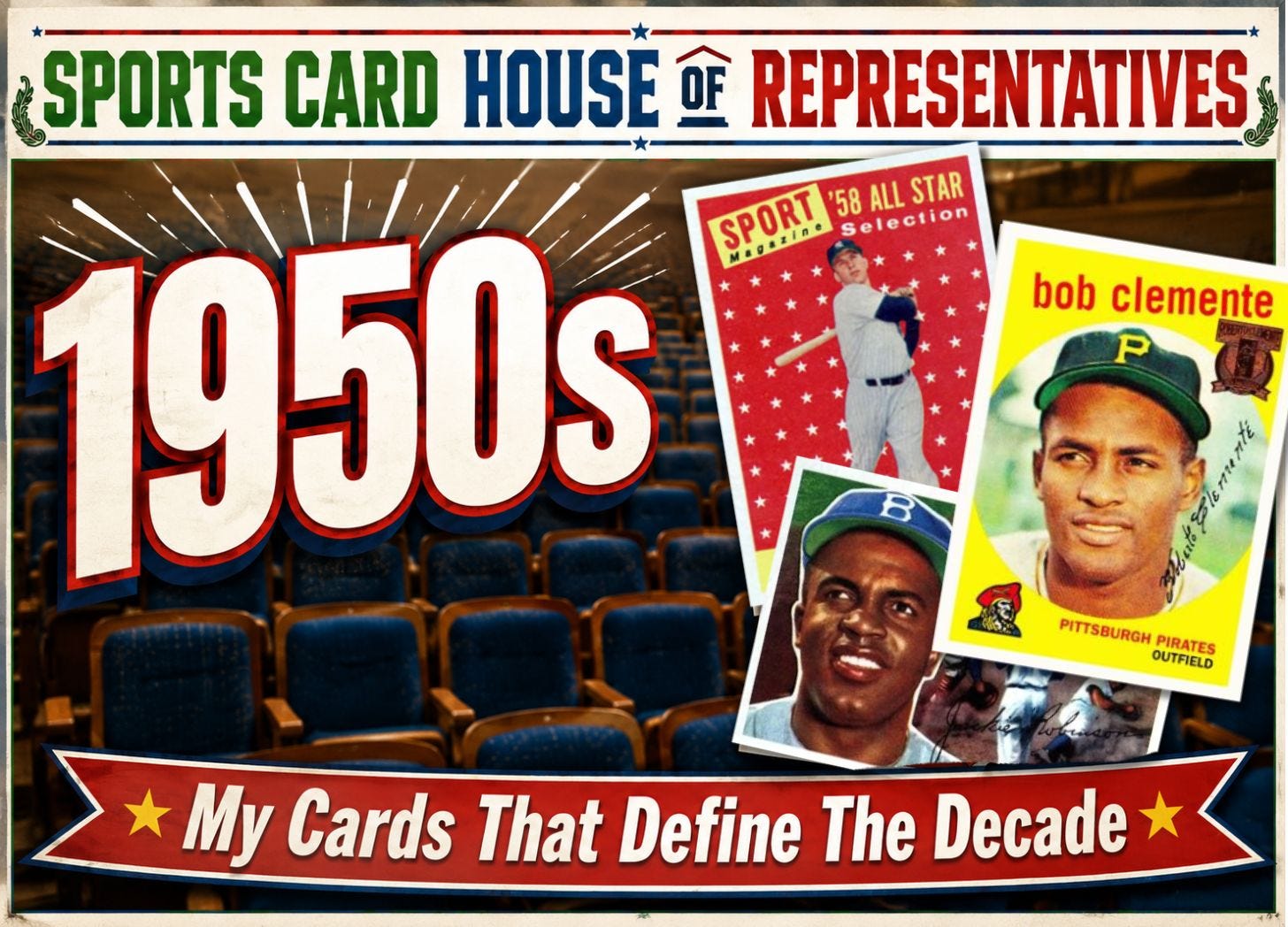
0:00
-0:00
Chapters
/ tap to jump
Searchable
Full Transcript
Every word from this episode, transcribed in full — search the page (Cmd/Ctrl+F) or let Google find the exact moment you’re looking for.
I don't need the most expensive card from every year. I just need the card that best represents that year to me. Welcome to my sports cards House of Representatives, the 1950s. Happy hobby. I'm David Goddess. Build a better sports card collection with a real world budget. That's what we're all about. That's what this series is all about. See, I'm starting to refocus my collection into something more manageable and more meaningful to myself. So I've been building what I like to call my sports card House of Representatives. One card from every year from 1952 through 2026 and then 2027 once we get in there. And every card has earned its place because every card tells a story. See, I'm a type collector. I like to collect one card that represents a set. For instance, a T206. I have one T206. It's not expensive card, just one card. A 1933 Gaudi. I have one card from that year. I just like to have one representative. That's what it's like. So that's what this is. I'm building a museum of my hobby journey. And I think this is something, if you're a comeback collector, this is an exercise that might just speak to you. See, collectors can't own everything as much as we try, and you're gonna try. But you can own the right example of each piece of hobby history, and that could do just enough for you. So in the comments at the end, I want you to tell me how your sports card House of Representatives would be different than than what I chose. So let's go through the rules real quick because there are some rules I know no matter what I do, even if I'm sharing the rules, there's still going to be somebody telling me I screwed something up. So let's go through this. First, you can only pick one card per year. Second, you can only pick one card per player. So in other words, once a player is elected into your sports card's House of Representatives, he can't be used for later years because there are no second terms, just one. It doesn't have to be a rookie card. It doesn't have to be an expensive or a high grade or a slabbed card. Preferably, it's a Hall of Famer or at least this player story card set. It has a great story behind it. Now, let me just warn you. Some players aren't going to get elected. There's only so many seats in this House of Representatives, you see. So some players, they Just didn't have long enough careers to get elected because I needed other guys in their place. Obviously there are better cards, better grades for a player that you can get. But this is an exercise for the sports card collector working with a limited budget. That's what I am. That's what I imagine a lot of you are. Yes, we would all love to have a 1952 Topps Mickey Mantle that he would be my top choice for My House of Representatives. But this list is of obtainable cards. And even this list has some expensive cards. Say expensive over, you know, around 500 bucks. That's expensive. That's expensive to me. So you want to choose players, cards, years that fit your budget that are obtainable for you, but you don't want to make a list that's just, you know, dollar cards. You want to make a list that's something you can grow into and try to Uptown these cards over the next few years. It's a journey. It's a journey. Now here are the candidates for my sports cards. House of Representatives. Let's see who got elected in the 1950s. 1951 Topps. Now I talk about 1951 Topps. Even though it's not generally considered Topps first baseball card reel set. It's a little different. See, they weren't traditional baseball cards. It was a 104 card dual series card game designed to be shuffled and played. See the Release. It featured two distinct 52 card sets, one with red backs and ones with blue backs. The blue backs were more rare just for if you're counting at home, the corners of each card front displayed specific baseball outcomes like a home run, a strike, a double a ball, which users would then use during simulated gameplay. Now, unlike standard modern cards, these cards were smaller. They're much smaller. They're measuring exactly 2 inches by 2 and 5, 8 inches with rounded corners to mimic playing cards. Makes sense, right? The cards were sold as pairs in $0.01 packages alongside a piece of caramel candy. Can you imagine that? Now you think conditioning condition of these cards would be pretty sensitive with caramel next to them. They're 75 years old, they're playing cards, people played with them. So you'd think they'd be pretty tough. Now, my choice, my election, my candidate for this one is 1951 Topps Phil Rizzuto. He's a 1950 Al MVP and he was a seven time World Series champion. Rizzuto was the steady shortstop. He anchored this Yankees dynasty. And I got this card, a SGC 6.5 for about 150 bucks. See what I'm saying? That's an obtainable card. This is a Hall of Famer. This is a legendary player turned sportscaster. Turn sportscaster Phil Rizzuto. So that's number one. Now we move into 1952, the most famous top set of all time. When Topps printed this set, they were still experimenting a little bit. So the first series went from number one to number 80 and it was printed on black, with black text on the back of the cards originally, that initial print. Eventually they would try and do red text on the back of the cards and they improved their other coloring aspects of the cards as they went. But, but that means that the first 80 cards in this checklist have both black back and red back variations. It's reported that about 40% of all the 1 to 80 cards have black backs. So they are considered a little bit more rare. So I wanted to have, by the way, the Phil Rizzuto was a red back for the, that 1951 tops. This one, 1952 tops. Duke Snyder. It's a black back. I wanted to have a card from 1952 tops that was of that black back version because it was a little more rare, it was a little more special. There's only 80 players that had, that had black backs available for us to check out. And Duke Snyder, the guy's a Hall of Famer, hit 407 career home runs. He was the power hitting centerpiece to great Brooklyn Dodgers teams of the 50s. Yu-Gi-Oh this guy's pretty great. So I got this slab PSA1. So it's very low grade, but it's a nice looking card. Got it for $100. See what I'm saying? You can get these amazing cards pretty cheap. So those are my first two candidates in our house. Let's move on to 1953. This is 1953 Topps. These were the first cards that had baseball trivia questions on the back. Their first cards with comics on the back, including ones that were drawn by Jack Davis, one of the original MAD Magazine artists. That's a nice little nugget I love. See 2018, that Topps Living set that we see cards still coming out from, that was designed around this original 1953 set design. Same design, same oil painted cards. Now, back then, Jerry Dvorak painted these cards. $25 each. He was paid and he'd do like three. Every weekend he would do three of these, which is just crazy to think up. So my candidate for this one, I don't own him yet, by the way. But my candidate is Yogi Berra. Now I have a different Yogi Berra card that I plan to sell to finance the purchase of this Yogi Berra card. So in a previous video I talked about downgrading my collection and that's the case here. Yogi Berra, he one-of-one an incredible 10 World Series championships as a player and he captured three American League MVP awards. He was the most direct decorated catcher in baseball history. He's considered one of the biggest, winningest players in baseball history. Pete Rose broke Yogi Berra's record for being on the most winning games, being on the right side, the most wins. I believe Derek Jeter passed Pete Rose, but I'm not positive on that because I can't figure out how to search that. But I do know Pete re. Pete Rose did beat Yogi Berra. So you got that going for you. Now moving on to 1954. Now, this Yogi Bear car I would like to mention before we go on. It's such a good looking car. It's such a beautiful painting. Yogi Berra has just that face. He's got like the best baseball face, the best sports face ever among all sports, just a great face. I do think this one, because it's a painting, it has a little more, I don't know, it's a little more childlike. You see a little bit more of his, just that pudgy, just goodness. And he's always smiling in all his pictures. But he gets, he's starting to get a little older in these years. But man, something about that 1953 painting just. It's the best one. It's the best one. 1954 tops. Now 1954 tops. These cards, they, they were the first to have two player poses on each card. So two poses of each player on the car, a portrait and an action shot. This is the first time Topps had a headshot and a full body shot on the front of the card. Now, it didn't have a Mickey Mantle in this set, the 1954 set, but it did have two Ted Williams cards. And that's pretty big deal because Ted Williams had not had a Topps card yet up to this point. He was, I believe, Bowman. He was with Bowman at that point. Up to them, Ted Williams holds the distinction of not only being the number one card in the series, but also the Last card, number 250, one of the most popular cards in the modern hobby. So his number one and number 250, they bookend the set perfectly. The card back though, of number 250. First, let me talk about the number one card. Normally I would be the one that's like, I gotta get that number one card. I, I gotta get the first card that Ted Williams ever had with tops. That said, that's a story for me. However, the number 250, the car, first of all, it's a much better looking card in my opinion. I like that the background much better than the orange. I just like it. It's just nicer. But the card back of number 250 is especially unique. It features nine illustrated panels instead of stats. And Williams returned to the big leagues after fulfilling his military obligation. That was also why he didn't have cards earlier. So it's just something about it. He finished his career the.344 batting average and remains the last player to hit.400 for a season. He batted.406 in 1941. So you see, he's a perfect candidate for the House of Representatives. Now, I do not own this one. He is. He's. What's. What is it when you're about to be elected. When you're elected but you're not in office yet. That's what he is. And I'm. My plan is I have a 1956 Ted Williams that I plan to sell to finance the purchase of this one. Again, downgrading a little bit because the card that I'm gonna get is gonna be a probably a low grade. Also. Moving on, are you keeping track of who's been chosen and who hasn't been chosen yet? That's a big deal. Hey, I wanted to call a timeout here for one minute. I have a quick question for you. Do you ever find yourself wondering, what are the best baseball rookie cards from, I don't know, 1987? Or what are the best football rookie cards from 1972? Well, I've got you covered. Head over to davidgannas.com where you'll find lists of the best rookie cards from every year for baseball, baseball, basketball, football, and hockey cards. And each page is like a time machine, except instead of awkward yearbook photos, you get the greatest rookie cards all neatly listed by year. And every card has a convenient link right to ebay. So if you want to find a forgotten gem for your collection, just click to find a great deal. Also, those links are affiliate links, which means you'll be supporting this podcast and helping me justify my own cardboard obsession. It's a one-of-one one-of-one really. So whether you're chasing hall of Famers or you just want to see who rocked the rookie scene, in your birth year. Check out davidganis.com your collection and your favorite podcast host will thank you. Number let's see, 1955. Now this top. These Topps cards featured both a headshot and a small action pose of each subject in 1955 Topps. And it was set up against a solid colored background. This is essentially the same design that Topps used in 1954, but the main difference was that the head shot and the action pose, they were in vertical or portrait mode in 1954. But now in 1955, these are landscape or horizontal. So for players who had Both cards in 54 and 55 sets tops, pretty much used the same headshot in, in both sets and they continue to use that same headshot 1956 too. Spoiler alert. So my choice for this one, it's a card I already own, Mr. Cub, Ernie Banks. I love it. I think it's. Yu-Gi-Oh this is just one of those greatest cards. He's a two time NL MVP, hit 512 home runs in his career at Wrigley Field. You know, Wrigley, there's a lot of sometimes, you know, the wind blows out, the wind blows in an awful lot at Wrigley Field. And my man's the face of the Cubs franchise, so of course I got to have him in My House of Representatives. 1956. Speaking of guys, I got to have in Jackie Robinson, 1956 tops. This card design, in my opinion, is one of the prettiest Topps card designs ever. It's between 1956 and 2018, I think are the two greatest card designs of all cards of all sets of all companies, everything. They're just awesome. Now, a lot of them use the same photos as 1955 we mentioned. You know, Jackie Robinson, of course, broke the color, the color barrier in 1947. He forever changed the sport and he one-of-one the 1949 NL MVP. Now, I don't need to convince you that Jackie Robinson is a great player to own or a great card to own of him, but they're expensive. Jackie Robinson is Zebra collectible. He's one of the, you know, one of the five most collectible baseball players with Mickey Mantle, Hank Aaron, Roberto Clemente, Jackie Robinson and who am I missing? Willie Mings. Those five guys, they're that, that's a, that's a pretty good group right there. Jackie Robinson's right there. However, there's not a lot of cards. You have 52, 53, 54 and 55 and 56. So five tops cards. This was the last card in his player run. So stands a reason it's the cheapest to get stands the reason. That's why I own it. Because it's probably the cheap. It's the cheapest. Now the I own this. I bought this as a raw card, sent it into sgc, came back as a authentic, altered, whatever you want to call it. But it's an A, so in other words it's not gradable. It came back saying it on it came back from PSA originally saying it had a minimum size requirement that it did not meet. So it sounds like it got trimmed at some point by somebody, whatever. It's my card. SGCA is a okay for me. Number 1957 tops. Now 25 cards having hall of Fame, hall of Fame players on it. The 1957 tops ranks as one of the largest star studded set sets of all time. For the first time, Topps put full year by year statistics for the player's entire career on the back of the card. That was a pretty big deal. Also, this is the first cards with photographs for Tops, color photographs for their cards. Bowman had done it in 1953. Topps had just bought Bowman in 1956. And now here we are, 1957 tops colored photographs. So the player I choose Here, Hank Aaron, hit 755 home runs, baseball's career record for more than three decades. That home run record he finished with 3,700 hits, almost 2,300 RBI, still the all time RBI leader. So why this car now? Hank Aaron played for a bajillion years and most all star teams ever I believe. Why did I choose this specific card? I have a 1958 card that I sold that I'm trying to finance buying this 1957 card. So I'm going a year earlier. My 1958 car is a PSA 5. This card, I'm probably gonna end up with a PSA 3. Two grades lower, about the same in price. But why this card? Because it tells some stories. First, look at Hank Aaron. It's just an awesome card. Second, Hank Aaron is a right handed slugger. Do you notice his batting stance here? It's left handed. Do you notice his jersey? Look at the jersey number on the front of his card. That four is flipped around backwards. This is a reverse negative on Hank Aaron's card is actually the first one of three times in a row that they screwed up something on his card. 56, 57 and 58. So this 57 card, beautiful card. One of the top five all time collectible players. And it's a. It's a notable one because this set color photographs for the first time. Easy call. This is my Hank Aaron representative and my 1957 Topps representative. Now let's move on. 1958. 1958. What a set. Now the set base cards, Yu-Gi-Oh they're all right. It's a, you know, profile shot with a colorful background or whatever. They're okay. But the All Star cards, that's what comes into those, were something special. That was something great. The AL had the red background, the NL with the blue background. So for me, my choice happens to be the same choice of one Mr. Bob Costas, one of the greatest sportscasters ever. See. This 1958 Mickey Mantle all Star card was the same card that Bob Costas would carry in his wallet for many years. What an odd thing right now. This was the first year that Topps had cards that represented Sports Magazine's All Stars. 21 cards depicting the 1957 Al and NL All Stars. Now, 11 of these cards of these players would go on to be enshrined in the Baseball hall of Fame, which is pretty amazing, right? Mickey Mantle, three time Al MVP, seven time World Series champion, elite power elite speed. 536 career home runs. By the way, he's the most collectible athlete in all of sports. The end. You can say Michael Jordan. You could say the other one. No, it's. Nobody's beating him. It's Mickey Mantle. Just way fewer cards of his produced than any of these others, which makes that. That rarity, makes him just more collectible. Oh, Yu-Gi-Oh and he's pretty awesome. Yu-Gi-Oh throw that in there. 1959 tops. The 1959 tops baseball set is famous for what's called the Porthole design. It featured a circular player photo framed by solid bright colored backgrounds. This iconic look introduced a number of clever little quirks. Player names written in lowercase letters. Facsimile autographs on the photos. Player specific cartoons on the card backs. So my choice for this set, the last of the or one of the five most collectible. Roberto Clemente. He collected 3,000 career hits, 12 Gold Gloves, one of the greatest humanitarian figures, and he had a tragic death while delivering earthquake relief supplies. But let's talk about this card. Why this card? For Roberto Clemente. For Bob Clemente. It's Roberto, by the way. He. He wasn't a fan of the Bob thing, but that's what the media was doing back then, so that's where we're at. But this card, why this card? Look at the. It's got the. Not all cards have backgrounds that match their team's colors. This is a modern day team color match card. What a beautiful card. The yellow and the on the card background. Pittsburgh Pirates. It's perfect. Pittsburgh, perfect. Pirates. It's great. I love it. All right, so those are my 1950 players. That's, those are ones I've checked off my list. Rizzuto dynasty builder. Duke Snyder. Brooklyn slugger Yogi Berra, ultimate winner. Ted Williams, the greatest pure hitter ever. Ernie Banks, Mr. Cub. Jackie Robinson, changed baseball forever. Hank Aaron, consistent greatness. Mickey Mantle, baseball's biggest superstar. And Roberto Clemente, a great player, greater legacy. So let's talk about who didn't make the list. Who's still out there, who's waiting to get voted in. Not all these guys will eventually get voted in. Some will get voted in the 1960s list, which is coming next, next week, by the way. So who didn't make it in? We're talking about guys like let's do alphabetical. We got, how about Bob Gibson? See there's a pink background. That's not red background. He's the Cardinals. We got Al Kaline, Sandy Koufax. We have Stan Musial, Frank Robinson, Brooks Robinson. Pretend I said those backwards so that they were in alphabetical order. It's a nice list here. A lot of guys left. Now a card can get voted out if I end up finding a better representative. Maybe it's a better version of that card. Maybe it's a better player that I got on a deal or it's just something I just grew into liking more. Some cards, they one-of-one in landslide victories in the voting process because there was never another choice. For instance, 1956 Jackie Robinson. Who was I going to pick instead? The best card. Maybe Mickey Mantle. But then I just, I love the Mickey Mantle All Star, which by the way, the All Star, that's a triple print. And you can buy that among all of his cards. You can buy that relatively cheap compared to the other one because it was, there was so many out there. That's a beautiful car too. Others, other cards, they require a runoff election because two cards from that same year are neck and neck. And you'll see that more in the coming videos as we move on. So this was my 1950s list. I'm doing every decade, including the 1960s and coming next week. So which player, year and which card would you elect to your sports cards? House of Representatives that I, I, I disagreed with. I want to know who you wanted. Let us know in the comments. Whatever you do, continue having a happy hobby.
Episode summary
<p>We’ve been told for decades now that the goal of collecting is to get bigger cards, higher grades and more expensive slabs. Upgrade! Upgrade! Upgrade! </p><p>Improving the value of your sports card collection isn’t necessarily a bad thing, mind you. It’s just not the <em>only </em>thing you should worry about.</p><p>Lately, however, I’ve realized that’s not the kind of card collection I actually want.</p><p>Instead of just spending my money on the biggest cards i can afford, I began to pivot how I collect, and I started buying more cards that mean more to me personally. </p><p>Some might call it “downgrading” (selling bigger cards for more smaller ones), and I’m OK with that. But I believe it’s actually an upgrade to my collection, as I focus more on what I want.</p><p>“Downgrading” My 1958 Topps Hank Aaron</p><p>I’m selling my 1958 Topps <strong>Hank Aaron</strong> #30 PSA 5, so I can eventually buy a 1957 Topps Hank Aaron in an SGC 3. </p><p>1958 Topps Hank Aaron #30</p><p>On paper, I’m gaining one year in card age, but I’m losing two grades and dropping to a perceived lesser grading service, not to mention the eBay fees from my sale. </p><p>1957 Topps Hank Aaron #20</p><p>In reality, though, I’m gaining my favorite Hank Aaron card ever — the reverse-negative photo, Topps’ first cards with color photographs, and one of the most beautiful cards Hank Aaron cards ever. </p><p>It’s a downgrade on the label, but a huge upgrade in my enjoyment. </p><p>7 Benefits of Downgrading Your Sports Card Collection</p><p><em>Here’s why selling my big sports cards makes sense for me right now.</em></p><p>1. Taking Advantage of a Strong Market</p><p>The sports card market is unpredictable, but what we do know is we’re in one of the strongest periods the hobby has ever seen. Look at the monthly volume of card sales on Card Ladder dating back to 2010 into the first half of this year.</p><p>Courtesy of CardLadder.com</p><p>If collectors are paying these premium prices for sports cards you own — why not let today’s market help finance tomorrow’s collection? You’ll simply move money out of sports cards you like into sports cards you’ll appreciate even more.</p><p>2. Enjoy More Cards</p><p>Remember that your sports card collection isn’t/shouldn’t be your retirement account — it’s something you’re supposed to enjoy. (It might end up being both, but it’s unlikely.)</p><p>Personally, I’d rather own vintage cards of five Hall of Famers that each tell a different story than have all of that value tied up in a single slab sitting in a safe. </p><p>Experience more of the hobby instead of concentrating all your enjoyment into one expensive card.</p><p>Yes, you can sell some cards you don’t love and buy an expensive card you do love, but you can also sell cards you “like.”</p><p>It also gives collectors permission to stop chasing someone else’s definition of the “right” card. Maybe you’ll never own a <strong>1952 Topps Willie Mays</strong>, and that’s perfectly all right. </p><p>If the <strong>1961 Topps Willie Mays</strong> is the card that makes you smile every time you see it, let that be your Willie Mays representative. The same goes for card condition. Your collection doesn’t have to be filled with PSA 10s to be meaningful collection. A PSA 3, an SGC 4, or even a beautiful raw card can tell some great stories.</p><p><a target="_blank" href="https://amzn.to/3Tuz2VR">Colored Toploader Binders I Buy</a></p><p>3. Less Financial Stress</p><p>Every collector has a dollar amount where a card stops being fun, and starts becoming stressful. Instead of thinking, “I can’t wait to show someone this card,” you start thinking, “I really hope nothing ever happens to this card.”</p><p>That’s not a fun feeling.</p><p>By selling my most expensive cards, I can still own pieces of hobby history without constantly worrying about whether they’re properly insured, safely stored, or protected from every possible disaster. </p><p>4. Greater Peace of Mind</p><p>The more valuable your collection becomes, the more responsibilities come with it, meaning you’ll have to worry about insurance policies, home security, shipping concerns, storage, and showing caution when displaying your cards online. </p><p>Three short years ago, showing my cards behind me in a video didn’t mean much. But now, I’d rather move on from those cards, and show good cards behind me, that won’t endanger my house or family.</p><p>While you might not have a YouTube channel, you still have people that likely come through your house at different moments, and you don’t want to become a target.</p><p>Collecting should be relaxing, not stressful.</p><p><a target="_blank" href="https://amzn.to/4fqCLuy">Check Out MagPro Holders on Amazon!</a></p><p>5. Every Card Tells Another Story</p><p>One of the main reasons I’ve pivoted to this new philosophy is because I’m a type collector. I don’t need 10 copies of the same rookie card. I’d much rather own one representative card from every year, every Hall of Famer, or every iconic Topps set.</p><p>Every new card becomes another story to tell.</p><p>Instead of buying doubles, I explore other players, other sets, other eras, or other piece of baseball history. To me, that’s far more rewarding than simply increasing the grade on a card I already own.</p><p>6. Your Collection Becomes More Personal</p><p>Once you stop worrying about investment value, you start asking different questions. Which player photo do I love the most? Which baseball card design brings back the best memories? Which card perfectly captures that era?</p><p>Nobody else gets to answer those questions for you.</p><p>Understand that the goal isn’t to own the “best” card according to the market. The goal is to own <em>your </em>best card. Basically, you want to own the card that means the most to you every time you look in your display or open your binder.</p><p>7. You Remember Why You Started Collecting</p><p>Most “Comeback Collectors” didn’t return to the this awesome hobby because they wanted to compete in a PSA registry. We came back because we remembered opening wax packs on our beds, flipping through our binders, trading cards with friends, and discovering cards we’d never seen before.</p><p>That’s the feeling I’m chasing now.</p><p><a target="_blank" href="%%checkout_url%%">Subscribe now</a></p><p>Holding Elections Now!</p><p>Instead of owning fewer and fewer cards that cost more and more money, I’d rather own more cards that tell more stories. That’s ultimately what led me to create what I’m calling my <strong>Sports Card House of Representatives! </strong>Just one baseball card from every year that best represents that season in my collection.</p><p><strong><em>I’m excited to share this journey with you over the next few weeks! </em></strong>I’ll share who got elected, which elections were landslide wins (1956 Topps Jackie Robinson!), and which seats are still open. Get ready — because I’ll ask for your Representatives, too!</p><p><strong>Have you ever improved your baseball card collection by selling a card to buy a lesser one?</strong></p><p><em>I’d love to hear about it! Drop it in the comments below!</em></p><p><strong>🏆 BEST ROOKIE CARDS FROM EVERY YEAR! 🏆</strong></p><p><em>We list the best rookie cards from each flagship release in all four major sports since the 1950s.</em></p><p><a target="_blank" href="https://davidgonos.com/who-are-the-best-rookies-from-each-topps-baseball-set/">Best MLB Rookie Cards From Every Year!</a></p><p><a target="_blank" href="https://davidgonos.com/best-football-rookie-cards-from-every-nfl-year/">Best NFL Rookie Cards From Every Year!</a></p><p><a target="_blank" href="https://davidgonos.com/who-are-the-best-basketball-rookie-cards-from-each-nba-season/">Best NBA Rookie Cards From Every Year!</a></p><p><a target="_blank" href="https://davidgonos.com/best-wnba-rookie-cards-ever/">Best WNBA Rookie Cards From Every Year!</a></p><p><a target="_blank" href="https://davidgonos.com/best-hockey-rookie-cards/">Best NHL Rookie Cards From Every Year!</a></p><p><strong>The Happy Hobby Sports Cards World</strong></p><p>📺 <a target="_blank" href="https://www.youtube.com/c/davidgonos">YouTube</a>: 9.2K Subscribers</p><p>📬 <a target="_blank" href="https://gonos.substack.com/">Newsletter</a>: 1.7K readers</p><p>🎙️ <a target="_blank" href="https://gonos.substack.com/podcast">Podcast</a>: 500+ podcast downloads/episode</p><p>🌐 <a target="_blank" href="https://davidgonos.com/">DavidGonos.com</a> - 1K daily visits</p><p><em>Our podcasts were ranked by MillionPodcasts.com as one of the </em><a target="_blank" href="https://www.millionpodcasts.com/basketball-card-podcasts/"><em>Top 10 Basketball Card Podcasts</em></a><em>, </em><a target="_blank" href="https://www.millionpodcasts.com/football-card-podcasts/"><em>Top 10 Football Card Podcasts</em></a><em> and </em><a target="_blank" href="https://www.millionpodcasts.com/hockey-card-podcasts/"><em>Top 10 Hockey Card Podcasts</em></a><em>! And we’re aiming to get ranked among the Top 10 Baseball Card Podcasts!</em></p><p><strong><em>Happy Hobby! Build a better sports card collection on a real-world budget!</em></strong></p> <br/><br/>This is a public episode. If you would like to discuss this with other subscribers or get access to bonus episodes, visit <a href="https://gonos.substack.com?utm_medium=podcast&utm_campaign=CTA_1">gonos.substack.com</a>
From the original show
This episode is published by Happy Hobby Sports Cards Podcast.