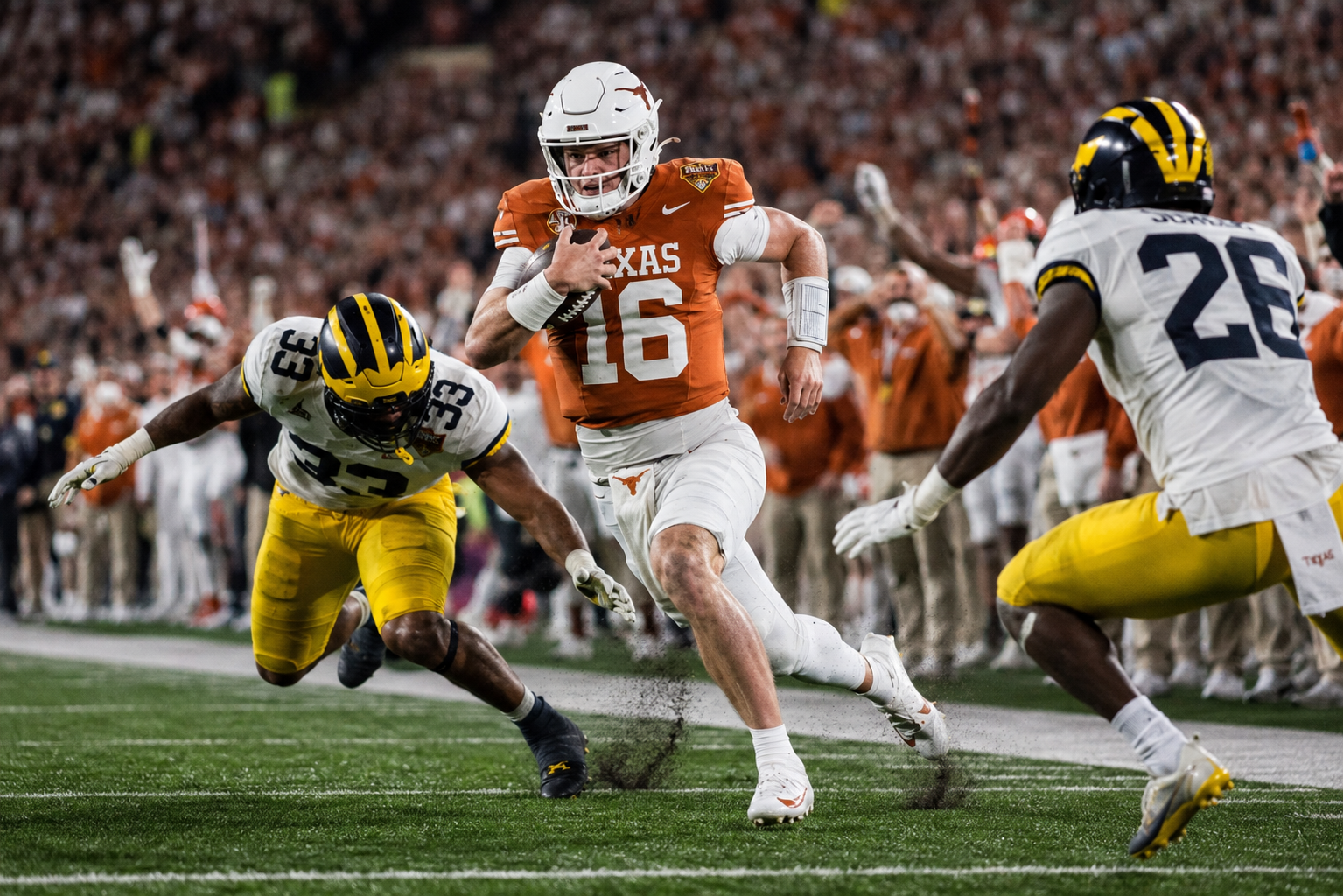
Arch Manning's Cards Price a Star. Ty Simpson's Season Says the Gap Is a Surname.
Manning's passer rating dropped 39 points when he became a full-time starter. A comparable QB in his own conference outproduced him in 2025. The Topps exclusive is real, but it does not close that valuation gap.
His passer rating was 184.0 in 2024. Then he became the starter, and it fell to 144.9. That 39-point drop from relief work to full-time duty is sitting inside every price Arch Manning's cards are trading at right now, and almost nobody is talking about it.
The Manning-Topps exclusive, announced September 3, is a genuinely important structural fact: one manufacturer controls all licensed trading cards of a player who has not yet thrown an NFL snap. No Panini Manning cards, no Leaf Manning cards, no competing products. Every Manning card that exists or will exist comes from Topps, which concentrates secondary market demand into a single catalog. That is the argument everyone is leading with heading into Texas's September 6 opener. It is not wrong. It is just incomplete.
The Comparable Nobody Is Pricing
In 2025, six SEC quarterbacks threw for 3,000 or more yards: Joey Aguilar at Tennessee, Trinidad Chambliss at Ole Miss, Diego Pavia at Vanderbilt, Marcel Reed at Texas A&M, Manning at Texas, and Ty Simpson at Alabama. Manning was one of six in his own conference, not a class apart.
Simpson's full 2025 line: 15 games, 305 of 473 passing (64.5%), 3,567 yards, 28 touchdowns, 5 interceptions, plus 93 rushing yards and 2 rushing touchdowns. Second-team All-SEC. Led Alabama to an 11-4 record and a College Football Playoff appearance in his only season as a full-time starter. Manning's line over the same season: 248 of 404 (61.4%), 3,163 yards, 26 passing touchdowns, 7 interceptions, a 144.9 passer rating, and 92 carries for 399 rushing yards and 10 rushing touchdowns.
On completion percentage, passing yards, passing touchdowns, and interceptions, Simpson finished ahead of Manning, in the same conference, in the same season. Manning's genuine edge is on the ground: 399 rushing yards and 10 rushing scores to Simpson's 93 and 2. That mobility is real and it matters, both as a football trait and as a draft-ceiling argument. But the passing line, the one that defines quarterback valuation in the card market, belongs to Simpson.
CN's own reporting has price movement on Simpson's 2026 Topps Flagship cards. A direct Manning-versus-Simpson price pair cannot be sourced with enough precision to print a number here, but the directional reality is visible to anyone who has pulled both names on the secondary market: Simpson's cards do not trade anywhere near Manning's. That spread is not a commentary on Simpson's NFL ceiling. It is the Manning surname premium, priced in real time.
On completion percentage, passing yards, passing touchdowns, and interceptions, Simpson finished ahead of Manning in the same conference in the same season. Manning's cards do not reflect that. The difference has a name, and it is not a football statistic.
What the Exclusive Actually Does and Does Not Do
The structural case for Manning's Topps cards is real. Exclusive deals compress the supply of a player's licensed cards and eliminate the competitive catalog fragmentation that dilutes demand across manufacturers. Every collector who wants a Manning card buys a Topps Manning card. That is a genuine market dynamic, and it has precedent.
What the exclusive does not do is close the valuation gap between what Manning produced in 2025 and what his cards are priced as though he produced. Supply concentration amplifies the price signal, whatever that signal happens to be. If the signal is inflated by surname weight rather than production weight, concentration amplifies that too.
One critical detail is still unconfirmed: the term length of the deal, and whether it covers college cards, NFL cards, or both. Those two questions are not footnotes. If the exclusive runs only through his college career, the structural argument is meaningful but bounded. If it extends into the NFL, Topps controls the single most commercially valuable quarterback catalog in the hobby for the foreseeable future, and the math changes substantially. Collectors leaning heavily on the exclusivity argument should know which scenario they are actually in before they commit.
The Bet You Are Actually Making Before Saturday
Manning may be excellent. The 2027 NFL Draft big board already has him ranked as a legitimate prospect, and the rushing dimension of his game, 399 yards, 10 scores, is a trait that translates. None of this is a bust call. The question is narrower: what portion of his current card prices reflects what he has done on a football field, and what portion reflects the surname?
The honest way to answer that is the exercise the market is not running. Find a 2025 FBS starter with a similar passing line: mid-60s completion rate, 3,000-plus yards, 25-plus touchdowns, single-digit interceptions: who does not carry a famous name, and check what his cards trade for. Simpson is that player. He played in the same conference, in the same season, and finished ahead of Manning in every major passing category. His 2026 Topps Flagship cards are moving. The gap between his market and Manning's is the number you are betting on when you buy a Manning card today.
If that premium is comfortable given Manning's draft ceiling and the structural lock Topps holds on his catalog, buy. The exclusive is a real tailwind. A strong opener Saturday compresses the window for this question considerably, because performance momentum will layer on top of the surname premium and make separating the two nearly impossible. A poor opener opens the window wider, and the honest valuation question becomes louder.
Either way, the question deserves an answer before the game, not after it.
Follow the hobby in the app
Track the products and players you collect and get told the moment anything moves.
Open Collector Nation