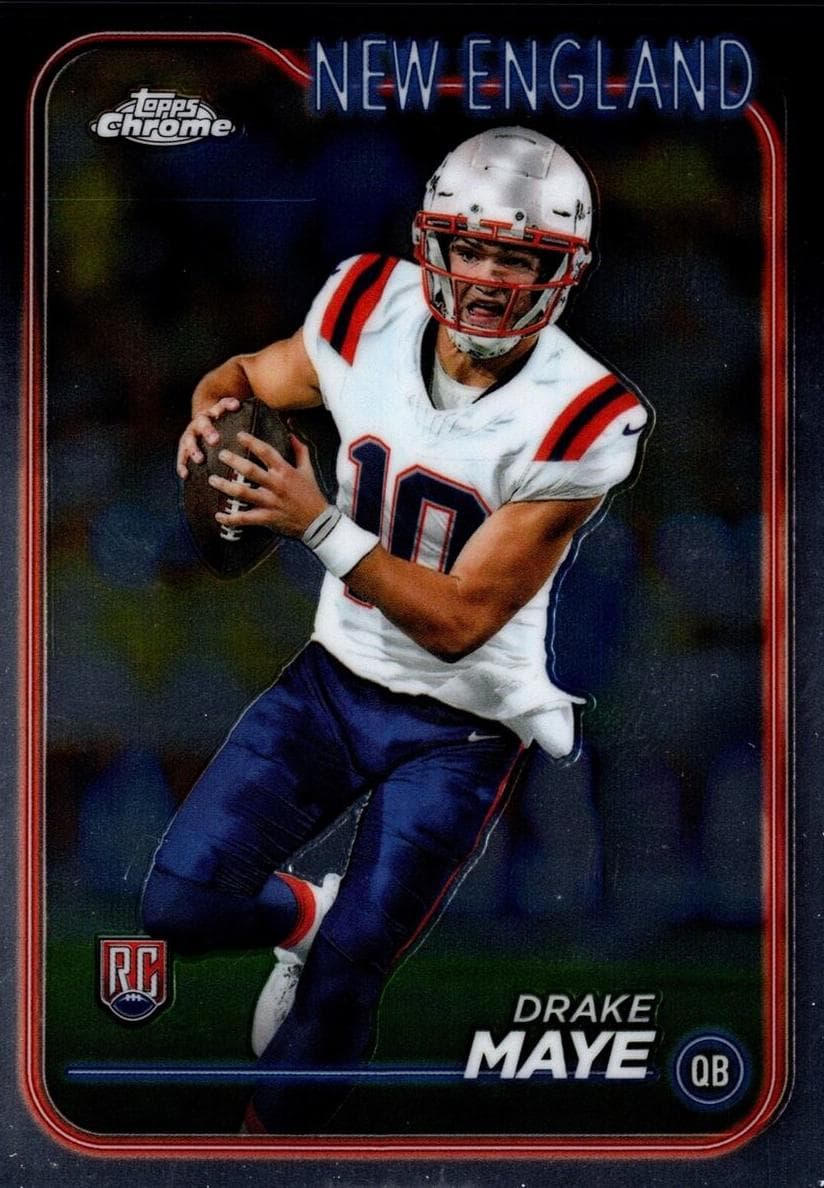
Drake Maye's Cards Are Priced Like a Franchise Quarterback. Wednesday Didn't Look Like One.
Three fourth-quarter interceptions against the same defense that beat him in the Super Bowl didn't just cost New England a game. It cost Maye something more valuable: the narrative that gets a premium paid.
With one minute left and the game sitting there to be won, Drake Maye threw into the end zone and cornerback Josh Jobe caught it. Third interception of the fourth quarter. Career worst. It was also the second time in seven months that this exact Seattle defense had ended a Drake Maye game that way — the first being a Super Bowl, six sacks, three turnovers, 29-13. The market had already started asking questions before kickoff. Now it has a second data point.
That second data point is the whole problem. One bad night against a great defense is noise. The same defense doing the same thing to the same quarterback, on the two most-watched occasions of his career, is something a premium has to absorb. And Maye's premium was already absorbing something before Wednesday's opener even kicked off.
On the 2024 Prizm Silver PSA 10, the card the class gets compared on, Maye was averaging $1,074 across eight sales in the seven days before the game. Bo Nix was at $776. Jayden Daniels was at $771. That 38% gap is not a fact about cardboard. It is the market's estimate of the distance between a good quarterback and a great one: the Josh Allen heir, the next Brady, the player whose ceiling is still being written. All of those figures are pre-game; no post-game sales are in the data yet.
Maye held the most valuable position in this quarterback class for most of the past year. Caleb Williams passed him only within roughly the last two months, and by the morning of the season opener Williams had extended that lead: his Prizm Silver PSA 10 was averaging $1,403, up 7.9% on the week, while Maye's was down 4.4%. The Williams-to-Maye ratio sat at 1.31 to 1. Maye was already losing a lead he had held all year, and he needed a statement game to answer it.
Card markets price narrative momentum more than box scores. The cost of Wednesday is not Maye's floor. It is his optionality.
What the Performance Actually Cost Him
The floor is intact. Maye's premium over Nix and Daniels was built on three seasons, a Super Bowl appearance, and a year at the top of his class. A three-interception Week 1 does not undo that thesis. Expect a shallow dip rather than a re-rating. That is Collector Nation's read, stated as a read.
What does not survive Wednesday is the near-term case for Maye retaking the highest price in his draft class from Williams. Card markets price narrative momentum more than box scores, and the heir-apparent story required him to look like one on the two biggest stages of his career. He has now had both of those stages against the same opponent and lost both the same way. The cost is optionality: the ceiling he carried into this season just got materially more expensive for a new buyer to believe in, and new buyers are what sustain a premium over time.
The volume data adds a sharper edge to this. In the seven days before the game, Maye's market ran about 1.23 times his recent normal, 1,733 sales across 300 cards, $179,933 in weekly volume. Some of that was buyers anticipating a statement opener. Those same buyers now have to decide what to do with the statement they got.
The 2024 QB Class, One Card, One Picture
The Prizm Silver PSA 10 is the cleanest cross-class comp because every quarterback in the 2024 class has one, and the liquidity is high enough that the prices mean something. Pre-game figures, trailing seven days: Caleb Williams at $1,403 (9 sales, up 7.9%), Drake Maye at $1,074 (8 sales, down 4.4%), Bo Nix at $776 (10 sales, down 0.5%), Jayden Daniels at $771 (6 sales, down 4.2%), Michael Penix Jr at $172 (7 sales, unchanged). The class is not close at the top, and the gap between Maye and the Williams tier is the number Wednesday put pressure on.
The Williams-to-Maye ratio at 1.31 to 1 is the real scoreboard. Not Maye's price in isolation, not a single sale, not a percentage move in a thin week. If that ratio widens to 1.45 or beyond over the next month, the premium over Nix and Daniels is the next thing the market reconsiders. If it compresses back toward 1.20, the market has decided Wednesday was noise. Track the ratio.
| 2024 QB class | 2024 Prizm Silver PSA 10 | Sales (7d) | Week | vs Maye |
|---|---|---|---|---|
| Caleb Williams | $1,403 | 9 | +7.9% | 1.31x |
| Drake Maye | $1,074 | 8 | −4.4% | — |
| Bo Nix | $776 | 10 | −0.5% | 0.72x |
| Jayden Daniels | $771 | 6 | −4.2% | 0.72x |
| Michael Penix Jr. | $172 | 7 | unchanged | 0.16x |
Trailing seven days, read 10 September 2026 from the SportsCardInvestor / Market Movers feed. No post-game sales are included — the newest sale recorded anywhere in that feed is 9 September 2026, the day of the game.
What to Do With Maye Cards Right Now
Holding Maye premium cards: not a sell. A career-worst fourth quarter in a Week 1 season opener does not break a thesis built on a Super Bowl run and a year at the top of his class. The dip coming is real; the re-rating is not, not yet.
Buying: wait. Do not pay a premium in the week the market was handed its clearest reason to doubt the ceiling. The card to watch is the 2024 Prizm Silver PSA 10. A sustained move below $1,000 through two more starts is a real re-rating signal. A bounce back inside two weeks is noise. The market needs to show its hand across a few data points, not one reactive session.
His most expensive card traded last week was the 2024 Prizm Manga SSP PSA 10 at $8,834 across three sales, up 2.9%: but three sales is not a market, it is a conversation between a small number of buyers. The Prizm Silver PSA 10 at eight sales is the only card high in his market where a directional move means something. Everything above it is too thin to read.
Darnold and Brown: Two Non-Events, Explained
Sam Darnold left Wednesday's game in the first quarter with a hip injury and did not return. Drew Lock finished the win. In a normal card market, a starting quarterback leaving a season opener injured would be a significant event. In Darnold's market, it is not, because there is no market to move. His entire card operation did $6,446 last week across 106 sales, roughly a twenty-eighth of Maye's weekly dollar volume. Only four of his cards traded five or more times all week. News cannot move a market that is not there. Nothing to do.
A.J. Brown's New England debut produced three catches for 26 yards on four targets. His card volume had already doubled into the game, running about 2.07 times a baseline of roughly 26 sales, consistent with the trade being priced in ahead of the debut rather than after it. With zero of his cards trading five or more times in the week, any post-game price is one buyer and one seller reaching an agreement, not a verdict. Nothing to do there either.
The View That Changes Everything
The view shifts entirely if the fourth quarter still looks like this in three weeks. One loss to a great defense is a data point. Two losses to the same defense, on the two biggest stages of a career, is a pattern. A third poor performance against a different opponent, or another collapse in a close game, and the premium over Nix and Daniels stops being a bet on a great quarterback and starts being a bet on a hope. That is when the floor moves.
For now, the read is this: Maye's floor survived Wednesday. His ceiling did not come through unscathed. The market was already pricing that doubt before kickoff, and it just got a second reason to keep doing so.
Follow the hobby in the app
Track the products and players you collect and get told the moment anything moves.
Open Collector Nation