Four 2026 Topps Flagship Rookies Are Spiking and Falling at the Same Time. One of Them Might Be Different.
Mendoza, Allar, and Downs are already past their exit windows. Simpson's Mojo Refractor is the one card in the class where the math doesn't match the pattern, yet.
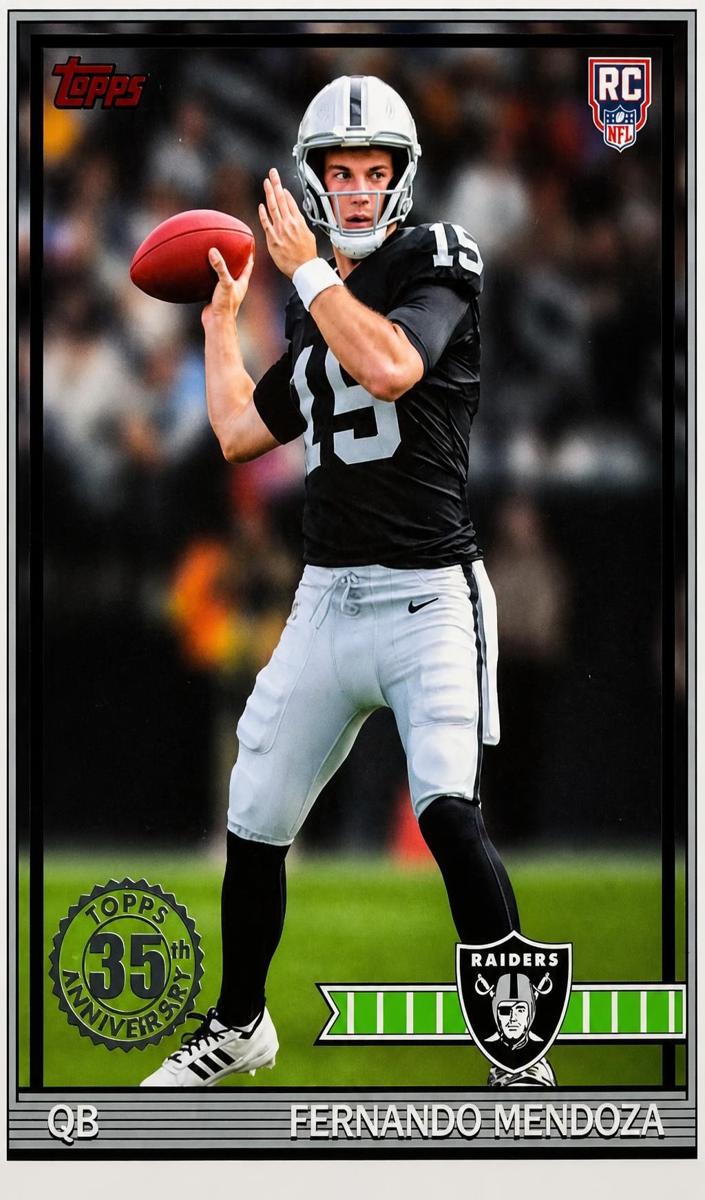
Eight days after 2026 Topps Flagship Football hit shelves, Fernando Mendoza's base card has traded 758 times in seven days. That is nearly a year's worth of normal transaction volume compressed into a single week. And every one of those sales closed lower than the one before it. The card is moving faster than it ever has and losing value with every transaction. That is not a rally. That is a liquidation.
The same pattern is running across three other rookies in the same set. Drew Allar's base is down 41% while selling at 8.3x its normal rate. Caleb Downs is down 23.3% at 10.4x. The velocity numbers look exciting until you put them next to the price numbers, and then the picture becomes very clear: breakers who pulled these cards on release week are selling into a buying wave that is already thinning. The buyers absorbing that supply are paying less each time they step in. This is what a post-launch dump looks like when it is actually happening, as opposed to when people describe one in retrospect.
Why the Dump Is Faster Now Than It Used to Be
Football cards are up 380% since 2020, and that growth has not been evenly distributed. It pulled in a much larger breaker and flipper ecosystem, which means the supply side of any post-launch spike is now bigger, more coordinated, and faster to move than it was in prior cycles. The market is not inefficient here. It is efficient in exactly the wrong direction for anyone still holding a base rookie from a set that dropped eight days ago.
The structural logic is straightforward. When a product releases, breakers open cases, pull rookies, and list them immediately. Early buyers pay a premium on reputation and hype. As more inventory hits the market, each successive buyer pays slightly less. The price decays in real time while the volume stays elevated because the same supply is still clearing. What looks like sustained demand is actually the tail end of a flush. By the time the volume finally drops, the price has already found its post-hype floor — and that floor is almost always lower than where the card was trading on day three.
Mendoza at 12.1x volume and down 25.5% is deep inside that pattern. Allar at 8.3x and down 41% is even further in. Downs at 10.4x and down 23.3% is in the same bucket. For all three, the exit window was the first 72 hours after release. That window closed before most collectors had time to think carefully about it.
The One Card That Does Not Fit the Pattern
Ty Simpson's Silver Pack Mojo Refractor is selling at 20.7x its prior rate, the highest velocity multiple in this entire spike cluster, and the price is down 6.7%. That last number is the one worth staring at.
At 20.7x normal transaction volume, a card absorbing that much supply while giving back less than seven cents on the dollar is either meeting genuine collector demand or sitting in front of a flipper supply that simply has not fully arrived yet. Those two explanations produce the same observable data right now, but they resolve very differently over the next five days. If it is the former, the Mojo Refractor has a real collector floor under it and holding into Week 1 is defensible. If it is the latter, the price decay accelerates the moment the remaining supply hits the market.
The Mojo Refractor is also a structurally different card from the base. It is a parallel with genuine scarcity, which means the pool of available copies is smaller and the buyer profile skews more toward collectors building a PC than flippers looking for a quick turn. That distinction matters when you are trying to read whether a floor is real. A base card selling at 12x volume is almost certainly clearing breaker inventory. A scarce parallel selling at 20x while holding price is a more complicated signal.
The read: Simpson's Mojo Refractor is the only card in this spike cluster showing the profile of genuine demand meeting supply rather than supply overwhelming demand. That read expires the moment Week 1 NFL performance data either validates or deflates his projection.
20.7x volume and down only 6.7%. Every other card in this spike cluster is telling a simple story. Simpson's Mojo Refractor is telling a different one, and the difference matters.
Five Days and Then the Market Reprices Everything
Week 0 college football opened August 29. Week 1, the first full national slate, opens September 3. That five-day gap is the structural reason any of this analysis has a time limit. Right now, every card in this rookie class is priced on reputation: what scouts said, what the draft capital implied, what the hype cycle established. On September 3, production data exists. Rookies who perform in their first meaningful action get a new bid underneath them. Rookies who disappoint get repriced immediately and without mercy.
Whether Simpson, Mendoza, Allar, or Downs played in Week 0 games on August 29, and what their performances looked like, is a live variable that directly affects the calculus here. A breakout showing from any of these names before this piece reaches you changes the floor. That is the nature of the window: it is real, it is short, and it is already running.
For Allar, Mendoza, and Downs, the guidance is clean. The price decay at high velocity means the flipper supply is still overwhelming the collector bid, and there is no structural reason to expect that reverses before Week 1 adds production context. Holding any of those three base cards through the weekend is a bet against the numbers. The exit window has closed.
For Simpson's Mojo Refractor, the position is more nuanced but still time-limited. If the price floor holds through Saturday's Week 0 action, it is the one Flagship rookie in this class where holding into Week 1 is a defensible call rather than wishful thinking. If the floor cracks and the decay accelerates to match the velocity, it joins the other three and the analysis becomes simple again. Watch the price, not the volume. Volume is already telling you what it knows. The price is the variable that still has something to say.
What the Broader Class Is Telling You
Five of the top nine market spikes this week are 2026 Topps Flagship Football rookies. That concentration is not a coincidence, and it is not a sign that the set is producing outsized value. It is a sign that the post-launch flush is happening across the board, and that the breaker community opened enough product in the first week to flood multiple names simultaneously. A set that generates five top-ten volume spikes in its first eight days is a set where a lot of supply hit the market very fast.
The one card that would break this pattern entirely: a Flagship rookie showing rising velocity alongside flat or rising price: has not surfaced in the data. That absence is itself informative. It means the buying wave that absorbed the initial launch supply has thinned across the entire class, not just for the four names tracked here. The market is not selectively dumping. It is broadly clearing.
The 380% growth in football cards since 2020 created the conditions for exactly this kind of cycle: more product opened, more inventory moving, faster price discovery, and a buyer pool that is sophisticated enough to step back when the price-to-value ratio shifts against them. The hobby is bigger and more liquid than it was five years ago, and that liquidity cuts both ways. It accelerates gains on the way up and accelerates losses on the way down. Anyone still holding Allar or Mendoza base cards into next week is not waiting for a recovery. They are waiting for a reason to believe one is coming, and the data is not providing one.
Follow the hobby in the app
Track the products and players you collect and get told the moment anything moves.
Open Collector Nation