Mendoza's Cards Are Still Moving at 3x Normal Volume. That Is Not a Reason to Buy.
621 copies of his base card sold in seven days while the price fell 12%. High velocity during a confirmed catalyst removal is not demand. It is the exit window.
621 copies of a $4 card changed hands in the last seven days. The price fell 12% while that was happening. That is not a market recovering. That is a market draining.
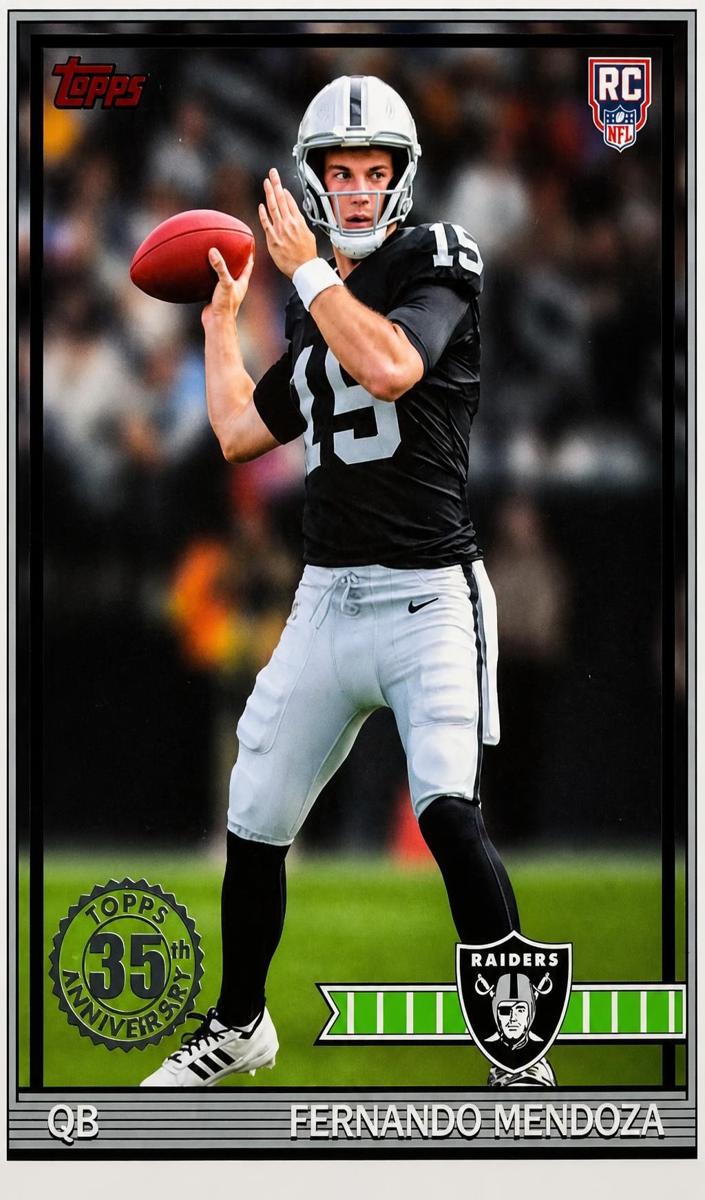
Fernando Mendoza's 2026 Topps Flagship base card is trading at 2.7x its prior-period baseline volume right now, and his Mojo Refractor is at 2.9x, with 181 sales averaging $36.73 — a number that was sitting 23.9% higher a week ago. The raw sales counts look like health. The price trend says otherwise. The question is which instrument you trust, and the answer matters because the window to act closes September 9.
The Catalyst Is Gone. The Volume Has Not Caught Up.
Mendoza's spike was built on a projection: a rookie QB competing for a starting job in Las Vegas, featured in 2026 Topps Flagship Football, with real upside if he won the role. That projection moved cards. Collectors bought the story before the box score existed, which is how rookie QB spikes always work. The problem is that the Raiders confirmed on September 2-3 that Mendoza will not start Week 1. The story ended. The volume has not.
This is the gap that matters. When a catalyst disappears, price moves first because it is set at the margin: the last trade, the most recent sale, the buyer who just decided to pay less. Volume is stickier. Sellers who bought at the spike's peak are still listing. Some buyers, seeing the elevated transaction count, interpret it as proof that the market is active and interested. It is active. The interest is mostly on the sell side.
The Mojo Refractor makes this clearest. A 23.9% price drop in a single week while volume runs at nearly 3x normal is not a card finding a new floor with healthy participation. It is a card repricing downward fast enough that sellers are still moving units before buyers notice how far the price has moved. At $36.73, that card was pricing in a starter. It is not pricing in a backup.
CN Has Seen This Sequence Before
The velocity-leads-price-decay pattern is not new. CN documented the same sequence in the Flagship launch spike and the Baez debut spike: volume surges on a catalyst, price follows the catalyst up, catalyst resolves, price turns first, and volume chases it down over the next one to two weeks. In every documented case, the sellers who moved during the elevated-volume window recovered more than those who waited for a bounce that never came.
The bounce requires a new catalyst. A benched quarterback does not produce one. The remaining reasons to hold Mendoza cards are a path back to a starting role later in the season, or a long-term collector bet on a career that has not yet started. Both are legitimate positions if you hold them deliberately. Neither justifies ignoring what the price is already doing.
In a confirmed-catalyst-removal event, elevated volume is a measure of how many people are trying to get out, not how many want in.
The Window, and What Closes It
If you hold Mendoza base or Mojo Refractors, the market is still liquid enough to sell into. 621 base card transactions in seven days means buyers are still arriving, even as price falls. That liquidity is the window. It exists because some portion of the market has not yet processed that the benching is confirmed and final for Week 1. Once September 9 produces a box score with Mendoza's name absent from the starter line, that last group of buyers loses their reason to show up. The bid side thins, volume follows price down, and the exit becomes more expensive.
Waiting for a bounce is waiting for a catalyst that no longer exists. The benching is confirmed. There is no scheduled announcement, no depth-chart reversal, no preseason game remaining that changes the September 9 reality. The sellers who understand that elevated volume is their last liquid moment, not evidence of demand, still have a few days. That is the piece of information the raw sales count does not tell you on its own.
The Inverse Trade Worth Running Down
Mendoza's benching means someone else is starting for Las Vegas on September 9. That role change is confirmed and immediate. Whether the Raiders' confirmed Week 1 starter has cards in the same 2026 Topps Flagship product cycle: and whether those cards have repriced to reflect the actual depth chart: is the question worth asking before kickoff. Role changes create two trades simultaneously: the exit from the player who lost the job, and the entry into the player who gained it. The first trade has a closing window. The second one may still be open.
The deeper issue for anyone watching Mendoza's numbers is what they reveal about how rookie QB spikes behave structurally. The card market priced a projection. The projection was wrong. The market is now correcting, but correction takes time, and during that time the volume looks deceptively healthy. Reading 2.7x normal volume as a buy signal in this context is reading the instrument backwards. The instrument is telling you there are still sellers. It is not telling you there are still reasons to buy.
Follow the hobby in the app
Track the products and players you collect and get told the moment anything moves.
Open Collector Nation