Malachi Toney Is the Heisman Frontrunner With No Card to Buy
He broke Miami's single-game receiving record, struck the Heisman pose twice before halftime, and landed on Polymarket. Then collectors went looking for his card and found almost nothing. That gap is the story.
Malachi Toney struck the Heisman pose twice before the first quarter was over. By the time Miami's 45-6 dismantling of Stanford was final on September 5, he had broken the program's single-game receiving record, scored three touchdowns, and landed on Polymarket as the face of the hottest Heisman narrative in college football. Then collectors went looking for his card.
They found almost nothing.
That is not a temporary inconvenience. It is the structural condition of the college card market in 2026, and understanding it is the only way to think clearly about what a Toney Heisman run actually means for a collector's portfolio — or whether it means anything at all right now.
Why the Shelves Are Empty
College players without active NIL trading card agreements exist in a market built almost entirely of unlicensed products and fan-made cards. There is no licensed Malachi Toney card on record. That means the collector who wants Toney exposure today is not choosing between a base card and a refractor. They are choosing between buying something unlicensed: which carries no secondary market guarantee and should be treated as speculative memorabilia rather than a card investment, or waiting.
The licensed pathway runs through Bowman Draft, which captures college players after they declare for the NFL Draft and go through a production cycle that historically runs six-plus months post-season. If Toney has a Heisman-caliber year, declares in January, and Bowman Draft follows its typical production arc, the earliest a licensed Toney card exists is well into 2027. Every week of Heisman narrative that builds between now and then is suppressed demand with nowhere to discharge. That demand does not evaporate. It waits.
The variable that changes everything is an NIL card deal. If a manufacturer signs Toney to a college NIL agreement, that becomes the first release window and it could open significantly faster than the Bowman Draft timeline. No such deal is confirmed. Until one is announced, the timeline belongs to the post-draft production cycle.
The Polymarket Problem
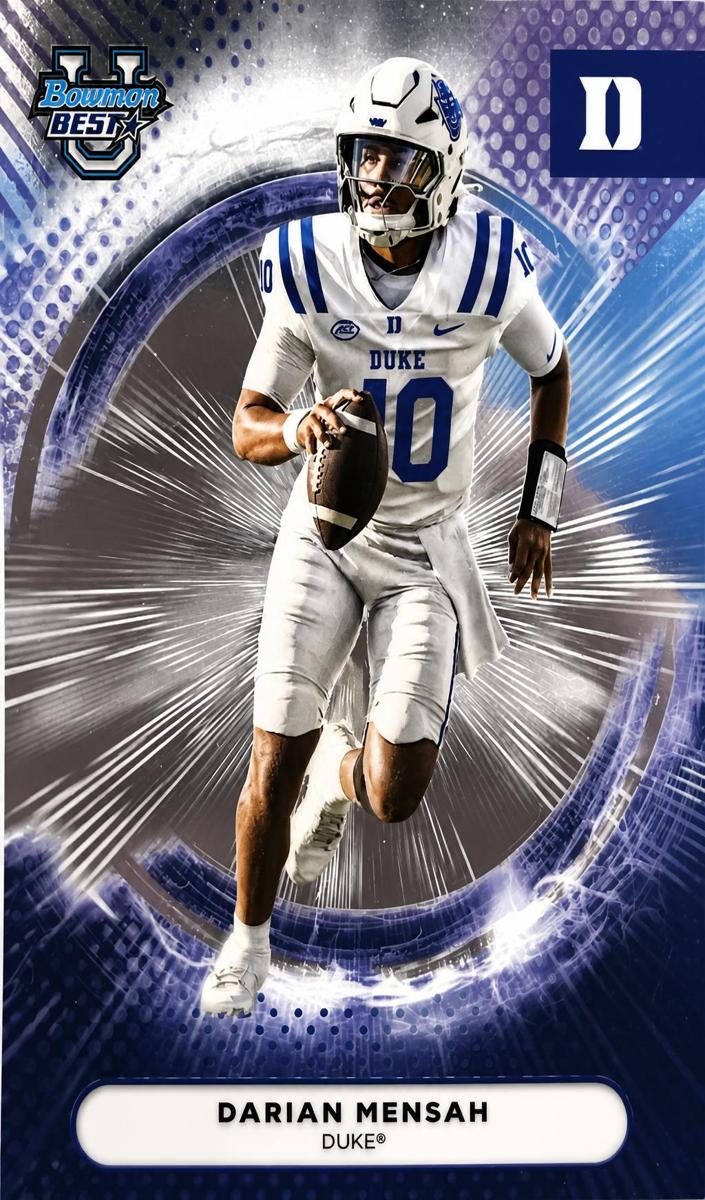
Before a collector buys into any Toney thesis, licensed or otherwise, there is a second complication worth sitting with. Polymarket's Heisman odds after Week 1 show Miami QB Darian Mensah as the new favorite, not Toney. The Miami Heisman narrative is real. The Toney-specific version of it is partially shared with the quarterback throwing him the ball. Pat McAfee named Toney his Heisman pick after the Friday night performance, which is meaningful as a signal of mainstream narrative momentum, but Mensah's presence in the same conversation means a collector betting on the Miami story is not automatically betting on Toney.
That distinction matters because the card market, when it eventually catches up, prices individual players. A Mensah Heisman run and a Toney Heisman run produce different cards, different products, and different demand spikes. Buying into the Miami narrative as a proxy for Toney is a loose thesis at best.
There is also the question of durability. Week 1 Heisman frontrunners have a complicated relationship with December. The season is twelve weeks long. Miami will face harder defensive looks as conference play begins, and a quiet game or two has a way of redistributing Polymarket's attention. The collector who treats a September 5 performance as a locked thesis is working with one data point.
Every week of Heisman narrative that builds before a first licensed card exists is suppressed demand with nowhere to discharge. That demand does not evaporate. It waits.
What the First Licensed Card Actually Looks Like
When the first licensed Toney card does arrive, the demand dynamics are predictable even if the timing is not. Bowman Draft releases have consistently shown front-loaded pricing on top prospects: the pop is heaviest in the first week of availability, driven by collectors who have been waiting since the player's college highlight reel went viral. The longer the gap between a player becoming a household name and their first licensed card, the more compressed and intense that initial window tends to be.
The practical implication is that waiting for the product announcement and moving early in the release window has historically been more effective than buying unlicensed product at a premium and holding it through an uncertain timeline. A collector who buys a fan-made Toney card today at a speculative price is paying for narrative momentum with no secondary market floor beneath them. A collector who tracks the Bowman Draft production calendar and positions at announcement has a defined entry point and a known product.
The work between now and then is not buying. It is tracking. Watch for any NIL card deal announcement. That is the variable that compresses the timeline most dramatically. Watch Toney's Heisman odds through October, when the race typically consolidates around two or three candidates. If he is still a frontrunner in November, the Bowman Draft angle becomes genuinely actionable. If the narrative has shifted to Mensah or faded entirely, the thesis goes with it.
The NFL Kickoff Factor
There is one more timing consideration that is easy to miss. The NFL season kicks off September 9, four days after Toney's record-breaking performance. Historically, the NFL kickoff pulls football card collector attention sharply toward the pro market: rookie cards, veteran parallels, and the annual scramble over which first-year players will break out. The window in which a college Heisman narrative dominates hobby conversation is genuinely short, and it is closing.
That is not a reason to panic-buy. It is a reason to be clear-eyed about what the next few weeks look like. Toney's story will be easier to revisit in October, with more games as evidence and a clearer picture of whether the Heisman race is his to lose or Mensah's to win. The college card market will still be structurally empty then. The suppressed demand will still be accumulating. Nothing about waiting costs a collector the thesis. It just requires patience that the Week 1 excitement makes harder to maintain.
Follow the hobby in the app
Track the products and players you collect and get told the moment anything moves.
Open Collector Nation