
The Most Valuable Charizard Cards Ever Sold
One card owns the top of the Charizard market: the 1999 first-edition Base Set holo. Here is CN’s ranking of the most valuable Charizard cards, built from verified auction records, and why grade decides almost everything.
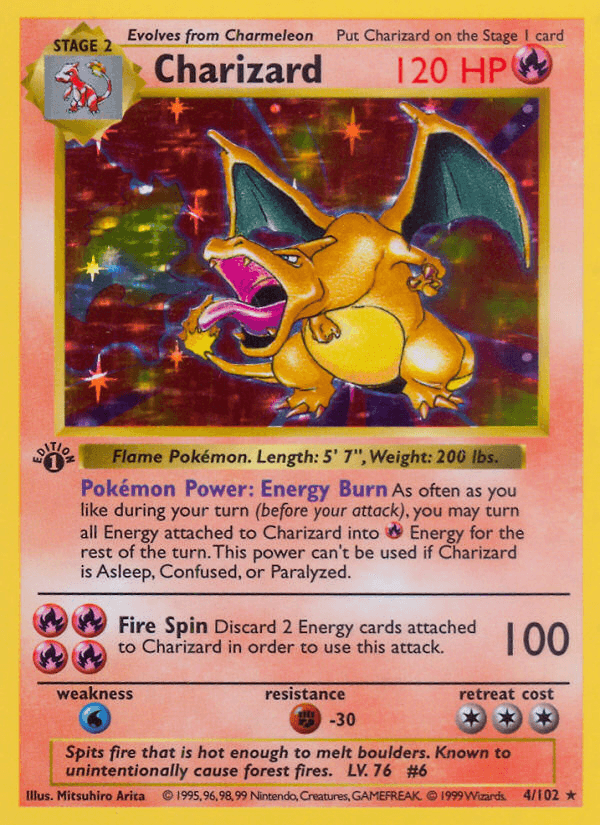
In December 2025, a single Charizard sold for $550,000. It was a 1999 first-edition Base Set Charizard, card #4, graded PSA 10, and it set a new public-auction record for the most famous card in the Pokémon hobby. The number is striking on its own, but what sits underneath it matters more: one card, in one grade, that the entire hobby has already agreed is the trophy.
The Charizard market is not a broad field of expensive cards. It is essentially one card, the 1999 first-edition Base Set holo, priced almost entirely by its grade, with a small number of older and rarer relatives sitting alongside it. This is CN’s ranking of the most valuable Charizard cards ever sold, built only from verified public auction results: the exact card, the grade, the price, the date, and the house. It sits beside CN’s wider ranking of the most valuable Pokémon cards and its companion on the most valuable Pikachu cards.
The most valuable Charizard cards
Read the list and one card dominates it. The 1999 first-edition Base Set Charizard holds the record at PSA 10, and its earlier PSA 10 sales trace a clean line of appreciation: $300,000 in January 2021, $336,000 and then $420,000 in 2022, and $550,000 at the end of 2025. Those are the same card selling again and again, which is why the ranking below reads as a price history as much as a leaderboard.
The one genuinely different card in the top tier is the 1997 Topsun Charizard with the scarce blue back, the earliest Charizard card ever printed, which brought $493,230 in PSA 10. Everything else in the Charizard market is a question of grade on the first-edition Base Set holo, and the drop is steep: a PSA 9 of the record card sold for $75,030, roughly a seventh of the PSA 10.
| Card | Grade | Price | Sale date | House |
|---|---|---|---|---|
| 1999 1st Edition Base Set Charizard #4 | PSA 10 | $550,000 | Dec 2025 | Heritage |
| 1997 Topsun Charizard (blue back) | PSA 10 | $493,230 | Jan 2021 | Goldin |
| 1999 1st Edition Base Set Charizard #4 | PSA 10 | $420,000 | Mar 2022 | PWCC |
| 1999 1st Edition Base Set Charizard #4 | SGC 10 | $369,000 | Dec 2020 | Goldin |
| 1999 1st Edition Base Set Charizard #4 | PSA 10 | $336,000 | Mar 2022 | Heritage |
| 1999 1st Edition Base Set Charizard #4 | PSA 10 | $300,000 | Jan 2021 | Heritage |
| 1999 1st Edition Base Set Charizard #4 | PSA 9 | $75,030 | Mar 2026 | Goldin |
Verified public auction results as of September 2026. Different grades and dates of the same card are counted as separate results, so the first-edition Base Set Charizard appears more than once; that repetition is its price history.
Why grade is the whole story
Charizard value is unusually easy to explain because it collapses to one variable. The first-edition Base Set holo exists in thousands of copies, but only 124 have ever graded PSA 10 out of more than 5,000 submitted. The record is not a payment for the card; it is a payment for the condition, and the market prices the top grade at a level that has almost nothing to do with the grade below it.
That is why the same card can read $550,000 and $75,030 in the space of this ranking. A PSA 9 first-edition Charizard is a beautiful card that most collectors would be thrilled to own, and it trades for a fraction of the PSA 10 because the buyers at the very top are not buying a Charizard, they are buying the best Charizard. The edition stamp works the same way: an unlimited Base Set Charizard shares the exact artwork and sells for a small fraction of the first edition, because the first-edition stamp is the scarcity, not the picture.
At the top of the Charizard market you are not buying a Charizard. You are buying the best one, and grade is what decides which that is.
The one card that is genuinely different
The 1997 Topsun Charizard is the exception that proves the rule. It predates the Base Set entirely, printed by a Japanese chewing-gum company before the trading card game existed, and the scarce blue-backed version is the earliest Charizard card in the hobby. In PSA 10 it sold for $493,230, and its value comes from being first rather than from grade sensitivity: there simply are not many, in any condition.
Everything the Charizard market teaches is a smaller version of what drives the whole hobby. Condition at the extreme, an icon the hobby has stopped arguing about, and genuine scarcity are the three levers, and they set the price of the card in your own binder exactly the way they set the price of the $550,000 one. For the full picture across every Pokémon, CN’s ranking of the most valuable Pokémon cards goes deeper, and the same forces run through the most valuable sports cards too.
Follow the hobby in the app
Track the products and players you collect and get told the moment anything moves.
Get the Collector Nation App