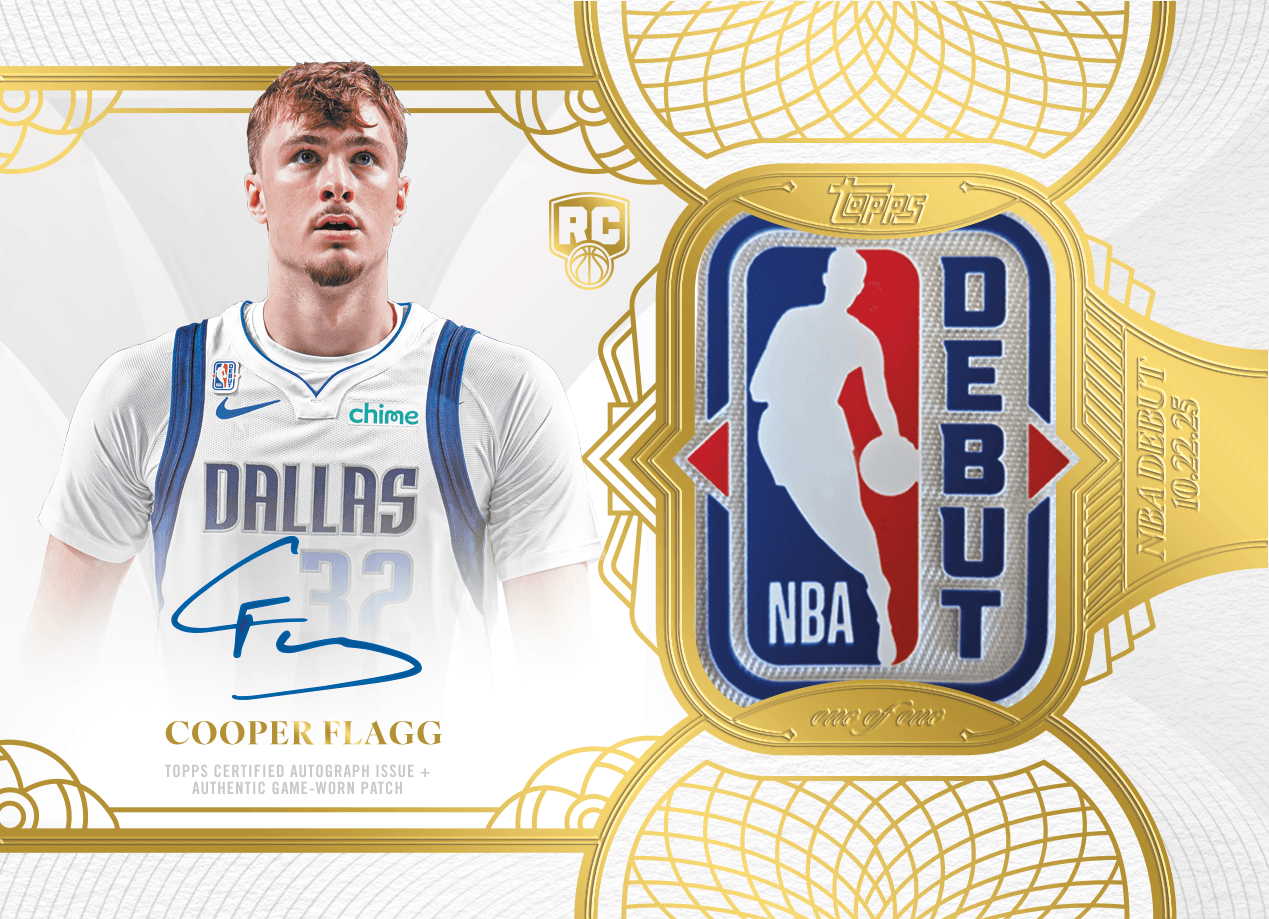
Fanatics Collect Has All Three Debut Patch 1/1s. What That Means for the Flagg Cards You Can Actually Buy.
One platform now controls price discovery for the ceiling of the most-watched rookie card market in years. The window to act on non-1/1 Cooper Flagg cards is the auction itself, not the aftermath.
The Dallas Mavericks put up 32 years of season tickets. Goldin put up $1.5 million in cash. The owner of Cooper Flagg's 1-of-1 Rookie Debut Patch Autograph said no to both, and then consigned the card to Fanatics Collect. That sequence of decisions is worth sitting with for a moment, because what it produced is not just a high-profile auction. It is a single platform holding all three of the most significant debut patch cards from the most-anticipated rookie class in recent memory: Flagg, Bryce Harper, and Christian Knueppel, all in the same queue.
Read that as three separate transactions and you miss what is actually happening. Read it as a platform play and the implications for every collector who will never see the bidding page on a seven-figure card become very clear very fast.
One Platform, All the Ceiling Cards
Price discovery in any collectible market works from the top down. The highest-profile sales set the comparables that anchor every negotiation beneath them. When those sales are spread across multiple platforms, Goldin, Heritage, PWCC, eBay, the data is distributed and no single entity owns the narrative. When they are concentrated in one place, that platform becomes the de facto price oracle for the entire program.
Fanatics Collect is now that oracle for Debut Patch cards. The Harper and Knueppel 1/1s will close before or alongside the Flagg card, and those results will be the first real data the market has on what collectors are willing to pay at the absolute ceiling of this program. Every numbered parallel, every base refractor, every non-1/1 Flagg card trading on eBay right now is being priced in relation to a ceiling that has not been formally established yet. Fanatics Collect will establish it, on its own platform, on its own timeline.
That is a different kind of market power than simply running the biggest auction. It is the power to decide when comparables appear, how they are framed, and which cards get the promotional weight that drives bidding. If this exclusivity extends structurally to future Debut Patch programs rather than being a deal-by-deal arrangement, the secondary market for those cards on competing platforms will be permanently downstream of whatever Fanatics Collect decides to surface.
The Floor Moves With the Ceiling, Until It Doesn't
For collectors holding base Flagg refractors or numbered parallels, the auction is already functioning as a ceiling-setter, and ceiling attention historically pulls floor prices upward during the lead-up. The logic is straightforward: visibility on the 1/1 drives search traffic, search traffic drives demand for accessible entry points, and demand for entry points bids up the cards that are actually attainable. This is not a theory. It is the observable pattern around every major trophy-card auction in recent memory.
The risk is the moment the hammer falls. If the Flagg 1/1 clears at a number that meets or exceeds what the market has been anticipating, floor cards get validation and likely another leg up. If the number disappoints: if the result lands below the implicit ceiling the market has been pricing in: the repricing moves in the other direction, and it moves fast. There is no soft landing in that scenario for someone who bought a numbered parallel at peak-hype prices two days before the close.
Flagg's market weight in basketball is 0.693, second only to Michael Jordan. That number matters here because it means the auction result will not stay contained to the debut patch tier. It will move the entire stack of Flagg cards beneath the 1/1. A result that clears expectations lifts everything. A result that disappoints pressures everything. The leverage cuts both ways.
The window to act on non-1/1 Flagg cards is the auction itself, not the aftermath.
What a Collector Should Actually Do
Selling into auction hype is a real strategy and it does not require any apology. If you are holding Flagg cards and the pre-close attention is generating the kind of buyer interest that lets you exit at a price you are happy with, that is a legitimate outcome. You are selling anticipation, and someone is paying for it. The trade is clean.
Holding through the result is a bet with a defined payoff structure: you win if the clearing number validates or exceeds current floor prices, and you lose if it does not. That is not a bad bet if your read on the Flagg market is that the 1/1 will close at a number that surprises to the upside. But it is a bet, and you should be clear with yourself that you are making one.
Buying now, before the result, means paying for anticipation you may not get back. The price of a numbered Flagg parallel today includes a premium for the fact that a 1/1 is actively in auction. That premium evaporates the moment the result is known, regardless of which direction it goes: because the uncertainty itself is part of what is being priced. After the hammer falls, the market reprices on the actual number, and the anticipation premium disappears.
Watch the Harper and Knueppel results closely. Those are the first real data points on what Fanatics Collect's platform produces for debut patch ceiling cards, and they will tell you something about the appetite in the room before the Flagg card closes.
Follow the hobby in the app
Track the products and players you collect and get told the moment anything moves.
Open Collector Nation