Flagship Football's Print Run Is Not the Problem. It Is the Product.
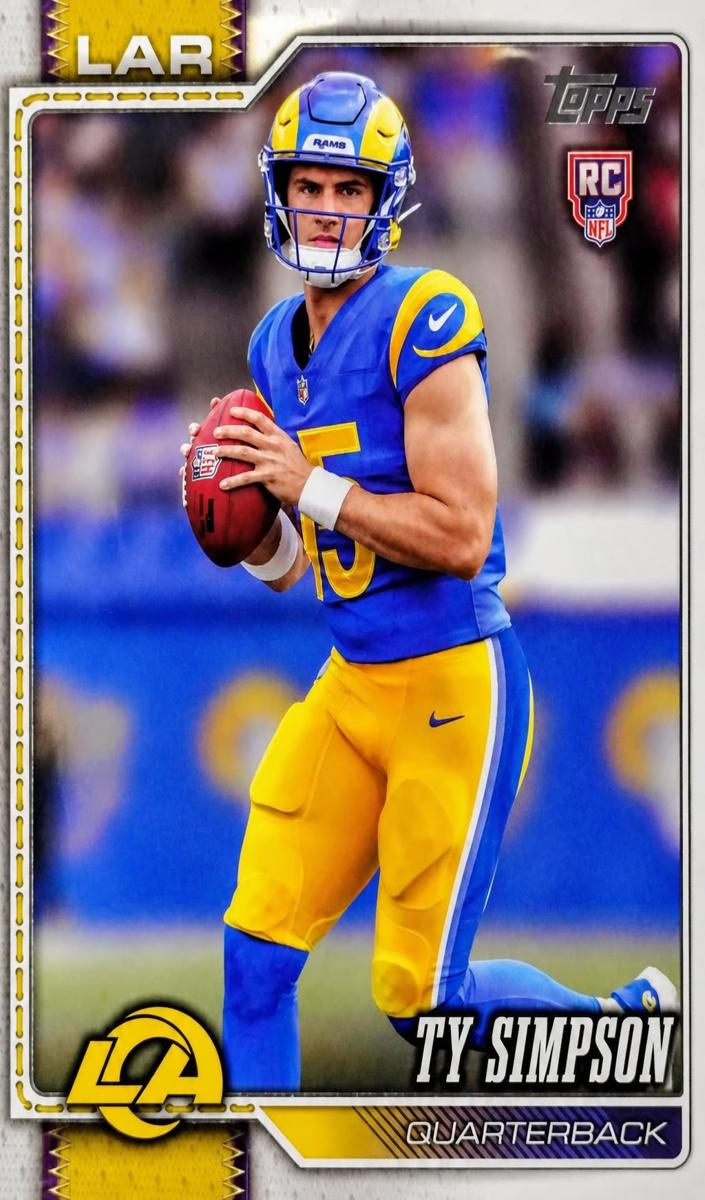
Ty Simpson's base card is up 61.9% while his Mojo Refractor is down 27.3%. Same player, same box, same week. The market is not confused. It is telling you exactly what Flagship Football was built to be.
Ty Simpson's base card is up 61.9% in seven days. His Mojo Refractor, pulled from the same box, is down 27.3%. Same player, same product, same week — and the market is sending completely opposite signals on each. That is not noise. That is the hobby telling you something precise about what 2026 Topps Flagship Football actually is.
The instinct is to call one of those numbers wrong. The base card is thin on liquidity, maybe a few sharp buys inflated it. The refractor is getting dumped, maybe someone knows something. Both of those readings miss the point. The divergence is the data. When a base card outperforms its refractor by nearly 90 percentage points inside the same week, the market is not pricing the player. It is pricing the format. Base cards in a mass-market product trade on performance narrative and impulse. Refractors in that same product trade on scarcity logic, and scarcity logic runs directly into the print run.
What the Mendoza Numbers Actually Say
Fernando Mendoza's base card (#301) has logged 651 sales in seven days at 6x velocity. His Mojo Refractor is moving at 5.4x. Both numbers sound like a product on fire. The prices say otherwise: base down 25.2%, refractor down 27.5%. That combination, high velocity, falling price, is not what accumulation looks like. It is what distribution looks like. Sellers are finding buyers, but only by lowering the ask. The market is clearing, not building.
Sports Card Investor flagged the print run concern on August 27, calling it 'colossal.' That word matters, because it reframes what the velocity data means. In a low-print-run product, 6x velocity with falling prices would be a short-term dip before scarcity reasserts itself. In a colossal-print-run product, 6x velocity with falling prices is the market discovering the floor. Supply does not thin because demand spikes for a week. It thins because boxes stop being opened: and Flagship Football boxes are still moving.
Accessibility Is the Feature. The Price Cap Is the Cost.
Topps built Flagship Football to be accessible. CN covered this at launch: the product was priced and positioned to bring NFL collecting to a wider audience, not to manufacture scarcity. That was a deliberate choice, and by any measure of reach and opening-week sales volume, it worked. The problem is not that Topps failed. The problem is that success in an accessible product means a large print run, and a large print run means the rookie cards inside it have a structural ceiling that no demand event can lift through.
The Sports Card Lessons Podcast made a comparison on August 28 that is worth sitting with: the current environment against the 2021 liquidity bubble. Their framing was that 2026 represents a 'scarcity-and-quality boom.' That read applies cleanly to premium releases with controlled print runs. It does not apply to Flagship Football, which is neither scarce nor premium by design. Treating it as though it belongs to the same boom is how collectors end up holding Mendoza refractors at launch-week prices while the market spends the next two months finding the real number.
High velocity alongside falling prices is not a contradiction. It is what distribution looks like when supply is larger than any demand event can absorb.
The Kickoff Thesis and Where It Breaks
September 9 is a real catalyst. Rookie cards reprice on the first real evidence of a role, and a strong Kickoff performance from Mendoza or Simpson will move prices. The question is not whether Kickoff moves the needle. It is whether it moves the needle enough to overcome a supply overhang that was already large before the first snap.
There is no confirmed historical case in the available material of a high-print-run NFL flagship product where rookie cards recovered meaningfully after the season's first week. That absence is not proof it cannot happen, but it is a reason to require evidence before assuming it will. A collector holding Mendoza's base card is essentially betting that one game generates enough new demand to absorb every unit that has already been opened and is sitting in someone's inventory waiting for exactly that moment to sell into.
The hold case that actually holds up is the serialized parallel. A card with a fixed, printed serial number has a supply that does not grow regardless of how many hobby boxes get ripped. That card competes on a different axis. Base cards and unlicensed refractors from a mass-market product do not have that protection. Their supply is not a number on the card. It is whatever Topps printed, and nobody outside Topps knows what that is.
The Chrome Problem Nobody Is Talking About Yet
2026 Topps Chrome Football is on the release calendar. Chrome carries its own scarcity story: lower print run, premium refractor market, the collector base that treats it as the definitive rookie card version. Under normal conditions, Chrome arrives into a market that is hungry for the upgrade.
The condition that is not normal: a collector who bought Mendoza or Simpson at launch-week prices and has already watched 25% disappear has less capital and less appetite for the next Topps NFL product. Chrome needs that buyer at full strength. If Flagship Football's supply overhang is still undigested when Chrome drops, it is not competing against Panini or against a different sport. It is competing against the memory of what just happened to the accessible version. That compresses demand at exactly the moment Chrome's scarcity story needs room to breathe.
None of that makes Chrome a bad product. It makes the sequencing a genuine risk, and it is a risk that is easier to see now, before Kickoff, than it will be after.
The One Signal Worth Watching
Simpson's base card is the tell. It is up 61.9% in a week where his refractor is down 27.3%. If that gain holds through Kickoff week: if a strong performance on September 9 builds on the base card's momentum rather than just creating a brief spike that fades: then something structural is happening. It means performance is overriding format, that collectors are willing to pay a premium for the narrative even inside a high-print-run product. That would be the signal that changes the calculus, not just for Simpson but for every Flagship Football rookie with a credible starting case.
If the 61.9% gain fades before Kickoff, it confirms the simpler read: a thin base-card market got moved by a handful of transactions, and the refractor's steady decline is the more honest price signal. Watch which one is right. The answer will tell you more about what Flagship Football actually is than any podcast take or print-run estimate can.
Follow the hobby in the app
Track the products and players you collect and get told the moment anything moves.
Open Collector Nation