Jul 9, 2026
Sports Card Collection Pillars: How to Define, Refine, and Avoid Common Mistakes - Ep. 3.25
ListenWatchunavailable
CALL IN TO THIS MOMENT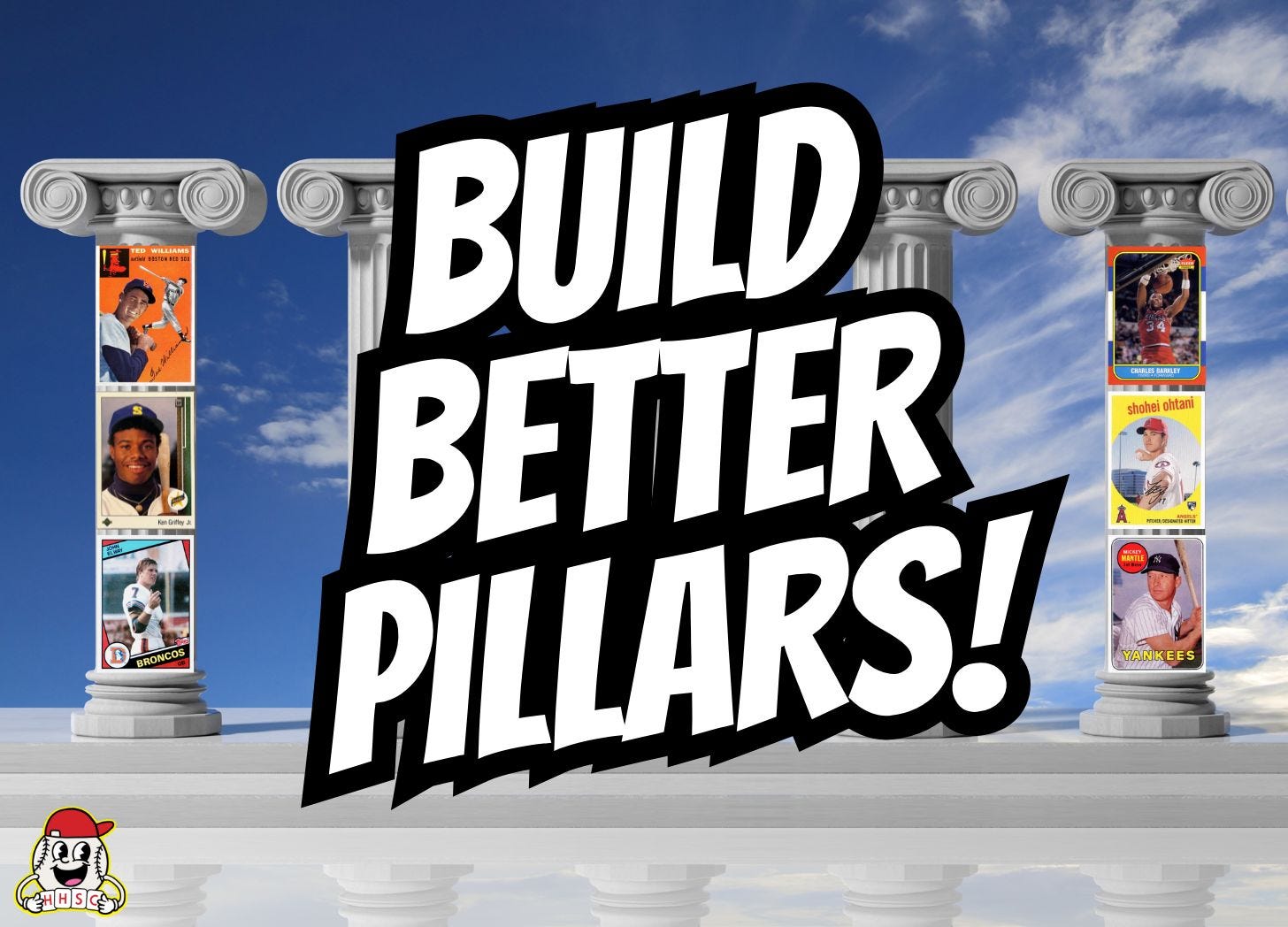
0:00
-0:00
Chapters
/ tap to jump
Searchable
Full Transcript
Every word from this episode, transcribed in full — search the page (Cmd/Ctrl+F) or let Google find the exact moment you’re looking for.
So you tell me, what are the pillars of your sports card collection? Today we're going to talk about how to define your collecting focus, how to avoid random buys and build a collection with real identity. Happy Hobby. I'm David Gahn. Build a better sports card collection with a real world budget. That's what we're talking about on this channel and this podcast and this YouTube channel. That's what we do at the Happy Hobby Sports Card world, including the newsletter at Ghana Stock Sport Ghana substack.com I don't even know how to say it. Today we're talking about sports card collection pillars. We're talking about how to define those pillars, how to refine them, and how to avoid common mistakes. You see, every sports card collection needs a backbone. We're going to explain why that is. See, without one, it's easy to drift into impulse buys, chase hype, and end up with a stack of cards that doesn't really tell a story. We don't want that. That's why understanding the pillars of your sports car collection matters so so much. They give your hobby purpose, focus, and they give your hobby staying power. You're going to stick with it much longer. Now, the good news is that pillars are not complicated. We're going to explain it. It's very easy to understand, not difficult. They're simply the main themes or standards and goals that define what belongs to in your collection and just as important, what doesn't belong in your collection. So let's talk about what are collection pillars. See, your pillars are the core lanes of your collection. They might be built around players, around teams, around eras, maybe sets, maybe grades, maybe card types. Or maybe it's a combination of all those things, which is basically what my sports card pillars are. For example, a collector might focus on favorite players from their childhood, might be hall of Fame players from the 1980s. Maybe it's rookie cards only. Maybe a collector focuses on graded cards in strong condition. Maybe it's just graded cards in any condition. It could be a specific team or franchise. Those are all the different things that a collector might focus on. A pillar becomes more powerful, though, when it includes a standard, not just a subject. So Michael Jordan cards, that's a theme. But Michael Jordan cards from key sets from the 80s and PSA 8 or higher, that's a pillar. So now why do pillars matter? Why am I listening to what do I care? That's what you're asking. Pillars make your collection easier to manage because they act as a filter, really. So when a card comes up for Sale, you can quickly ask yourself, does that card fit in my lane, or is it just an attractive distraction? It could be. They also help with budgeting. So instead of spreading your money across many random cards, your sports card pillars help you concentrate on the cards that matter most to your goals. And just as important, pillars make your sports card collection more satisfying. A focused collection feels intentional. You're accomplishing something, while a scattered one feels like a pile of unrelated purchases. Really, you're just chasing after stuff. If you ever want to explain your collection to another collector or even to yourself a year from now, having clear pillars makes that much easier. All right, Dave, tell me, how do you. How do I choose my pillars? What do you mean, what do I do? So the best place to start is with your Y. Wh Y. Not. Not just the letter Y. So ask yourself what you actually enjoy most in the hobby. Is it nostalgia? Is it a favorite team that you enjoy most? A favorite era? Rookie cards? Vintage cards? Graded cards? Rare inserts or parallels? Autographs? Or maybe it's special inserts. Or maybe it's a specific set that you want to build. Then you want to narrow that into a few lanes that you can realistically sustain. Most collectors do better with three to five pillars than with a dozen loosely connected ideas. So we have a simple formula that should help you. You say, I collect subject in format or standard, from era or set, because reason. So, for example, you say, I collect graded rookie cards of my favorite players from the 1980s and the 1990s because that era brings back the best memories for me. See, that kind of statement gives your collection direction. Collection direction is always good to have. You always want that. So how do you improve your pillars? That's the next question. See, once you have them, the next step is to refine those pillars, and you prove you improve your collection pillars by making them one more specific, two, more realistic, three, more more aligned with your budget, the big one. Four, more consistent with your taste. And then five, easier to buy over time. You see, if your focus is too broad, you want to narrow it down. If your standards are too loose, define them more clearly. If your budget keeps getting stretched, adjust the lane so it fits your actual collecting life instead of your fantasy collecting life. See, a good pillar should feel both exciting and sustainable. If it only works when the market is hot or your wallet is full, it probably needs refinement. Hey, I wanted to call a timeout here for one minute. I have a quick question for you. Do you ever find yourself wondering, what are the best baseball rookie cards from, I don't know, 1987 or what are the best football rookie cards from 1972? Well, I've got you covered. Head over to davidgannas.com where you'll find lists of the best rookie cards from every year for baseball, basketball, football, and hockey cards. And each page is like a time machine, except instead of awkward yearbook photos, you're gonna get the greatest rookie cards, all neatly listed by year. And every card has a convenient link right to ebay. So if you want to find a forgotten gem for your collection, just click to find a great deal. Also, those links are affiliate links, which means you'll be supporting this podcast and helping me justify my own cardboard obsession. It's a win win, really, if you think about it. So whether you're chasing hall of Famers or you just want to to see who rocked the rookie scene in your birth year, check out davidganis.com your collection and your favorite podcast host will thank you. So here's some common mistakes you'll want to avoid. The biggest mistake is making your collection too broad. See, collectors often start with a vague idea. Oh man, I that I like that. I want to start collecting those. And then they keep expanding until that original focus disappears. And they're just collecting everything. Because that's what collectors do. We want everything. The reasonable collector, the veteran collector, the smart collector, knows you cannot collect everything. If you did collect everything, you wouldn't enjoy everything you think about like that. So that's where collecting my favorite team turns into buying anything that looks cool because your, your focus is too broad. Your collection, your idea of what you want, that's too broad. So that's a big mistake. Now other mistakes include copying someone else's collection instead of building your own. Don't, don't worry about what other people like that make them happy. They have different budgets, they have different values, they have different memories, they have different nostalgia. It's a whole different world. Think about what you enjoy. Another common mistake is chasing hype. Instead of staying true to your goals, setting too many rules, and making the hobby feel like homework. Like, okay, I can only have this grade from this. It must be this. It's just too much refining could be a mistake. The other mistake is changing directions so often that your collection never really develops an identity. Refining your collection should make it stronger, not more confusing. So here's a simple decision. Before you buy a card, ask does it fit one of my pillars? Does it meet my standards? And would I still want this card if the price did not move so Those three questions, that's pretty easy. Does it fit a pillar? Does it meet my standards? And would I still want it if the price didn't drop? If the answer is yes to all three, that card probably deserves a place in your collection. Now, if it doesn't, then maybe it is just a distraction for your collection. That little check can save you a lot of money and a lot of regret. So I want you to build your story. The best collections are not just piles of cards. They're stories. Your pillars are what give that story shape. They tell you what to chase, what to pass on, and how to keep the hobby fun without losing focus. So if your collection starts feeling scattered, don't just buy more cards. Step back. Define the backbone of your collection first. See, once the pillars are clear, everything else gets easier. A lot of decisions are pre made once you set up your sports car collection pillars. The strongest card collections are not the biggest card collections. They're the ones with the clearest identity. All right, so I want to know what are the pillars of your sports card collection? I want you to drop a comment in the YouTube video. If it's the podcast you're listening to, shoot me an email at ghaniscards. Maybe I'll go through these in a future podcast episode or a future video and talk about what the pillars are of your collection. And when I do that, I'll share what the pillars are of my collection. Be a nice, fun video. So until then, whatever you do, just make sure you have a happy hobby.
Episode summary
<p><strong><em>How to define your collecting focus, avoid random buys, and build a collection with real identity.</em></strong></p><p>What Are the Pillars of Your Sports Card Collection?</p><p>Every sports card collection needs a backbone.</p><p>Without one, it’s easy to drift into impulse buys, chase hype, and end up with a stack of cards that doesn’t really tell a story. That’s why understanding the pillars of your collection matters so much: they give your hobby purpose, focus, and staying power.</p><p>The good news is that pillars are not complicated. They’re simply the main themes, standards, and goals that define what belongs in your collection and what doesn’t.</p><p>What are “Collection Pillars?</p><p>Your pillars are the core lanes of your collection. They might be built around players, teams, eras, sets, grades, card types, or a combination of those things.</p><p>For example, a collector might focus on:</p><p>* Favorite players from childhood.</p><p>* Hall of Famers from the 1980s.</p><p>* Rookie cards only.</p><p>* Graded cards in strong condition.</p><p>* A specific team or franchise.</p><p>A pillar becomes more powerful when it includes a <strong>standard</strong>, not just a subject. “Michael Jordan cards” is a theme. “Michael Jordan cards from key sets in PSA 8 or better” is a pillar.</p><p>Why Pillars Matter</p><p>Pillars make your collection easier to manage because they act as a filter. When a card comes up for sale, you can quickly ask whether it fits your lane or whether it’s just an attractive distraction.</p><p>They also help with budgeting. Instead of spreading your money across random cards, you can concentrate on the cards that matter most to your goals.</p><p>And just as important, pillars make your sports card collection more satisfying. A focused collection feels intentional, while a scattered one can feel like a pile of unrelated purchases. If you ever want to explain your collection to another collector, or even to yourself a year from now, having clear pillars makes that much easier.</p><p>How to Choose Your Pillars</p><p>The best place to start is with your why.</p><p>Ask yourself what you actually enjoy most in the hobby:</p><p>* Nostalgia.</p><p>* A favorite team.</p><p>* A favorite era.</p><p>* Rookie cards.</p><p>* Vintage cards.</p><p>* Graded cards.</p><p>* Rare inserts or parallels.</p><p>* Autographs.</p><p>* A specific set build.</p><p>Then narrow that into a few lanes you can realistically sustain. Most collectors do better with three to five pillars than with a dozen loosely connected ideas.</p><p>A simple formula helps:</p><p></p><p>I collect<strong> </strong><strong><em>subject </em></strong>in<strong> </strong><strong><em>format/standard</em></strong><strong> </strong>from <strong><em>era or set</em></strong><strong> </strong>because <strong><em>reason</em></strong><strong>.</strong></p><p></p><p>* <em>Example: I collect</em> <strong>graded rookie cards of my favorite players</strong> <em>from </em><strong>the 1980s and 1990s</strong> <em>because</em> <strong>that era brings back the best memories</strong>.</p><p>That kind of statement gives your collection direction.</p><p>How to Improve Your Pillars</p><p>Once you have them, the next step is refining them.</p><p>You improve collection pillars by making them:</p><p>* More specific.</p><p>* More realistic.</p><p>* More aligned with your budget.</p><p>* More consistent with your taste.</p><p>* Easier to buy for over time.</p><p>If your focus is too broad, narrow it down. If your standards are too loose, define them more clearly. If your budget keeps getting stretched, adjust the lane so it fits your actual collecting life instead of your fantasy collecting life.</p><p>A good pillar should feel both exciting and sustainable. If it only works when the market is hot or your wallet is full, it probably needs refinement.</p><p>Common Mistakes to Avoid</p><p>The biggest mistake is making your collection too broad.</p><p>Collectors often start with a vague idea, then keep expanding until the original focus disappears. That’s how “collecting my favorite team” turns into buying anything that looks cool.</p><p>Other common mistakes include:</p><p>* Copying someone else’s collection instead of building your own.</p><p>* Chasing hype instead of staying true to your goals.</p><p>* Setting too many rules and making the hobby feel like homework.</p><p>* Changing direction so often that the collection never develops an identity.</p><p>Refining your collection should make it stronger, not more confusing.</p><p>A Simple Decision Test</p><p>Before you buy a card, ask:</p><p>* Does it fit one of my pillars?</p><p>* Does it meet my standards?</p><p>* Would I still want it if the price did not move?</p><p>If the answer is yes to all three, it probably deserves a place in your collection. If not, it may just be a distraction.</p><p>That little check can save you a lot of money and a lot of regret.</p><p>Build Your Story</p><p>The best collections are not just piles of cards. They’re stories.</p><p>Your pillars are what give that story shape. They tell you what to chase, what to pass on, and how to keep the hobby fun without losing focus.</p><p>So if your collection feels scattered, don’t just buy more cards. Step back and define the backbone first. Once the pillars are clear, everything else gets easier.</p><p>The strongest card collections are not the biggest ones — they’re the ones with the clearest identity.</p><p><em>I want to know — what are the pillars of your sports card collection! Let us know in the comments below!</em></p><p><em>If you enjoyed this post about great baseball rookie cards, check out these posts you might have missed:</em></p><p><strong>🏆 BEST ROOKIE CARDS FROM EVERY YEAR! 🏆</strong></p><p><em>We list the best rookie cards from each flagship release in all four major sports since the 1950s.</em></p><p><strong>The Happy Hobby Sports Cards World</strong></p><p>* 📺 <a target="_blank" href="https://www.youtube.com/c/davidgonos">YouTube</a>: 9.1K Subscribers</p><p>* 📬 <a target="_blank" href="https://gonos.substack.com/">Newsletter</a>: 1.6K readers</p><p>* 🎙️ <a target="_blank" href="https://gonos.substack.com/podcast">Podcast</a>: 500+ podcast downloads/episode</p><p>* 🌐 <a target="_blank" href="https://davidgonos.com/">DavidGonos.com</a> - 1K daily visits</p><p><em>Our podcasts were ranked by MillionPodcasts.com as one of the </em><a target="_blank" href="https://www.millionpodcasts.com/basketball-card-podcasts/"><em>Top 10 Basketball Card Podcasts</em></a><em>, </em><a target="_blank" href="https://www.millionpodcasts.com/football-card-podcasts/"><em>Top 10 Football Card Podcasts</em></a><em> and </em><a target="_blank" href="https://www.millionpodcasts.com/hockey-card-podcasts/"><em>Top 10 Hockey Card Podcasts</em></a><em>! And we’re aiming to get ranked among the Top 10 Baseball Card Podcasts!</em></p><p></p><p><strong><em>Happy Hobby! Build a better sports card collection on a real-world budget!</em></strong></p><p></p> <br/><br/>This is a public episode. If you would like to discuss this with other subscribers or get access to bonus episodes, visit <a href="https://gonos.substack.com?utm_medium=podcast&utm_campaign=CTA_1">gonos.substack.com</a>
From the original show
This episode is published by Happy Hobby Sports Cards Podcast.